A Bank Built Its Own Coding Agent. It Took Off — Felipe Felisola Caso & Francesco Galletta, Monzo
Felipe Felisola Caso and Francesco Galletta from Monzo explain how an internal Slack agent grew from a viral emoji trigger into a teammate authoring over 10% of merged PRs and running more than 1,800 tasks a day. They attribute its speed to existing platform capabilities, an MCP gateway, a sandboxed orchestration system suited to a regulated bank, and an agent designed as a composable building block for incidents, on-call data quality and non-engineer contributions.
Origins: a Slack emoji that became a teammate
Felipe and Francesco open with the scale of the problem Monzo is working on. Monzo is a digital bank, and its engineers maintain more than 3,000 back-end services, around 13,000 data warehouse models, and dozens of ML predictors that make credit and financial crime decisions. They argue that this complexity is exactly why coding agents matter, and they note how widely AI coding agents are now discussed across the industry.
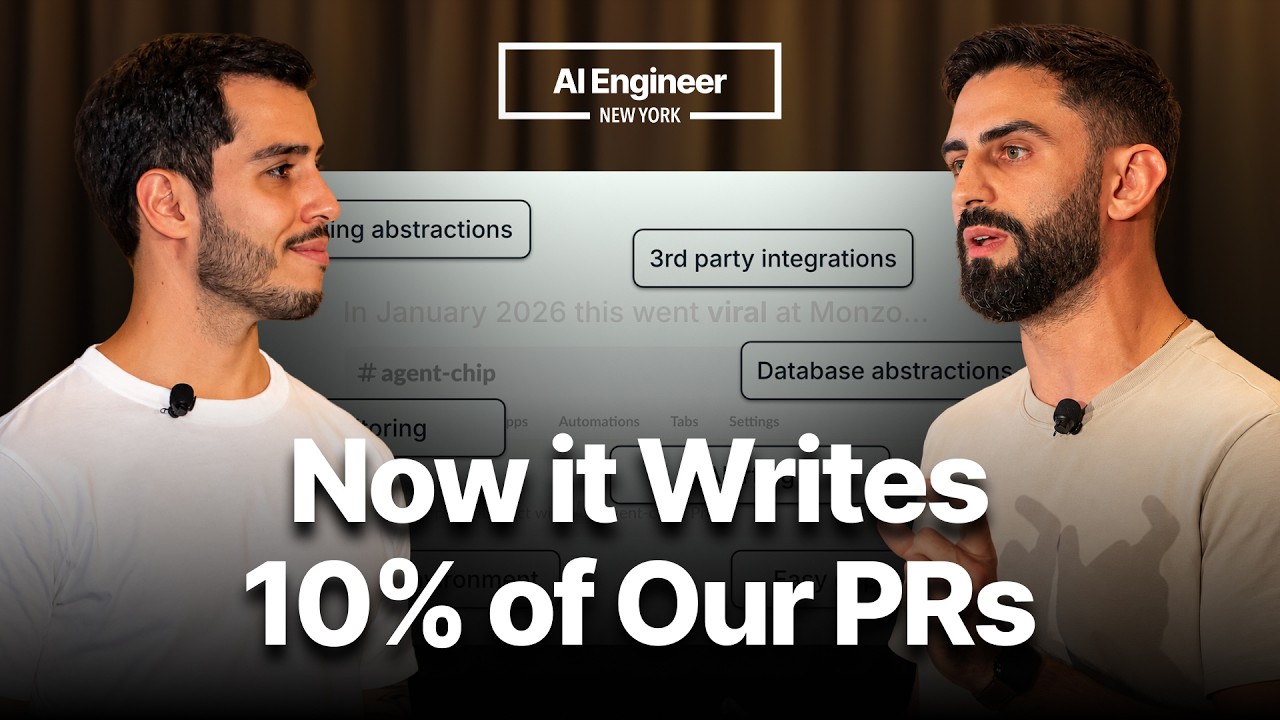
In January 2026 an internal Slack agent, referred to in the talk as Agent Ship (the transcript also renders it as Agent Chip), went viral inside Monzo. The mechanic was simple: react to any message with the agent’s emoji and it picks up that message as a prompt. That started as a novelty and grew into an always-available teammate. Engineers can mention it to answer questions, explain architecture, or hold a conversation. It performs code reviews, with the presenters joking that it reviews like a very senior engineer who simply says “looks good to me.” It can also take on Linear tickets. Today it authors over 10% of merged PRs across Monzo’s tech teams, which spans data, ML, back-end and app engineering, and it runs more than 1,800 tasks a day. Business users are starting to adopt it too, for answering business questions, writing queries and self-serving data needs.
The presenters are clear that the point is not to brag about shipping a Claude Code-style product before Anthropic did. Their thesis is that the real “secret sauce” is the platform underneath. In their framing, LLMs stands for “lots of little multipliers.”
Lots of little multipliers
Agent Ship did not appear from nothing. It leaned on capabilities Monzo already had: alerting, monitoring, integrations with third-party services, a staging environment for easy testing, queuing abstractions, easy deployment, database abstractions, and more. The argument is that a mature internal platform is what lets a new agent go from idea to viral product in a short time. Each existing piece is a multiplier, and combined they compound.
The MCP gateway
Before remote agents existed, Monzo was already investing in supporting AI coding agents in local environments. The first major piece was an MCP gateway that gives agents easy and controlled access to internal tools, knowledge sources and services. The gateway sits in front of everything Monzo wants to connect and deliberately decides what to expose, which gives the team deterministic control over agent behaviour. It also handles authentication and authorization across the different agents. The underlying principle, which the speakers say is now widely accepted, is that agents perform better the more context they have, as long as that context can be shared safely.
Orchestration inside a sandbox
The second major piece is the agent orchestration system, which powers Agent Ship behind the scenes. It runs remote agents inside sandboxes, with strict tools and permissions, and it sits behind the MCP gateway as a single box in the overall architecture.
The speakers walk through the layers. Inside an isolated Kubernetes-style namespace, multiple pods run sandboxes where agents execute. The agent image defines exactly which tools, CLIs, environment and authentication an agent has, with authorization sourced from the gateway. A proxy controls egress to the outside world. That is how Agent Ship can reach Monzo’s code repositories, but only through egress the team has deliberately allowed. The innermost box is where the agent itself runs, and where the non-determinism lives.
The design reflects the constraints of a bank. Monzo wants agents to be able to “run loose and develop,” but it also needs to keep that non-determinism separated from production infrastructure and tightly controlled. The sandbox provides both freedom to experiment and containment.
The agent as a building block
Once the gateway and orchestration layers existed, Agent Ship itself became a composable building block. It connects to Slack, GitHub, Linear and the 3,000-plus services behind the gateway. The presenters observed two kinds of outcomes. The first is breadth and volume: engineers can delegate tasks to remote agents rather than babysitting a coding assistant, and routine processes get automated, which frees people for the ambiguous, high-value problems. The second is business value, since other parts of the bank can build their own use cases on top of the same foundation.
Several concrete use cases illustrate this:
- Incident mode: when a new incident is triggered, Agent Ship joins the channel and starts an investigation. It reads logs and traces, connects to the affected service, and inspects the relevant code. The team deliberately keeps its output high-signal, avoiding a flood of hypotheses, and humans control how much it participates.
- Ask channels: squads at Monzo often need context on a back-end service, a product, or the roadmap. Agent Ship drafts responses using the knowledge sources, keeping a human in the loop. Sometimes the draft is enough and the agent closes the ticket itself. Other times it asks for more context and a human steps in.
- Agent on Call for data quality: a reactive mode observes failures and triggers investigations automatically when data quality alerts fire. A proactive mode goes further, monitoring back-end changes and predicting their impact on data before the next batch run, so that problems never materialise.
- Non-specialists: product people and others can request changes through Slack based on feedback or discussions, and get a draft that already works and has been tested in staging. Only then is an engineer involved to review and deploy. The presenters stress that this does not lower the bar for rigour, but it lets non-engineers contribute much more closely to the team.
Why keep building it in-house
The talk closes by addressing the question of why a company would keep investing in its own agent when the market moves so quickly. The platform is provider-agnostic by design. The model inside the sandboxed agent box can be swapped, and Monzo can dynamically choose the model that best fits each purpose, so it is not locked to any one provider. The presenters are also clear that they are not married to Agent Ship specifically. Even if development stopped today, they consider it already valuable.
The direction of travel is towards end-to-end work. Agents could draft back-end and app changes, test them in staging, cover data tests and perhaps even touch predictors. That would let the team understand and integrate its systems much more deeply.
The key takeaway, as Felipe and Francesco put it, is to think about LLMs not just as a model you call, but as a set of many small multipliers that a team can compose to create lasting value.