Incident response

A Bank Built Its Own Coding Agent. It Took Off — Felipe Felisola Caso & Francesco Galletta, Monzo

A Bank Built Its Own Coding Agent. It Took Off — Felipe Felisola Caso & Francesco Galletta, Monzo

Felipe Felisola Caso and Francesco Galletta from Monzo explain how an internal Slack agent grew from a viral emoji trigger into a teammate authoring over 10% of merged PRs and running more than 1,800 tasks a day. They attribute its speed to existing platform capabilities, an MCP gateway, a sandboxed orchestration system suited to a regulated bank, and an agent designed as a composable building block for incidents, on-call data quality and non-engineer contributions.
Why AI Can Write Code But Can’t Keep It Running (Yet)

Why AI Can Write Code But Can’t Keep It Running (Yet)

Grepr CEO Jad Naous talks with a16z's Martin Casado about how coding agents have changed a 10-person engineering team, with projects that once took six months now finishing in about ten days. They examine whether AI can reason about and troubleshoot production distributed systems, why operations is a harder problem than code generation, and where AI adoption is likely to go next.

Your AI Agent Is Confidently Wrong About Production — Willem Pienaar, Cleric

Your AI Agent Is Confidently Wrong About Production — Willem Pienaar, Cleric

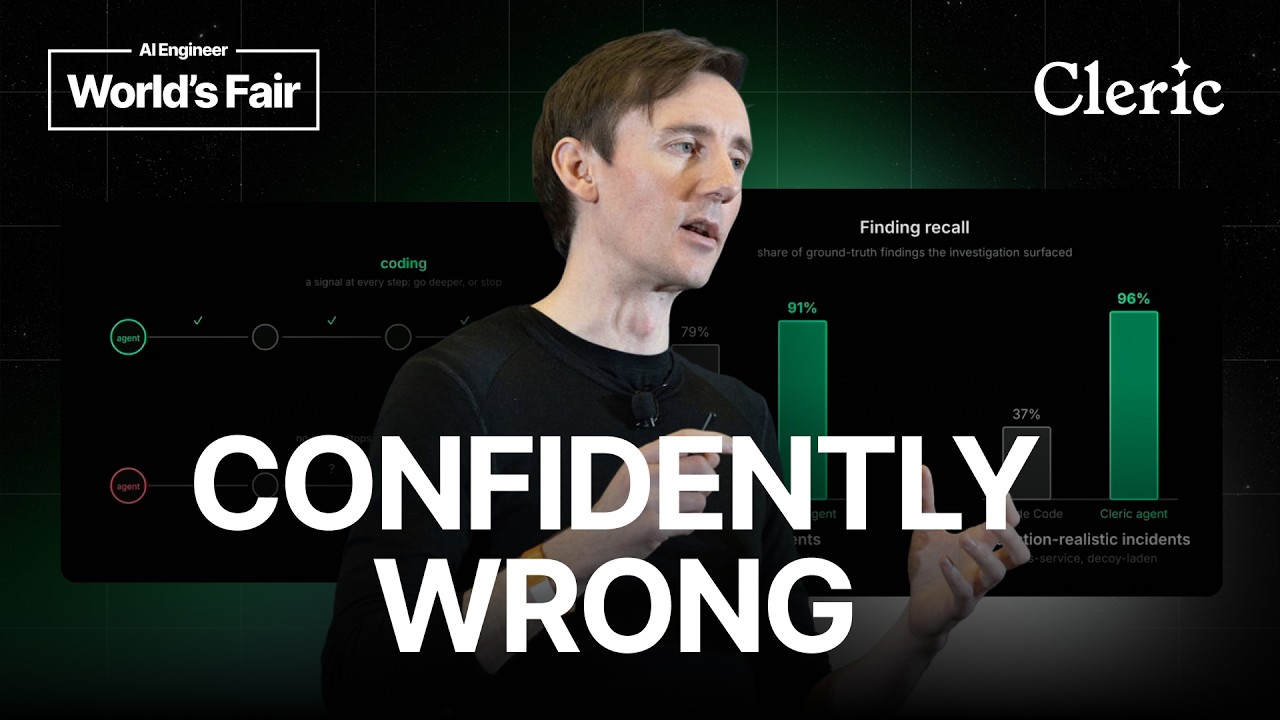
Willem Pienaar, CTO of Cleric, details why AI agents struggle with production debugging compared to code generation. He explains the unique challenges of dynamic, unverified production environments and LLMs' inherent confidence bias. Pienaar outlines four common agent failure modes (symptom/cause confusion, missing baselines, abstraction loss, anchoring) and introduces grounding techniques—like generating multiple theories, using baselines and dependency graphs, temporal analysis, and evidence propagation—to enhance diagnostic accuracy. He also emphasizes the critical need for verifying fixes against real outcomes to calibrate agent confidence, ultimately aiming to bring production signals into the development environment for proactive failure prediction.

The 5 Levels of Self-Driving Production — Eric Schwartz, Traversal

The 5 Levels of Self-Driving Production — Eric Schwartz, Traversal

Eric Schwartz, a product manager at Traversal, argues that AI-generated code has moved engineering time from building to troubleshooting, and that observability dashboards show what broke but not why. He frames root cause analysis as a causal problem, lays out five levels of self-driving production, walks through alert intelligence at PepsiCo and incident response at American Express, and offers five questions for evaluating an AI SRE.

Why OpenAI is calling for a ‘cyber defense surge.’ Plus: Find Evil! winners and TeamPCP losers

Why OpenAI is calling for a ‘cyber defense surge.’ Plus: Find Evil! winners and TeamPCP losers

IBM and OpenAI, alongside 100+ organizations, have called for a 'global surge in cyber defense' to counter escalating AI-enabled attacks, emphasizing collective action and proactive remediation strategies over mere threat intelligence sharing. Concurrently, the SANS Institute's 'Find Evil!' hackathon revealed autonomous AI agents capable of advanced cyber investigation, though human oversight remains crucial for incident response actions due to AI's limitations. The podcast also dissects the unmasking of the TeamPCP hacking group, highlighting how basic cybersecurity hygiene failures led to their downfall, underscoring that even sophisticated threat actors are susceptible to fundamental operational security lapses.

Security Firewall for Agents — Ryan Dahl, Deno

Security Firewall for Agents — Ryan Dahl, Deno

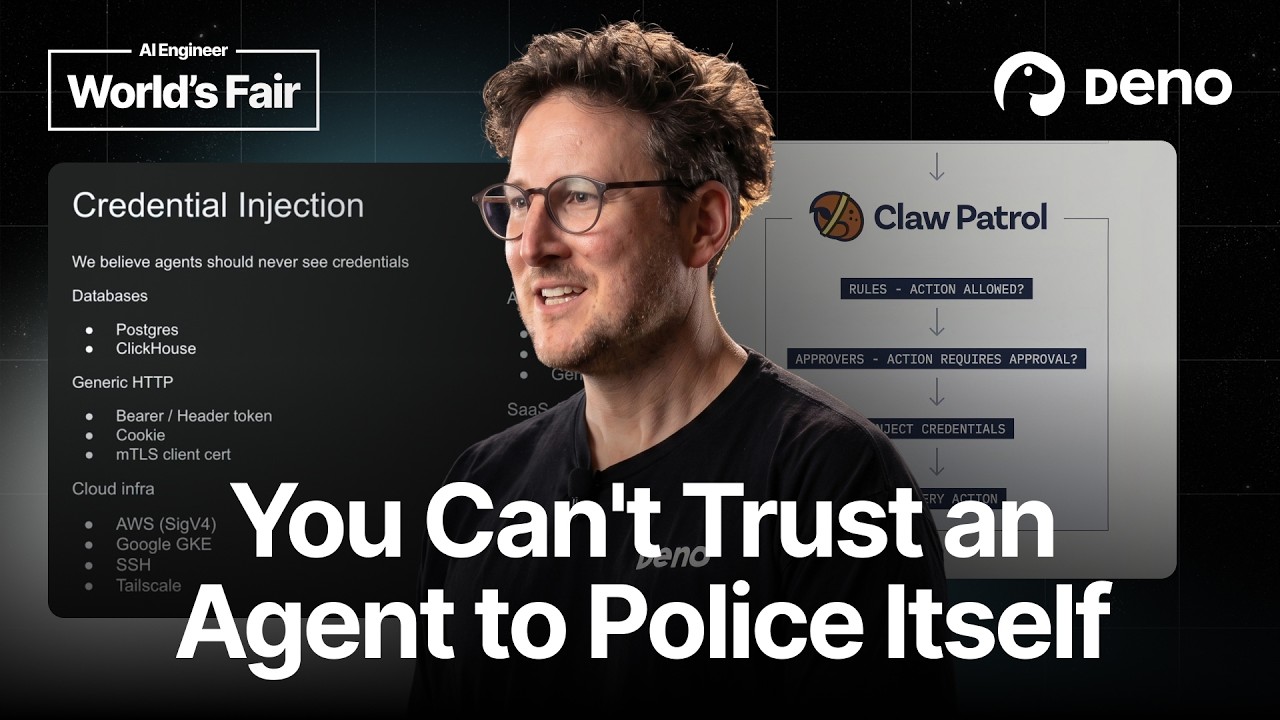
Deno addresses the critical security challenge of AI agents with production write access by introducing Claw Patrol. This MIT-licensed proxy operates below the HTTP layer, deep inspecting all agent communications (including non-HTTP protocols), enforcing granular HCL-based rules, and handling credential injection. It allows for human or LLM approval workflows, ensuring robust, external security against prompt injection and malicious actions, as agents are fundamentally considered untrusted software.