Model context protocol

5 Ways to Connect AI Agents to Tools: From APIs to MCP

5 Ways to Connect AI Agents to Tools: From APIs to MCP

Grant Miller outlines five evolving patterns for integrating AI agents with tools, starting from simple direct API connections to complex, secure token-based architectures. The discussion highlights the progression of these methods, emphasizing how authentication, user delegation, abstraction layers like MCP, and secure credential management using vaults improve security, observability, and scalability in agentic systems.

Using Spec-Driven Development for Production Workflows - Erik Hanchett, AWS

Using Spec-Driven Development for Production Workflows - Erik Hanchett, AWS

Erik Hanchett discusses spec-driven development (SDD) as a structured approach to building complex software features with AI coding assistants. He explains how to guide AI "interns" through distinct phases of requirements, design, and implementation, emphasizing context management, the use of "skills," and the crucial role of the human in the loop for review. Hanchett highlights AWS's Kiro tool, which automates much of this process, and the Model Context Protocol (MCP) for integrating external data sources, offering a pathway to higher-quality code and more effective AI collaboration.

Power agents with full context of your experiments and traces with W&B MCP server

Power agents with full context of your experiments and traces with W&B MCP server

The W&B Model Context Protocol (MCP) is a hosted endpoint that enables AI agents to intelligently interact with all Weights & Biases data, including runs, traces, evaluations, and reports. It features discovery tools for smart queries, automated analysis for comparing experiments and identifying regressions, and seamless integration with IDEs, coding agents, and chat interfaces like Mistral AI for streamlined ML workflows and on-the-go reporting.

Stop AI Agents From SQL Injecting Your Database

Stop AI Agents From SQL Injecting Your Database

Averi Kitsch, Staff Software Engineer at Google, outlines a four-step evolution for securing AI agents that access databases, moving from dangerous, model-controlled tools to a zero-trust architecture. Drawing on insights from over 20 million monthly tool calls, the talk provides a practical roadmap for preventing data leaks by separating identities, constraining actions, and removing credentials and PII from the agent's control.

Serverless Agents: Real-World Tooling with Strands SDK, MCP & AWS • Akshatha Laxmi • GOTO 2025

Serverless Agents: Real-World Tooling with Strands SDK, MCP & AWS • Akshatha Laxmi • GOTO 2025

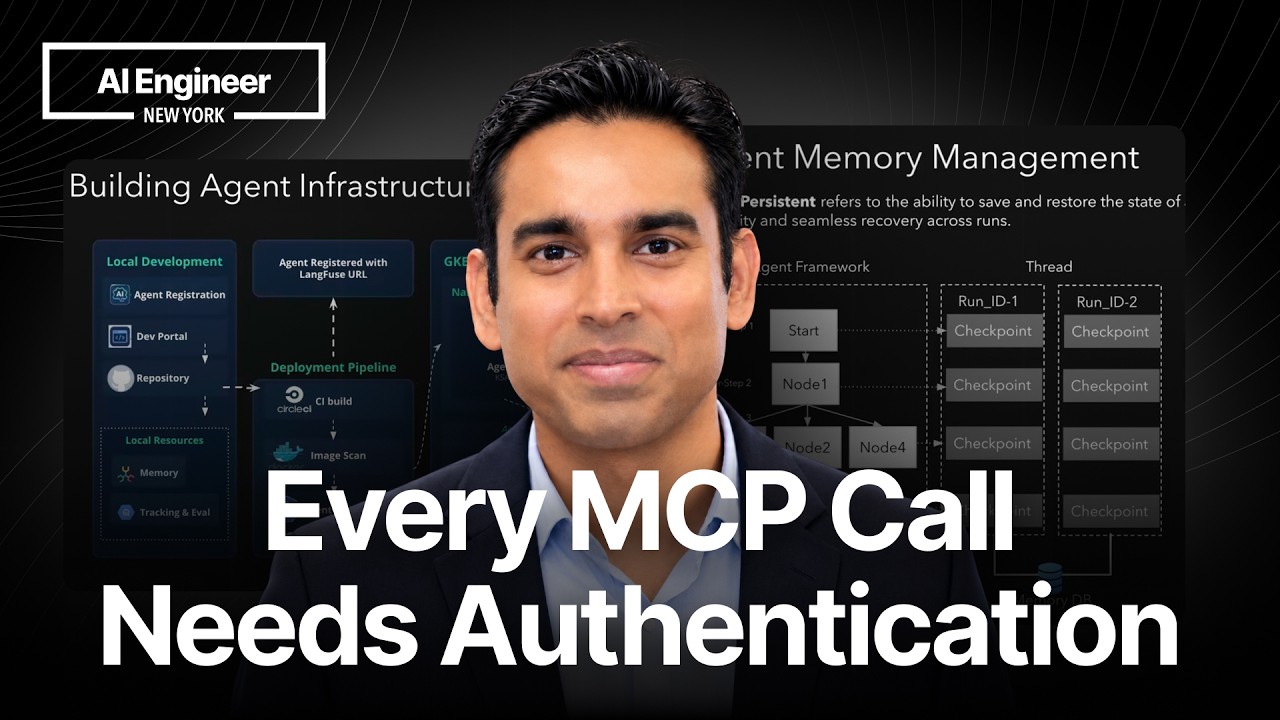
A deep dive into building production-ready, stateless, and scalable LLM agents by leveraging the Model Context Protocol (MCP) and Strands SDK on AWS Lambda. The session demonstrates how to expose real-world functionality to language models, moving beyond mere reasoning to tangible action.

CLI vs MCP: How AI Agents Choose the Right Tool for the Job

CLI vs MCP: How AI Agents Choose the Right Tool for the Job

AI agents can interact with the world through either the Command Line Interface (CLI) or the Model Context Protocol (MCP). This summary explores the trade-offs between the two, highlighting CLI's efficiency for tasks the model is trained on, versus MCP's power of abstraction and governance for more complex, high-level operations.