Research to Reality with Google DeepMind — Benoit Schillings, Google DeepMind, VP of Technology
Benoit Schillings, VP of Technology at Google DeepMind, explores the evolution of AI's role in software development, highlighting the transition from human-limited coding to an AI frontier where syntax generation is solved. He delves into the power of self-play for model training, the shifting economics of software engineering, and the imperative for active guardrails. Schillings also discusses the need for inductive architecture, advanced model planning, multimodal reasoning (as seen in Gemini), and the potential for AI to drive scientific breakthroughs in fields like chemistry and biology by uncovering patterns imperceptible to human bias.
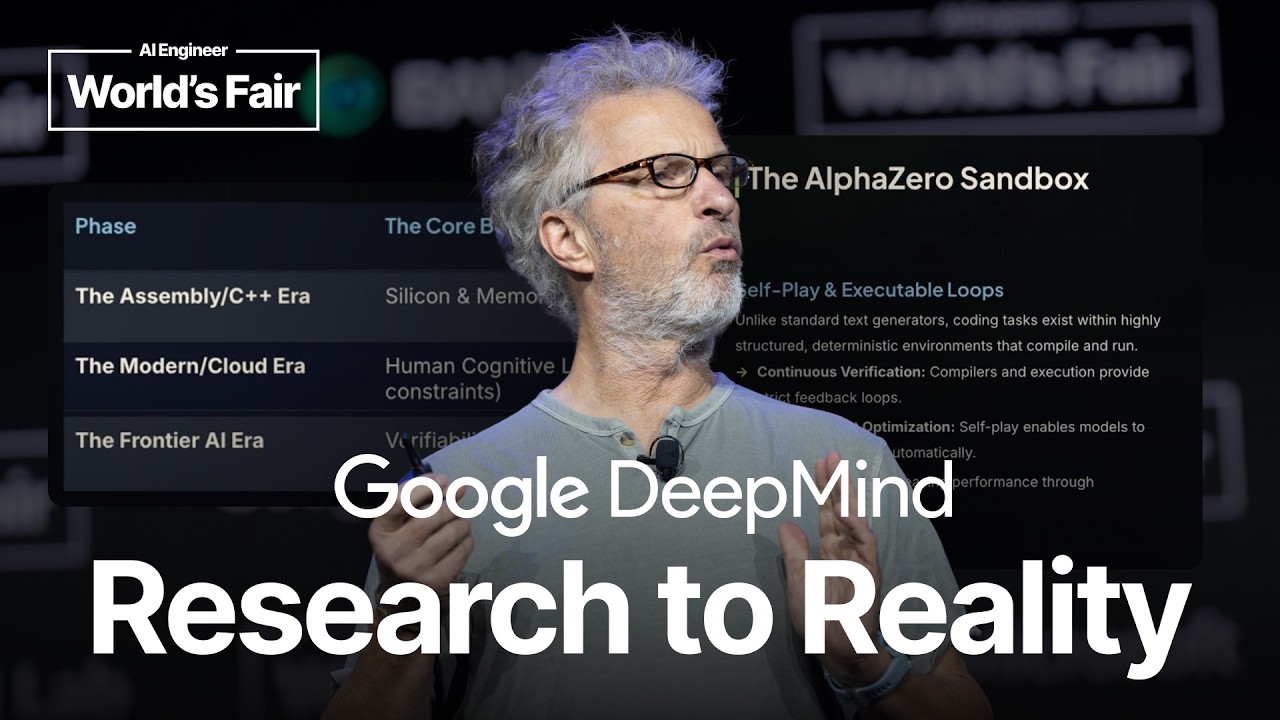
Benoit Schillings, VP of Technology at Google DeepMind, outlines the transformative journey of generative AI in software engineering and beyond, emphasizing the future of model reasoning and the capabilities of Gemini.
The Shifting Landscape of Software Development
Schillings begins by reflecting on his career, from assembly language to modern Python, underscoring his initial skepticism about AI’s role in coding, a sentiment widely shared when the “Pitchfork” project was initiated at Google X in 2018. This project, aimed at improving code writing with ML, was initially met with resistance but has since proven prescient.
He categorizes software development into distinct eras:
- Machine-Constrained Era: Early days of computing where the machine was the limiting factor, necessitating precise assembly language to extract every ounce of power.
- Human-Constrained Era: With cheaper computing and the rise of modularity and cloud, the human brain’s limited context (7-9 “tokens”) became the bottleneck, influencing practices like libraries and function design.
- AI Frontier Era: The current stage where syntax generation is largely solved. The challenge has shifted from writing code to ensuring the generated code aligns with human intent, architectural design, and long-term implications. Humans now focus on architecture and inductive thinking, while AI handles the minutiae.
The Dawn of Superhuman Syntax Generation
Schillings asserts that the era of humans outperforming AI in basic code syntax is over. While models excel at generating functions, the frontier is now in managing multi-step codebases, breaking down extreme complexity, and designing robust architectures that avoid future “regrets.” This requires a level of thinking analogous to designing systems like Google’s core infrastructure.
Self-Play: Overcoming Training Data Saturation
Code presented a unique problem for early ML: an abundance of data (e.g., GitHub) and reasonable verification methods (compilation, unit tests). However, with 80% of new GitHub code now machine-generated, human-sourced training data is saturating. The solution lies in self-play, a concept pioneered by AlphaZero. Frontier models for code can now generate their own challenges, evaluate correctness, and even assess architectural choices. This ability to undergo “hundreds of millions of hours of self-play” will push the boundaries of superhuman coding, much like a human engineer would improve by constantly challenging themselves.
Changing Economics and the Need for Guardrails
The economic implications are profound: if writing code becomes “free or nearly free,” the volume of generated code will explode. This shifts focus from code production to ensuring design adequacy, system reliability, and robust security. Schillings predicts that code reviews, similar to checking compiler-generated assembly, will become obsolete as models generate code that is rarely human-inspected. The emphasis must move towards active guardrails and teaching models to write inherently correct and secure code from the outset, rather than patching vulnerabilities post-generation. This is an extremely challenging, context-dependent problem.
Inductive Architecture and Advanced Planning
Current models struggle with transferring knowledge across domains and performing deductive reasoning by intersecting concepts. To build complex software systems with ML, models need to be taught correct planning—how to effectively decompose complex problems into manageable, clear, and correct sub-problems.
Evolving Evaluation for True Innovation
Traditional benchmarks like HumanEval or ThreeBench are insufficient because they only test code execution and output, not comprehensive software engineering principles. Schillings advocates for open-ended problems such as creating the most efficient lossless text compressor. Such problems would force models to invent novel algorithms and drive genuine algorithmic breakthroughs.
Beyond Tokens: Multimodal Reasoning and New Languages
Reasoning extends beyond mere token sequences. Human thought is often visual (e.g., block diagrams, data flow). This insight underpinned Gemini’s multimodal design, allowing models to think in terms of spatial and dynamic representations. Schillings poses the question of creating new programming languages specifically for models, unburdened by human readability. These languages could leverage strong typing or formal verification inspirations (like Lean) to embed correctness by design, offloading the burden of reliability onto the model itself.
The Future: AI as a Scientific Accelerator
Beyond software, code acts as a universal problem-solving language. AI’s ability to rapidly experiment will impact scientific domains:
- Chemistry: Models could unlock understanding beyond simple molecules (e.g., 20+ atoms), potentially designing complex systems resembling life.
- Biology: AI can decipher the “terrible documentation” of nature’s engineering, revealing elusive relationships.
- The Gold We Cannot See: Human perception is biased by evolution. ML offers a fundamentally different viewpoint, capable of uncovering breakthroughs that are invisible to human intuition, leading to “oh my god, this was in front of us the whole time” moments. This signifies an era of profound, unexpected discoveries.