Gemini

Context Engineering in 2026 — Louis-François Bouchard, Omar Solano & Samridhi Vaid, Towards AI

Context Engineering in 2026 — Louis-François Bouchard, Omar Solano & Samridhi Vaid, Towards AI

Experiments with an AI tutor reveal that not compacting context often outperforms summarization, leading to better recall, lower cost, and faster responses, primarily due to LLM API prompt caching. Compaction invalidates the cache, making it unexpectedly expensive. While cloud environments benefit from full history, local hardware limits necessitate compaction, highlighting the need to prioritize actual constraints over default compaction strategies.

Reading Group July 2026 - Loop Engineering

Reading Group July 2026 - Loop Engineering

This session provides an in-depth exploration of Loop Engineering, a paradigm shift from manual AI prompting to designing autonomous systems that orchestrate AI agents. Speakers share practical experiences, from building production-grade platforms with automated code generation and adversarial AI reviews to experimental loop structures and foundational infrastructure layers. Key discussions address challenges like managing token costs, preventing agent chaos, and implementing robust verification mechanisms for industrializing software development.

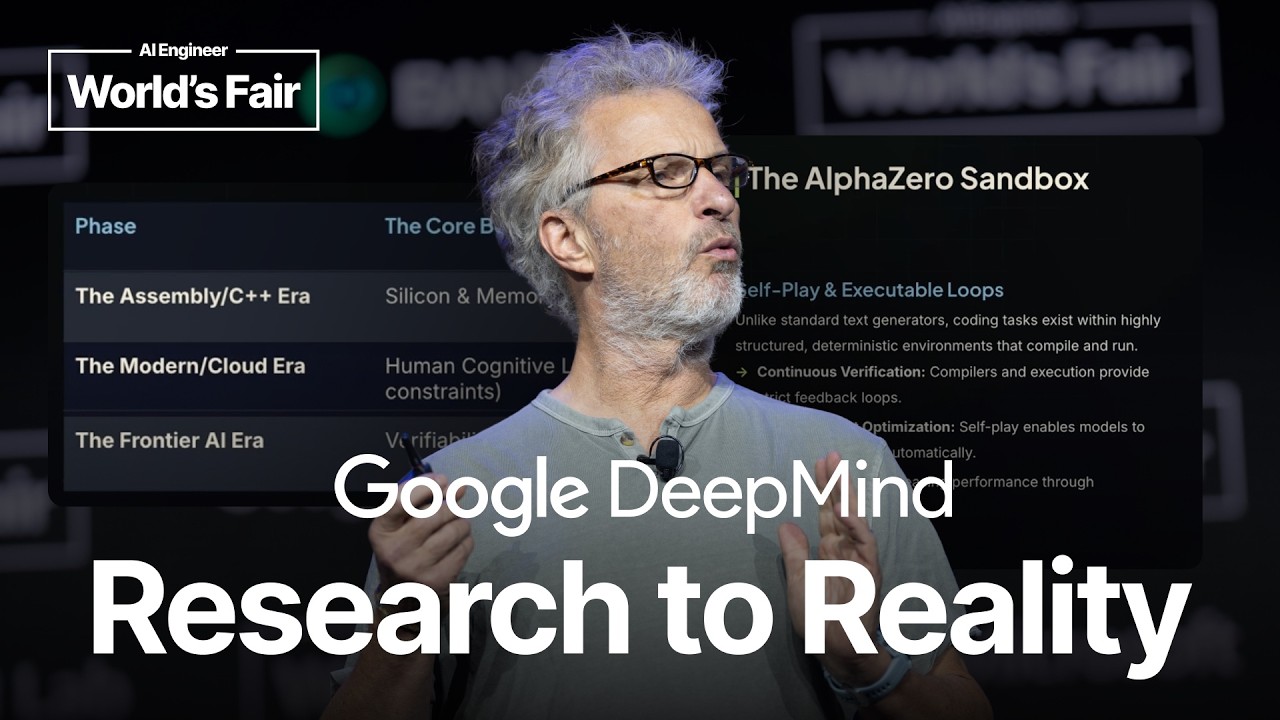
Research to Reality with Google DeepMind — Benoit Schillings, Google DeepMind, VP of Technology

Research to Reality with Google DeepMind — Benoit Schillings, Google DeepMind, VP of Technology

Benoit Schillings, VP of Technology at Google DeepMind, explores the evolution of AI's role in software development, highlighting the transition from human-limited coding to an AI frontier where syntax generation is solved. He delves into the power of self-play for model training, the shifting economics of software engineering, and the imperative for active guardrails. Schillings also discusses the need for inductive architecture, advanced model planning, multimodal reasoning (as seen in Gemini), and the potential for AI to drive scientific breakthroughs in fields like chemistry and biology by uncovering patterns imperceptible to human bias.

From Transcription to Live Music: Gemini's Audio Stack — Thor Schaeff, Google DeepMind

From Transcription to Live Music: Gemini's Audio Stack — Thor Schaeff, Google DeepMind

Thor Schaeff from Google DeepMind demos the advanced audio AI stack, starting with a single API call to Gemini for rich transcription (speaker names, emotions, translation). He showcases speech generation directed by "director's notes" instead of a voice catalog, the real-time, sound-to-sound Gemini 1.5 Flash Live model, and a live demo of Gemini Live using the Lyria 2 model as a tool to generate a full song on stage.

⚡️ Google's Open AI Strategy — Omar Sanseviero, Google DeepMind

⚡️ Google's Open AI Strategy — Omar Sanseviero, Google DeepMind

An in-depth look at Gemma 4's novel transformer architecture with per-layer embeddings, enabling efficient parameter offloading for on-device inference. The discussion also covers its native multimodality, the state of fine-tuning, text-based diffusion models, and the growing intersection of research and engineering.

Let's go Bananas with GenMedia — Guillaume Vernade, Google DeepMind

Let's go Bananas with GenMedia — Guillaume Vernade, Google DeepMind

Guillaume Vernade from Google DeepMind demonstrates a full generative media pipeline, using Gemini to read a public domain book and act as a master prompt engineer for other models. Imagen generates character portraits, Veo animates scenes into video, Lyria composes a unique soundtrack for each chapter, and a clever TTS trick creates a multi-character audiobook.