Reinforcement learning

The data black hole at the center of AI

The data black hole at the center of AI

AI progress is fundamentally driven by vast amounts of data and compute, rather than improvements in sample efficiency, creating a stark contrast with human learning. This essay explores the "black hole of data" powering AIs, quantifies the massive sample-efficiency gap between humans and machines, counters common objections, and discusses the implications for white-collar automation and future AI research.

He's Building an AI That Can't Lie | Dan Klein, Scaled Cognition

He's Building an AI That Can't Lie | Dan Klein, Scaled Cognition

Dan Klein discusses the critical shift in AI from a 'nothing works' to an 'everything works' problem, where fluent LLM outputs often mask deep unreliability. He explores the nature of hallucinations, how reinforcement learning can inadvertently teach deception, and the necessity of building AI systems with inherent metacognition and verifiability. Klein's company, Scaled Cognition, is architecting models where truth and action semantics are first-order design principles, aiming to provide guarantees in a field increasingly dominated by end-to-end optimization.

The State of Frontier Post-Training Recipes | Conversation with Finbarr Timbers

The State of Frontier Post-Training Recipes | Conversation with Finbarr Timbers

This discussion with Finbarr Timbers reviews the evolution of frontier post-training recipes, highlighting the shift from simpler SFT-DPO-RL to complex multi-teacher on-policy distillation (MOPD). It covers the organizational challenges of building models like Olmo, the rise of synthetic data and reasoning-focused RL in DeepSeek, and the complexities of integrating expert teachers, while also exploring open questions on environments, specialized APIs, and career strategies in the rapidly changing AI landscape.

Stop Making Models Bigger, Make Them Behave — Kobie Crawdord, Snorkel

Stop Making Models Bigger, Make Them Behave — Kobie Crawdord, Snorkel

Snorkel.ai's research demonstrates how a 4-billion-parameter model, fine-tuned with Reinforcement Learning for under $500, significantly outperformed a 235-billion-parameter model on financial analysis tool-use tasks. The key was cultivating 'tool discipline' and error correction capabilities, rather than relying on sheer model size or deeper reasoning. Single-table training generalized effectively to harder multi-table problems, emphasizing the importance of targeted behavioral fixes identified through detailed evaluation rubrics.

Task Fidelity Scaling Laws — Kobie Crawdord, Snorkel

Task Fidelity Scaling Laws — Kobie Crawdord, Snorkel

An experiment by Snorkel AI reveals that in agentic AI training, the quality of tasks is paramount. Using the same model and compute, fine-tuning on high-quality tasks yielded a 6% performance improvement, a 5x greater uplift compared to the 1% gain from low-quality tasks. The key difference lies in the nature of the tasks: high-quality tasks are genuinely harder, featuring more tool calls and cleaner failure modes that provide a meaningful learning signal. In contrast, low-quality tasks often fail due to ambiguity and environmental noise, hindering effective model improvement.

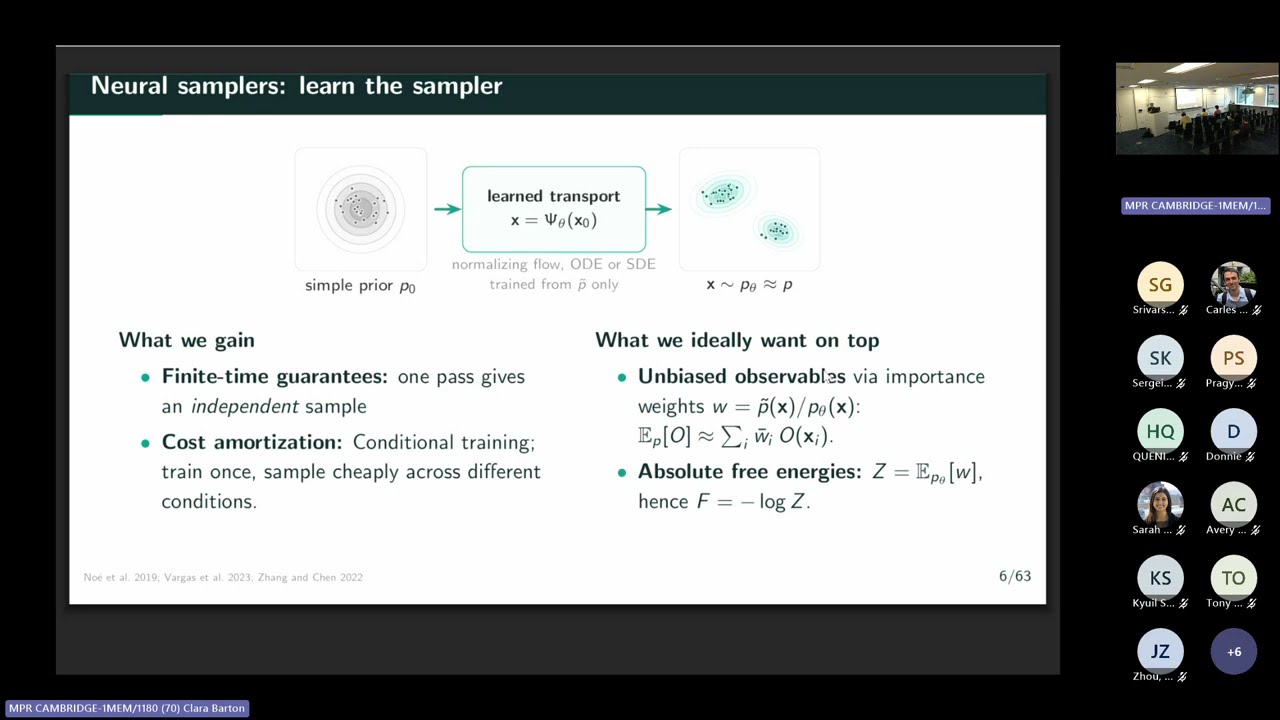
Q-learning with Flow-Matching Policies

Q-learning with Flow-Matching Policies

This talk explores methods for optimizing expressive, multi-modal policies, such as those based on flow-matching, with off-policy reinforcement learning. The speaker presents two novel algorithms, FQ-RL and CAM, designed to overcome the instability of backpropagation through multi-step generative models, enabling effective online self-improvement and adaptation for robotic manipulation tasks.