Robots That Predict the Future: Dyna-2 & Physical AI — Jason Ma, Dyna Robotics
Dyna Robotics is pioneering physical AI with Dyna-2, a world-action model trained on over a million hours of human video, predicting future states and generating robot actions. Co-founder Jason Ma explains how this enables robots to learn new tasks from minimal demonstrations, tackles the robotics data bottleneck with synthetic data and self-improving models, and details their full-stack approach, including custom semi-humanoid hardware for real-world deployments at Din Tai Fung. The discussion delves into diffusion transformers, agentic harnesses for hour-long workflows, the "Bitter Lesson" of scaling data, and the distinction between world-action models and VLAs, all driven by a deployment-first research culture.
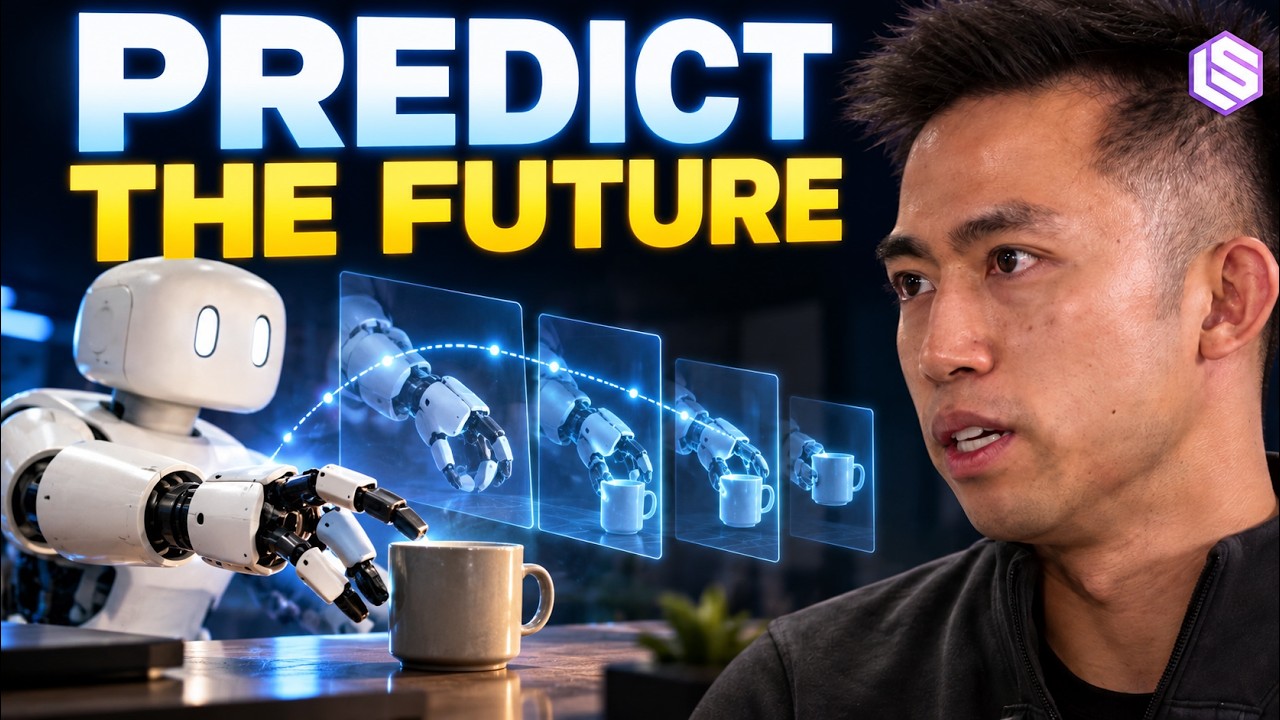
Dyna Robotics, co-founded by Chief Scientist Jason Ma, is at the forefront of pushing physical AI from impressive demonstrations to real-world production. Their core innovation is the Dyna-2 world-action model, the first of its kind trained on over one million hours of human video. This model is designed not just to predict the future state of the world (like a traditional world model) but also to simultaneously generate robot actions to control physical robots, mirroring how humans implicitly consider the evolution of the world based on their actions. This architecture yields robots that are more dexterous, robust, and capable of generalizing to novel environments.
The Dyna-2 model’s inputs include video feeds from the robot’s cameras, joint encoder data reflecting the robot’s own physical state, and language instructions for task guidance. Its outputs encompass both the actions the robot executes and future video predictions, which act as a form of “chain of thought” for visual and physical reasoning, guiding subsequent actions. Architecturally, Dyna-2 is a diffusion transformer. The transformer component excels at ingesting vast amounts of data, while the diffusion aspect, leveraging techniques like flow matching, refines the output to produce the smooth, precise, and fine-grained motions crucial for physical interaction. Flow matching, specifically, offers an efficiency speed-up, reducing the iterative steps required in diffusion and making it well-suited for real-time action generation in robotics.
A significant challenge in robotics is the data bottleneck, as “there is no internet” equivalent for robotics data. Each company must grapple with data collection. Dyna’s strategy involves pre-training on large datasets of egocentric human video (over a million hours), which provides a diverse and strong prior on physical manipulation. This is then combined with smaller, more expensive robot-specific data to adapt the general model and master particular tasks, enabling robots to learn new tasks from as little as 45 minutes of demonstrations. Jason Ma emphasizes that data quality is non-stationary, evolving with the model’s capabilities, and welcomes data partnerships for diverse, high-quality egocentric, robot, or video data.
Dyna is actively exploring synthetic data and self-improving world models as the next frontier for scaling. Leveraging frontier models (large language models with advanced vision capabilities), they generate synthetic environments and tailor data. Jason references his past Eureka project at NVIDIA, where GPT-4 generated environments and reward functions for reinforcement learning, demonstrating the potential for LLMs to accelerate robotics research. Crucially, Dyna’s world-action model can generate its own training data, creating a self-fulfilling flywheel for continuous improvement.
For real-world deployment, real-time inference is paramount; robots cannot afford latency. This necessitates on-device inference and model distillation, where large, powerful models are trained and then compressed for efficient local execution. Dyna adopts a full-stack robotics approach, owning the development of critical hardware components like actuators and even the robot’s proportion. This contrasts with model-only companies, as controlling the entire stack allows for maximal optimization, which is essential for robots delivering physical services. Their chosen wheeled semi-humanoid design prioritizes practicality: a humanoid upper body (including a 4-degree-of-freedom waist) for human-like manipulation and data transfer, combined with a wheeled base for stability and energy efficiency over bipedal legs. This design choice enables the robot to leverage human torso movements prevalent in human demonstration data.
Teaching new tasks involves starting with Dyna’s strong base model, then fine-tuning it with minimal robot data (tens of minutes to a few hours). Evaluation occurs by deploying the model in the real world, observing its behavior, identifying weaknesses, and iteratively collecting more data, akin to reinforcement learning from human feedback. This allows for tasks like chopping food or opening a fridge to be learned quickly. Dyna’s robots are capable of autonomous, hour-long workflows thanks to agentic harnesses that provide a high-level reasoning layer around the world-action model. This hierarchical approach allows the robot to make complex decisions, manage sequences of tasks (e.g., full laundry cycle), and coordinate actions, much like agentic systems in large language models. However, current bottlenecks include hardware limitations (e.g., dexterous hands overheating) and missing sensory data (tactile, audio, smell).
Dyna’s focus is on scaled deployments, not just pilots. They boast partnerships with customers like Din Tai Fung, where their robots fold thousands of napkins daily across multiple locations, demonstrating value sufficient for widespread deployment. These robots maintain extremely high quality standards and consistency, even for deformable objects like napkins. This embodies the “Bitter Lesson of Robotics”: prioritizing scaled data and simpler algorithms over specialized engineering leads to emergent generalization and predictable performance. The challenge lies in building the necessary hardware and sensor infrastructure to acquire this data, as there is no single “internet” for robotics.
Comparing their approach to others, Jason discusses world-action models versus Vision-Language-Action (VLA) models. While VLAs adapt language and vision models, Dyna’s world-action models emphasize predicting as much of the world as possible, aiming to remove human biases by using raw camera inputs. The fundamental principle is that robotics is about predicting the future state of the world to inform actions. While VLAs might predict abstract representations, potentially injecting human bias, world-action models aim for a more foundational prediction. Jason acknowledges that a potential limitation could be if current visual sensors alone are insufficient without critical information like tactile or audio data, but Dyna’s full-stack approach uniquely positions them to integrate such modalities.
Jason’s journey from being inspired by AlphaGo, through academia (UPenn/GRASP), NVIDIA (Eureka project), and Google DeepMind, led him to co-found Dyna Robotics with a mission to bring robots into the real world. He emphasizes Dyna’s “research + product” culture, where frontier research is driven by the practical problems of deploying robots for real customers. This deployment-first mindset helps them identify and solve true bottlenecks early on. The company’s vision is to deploy thousands, even millions, of robots, fundamentally integrating intelligence into the physical world. The name “Dyna” is a nod to Richard Sutton’s seminal “Dyna” paper on self-improving agents with world models, combined with a personal reference to Ultraman Dyna from his childhood.
- Tags:
- Synthetic Data
- Reinforcement Learning
- Model Distillation
- Vision-Language-Action Models
- Bitter Lesson
- Flow Matching
- AlphaGo
- Dyna Robotics
- Jason Ma
- World-Action Model
- Dyna-2
- Diffusion Transformer
- Robotics Data
- Egocentric Video
- Eureka Project
- On-Device Inference
- Full-Stack Robotics
- Semi-Humanoid
- Agentic Harnesses
- Din Tai Fung
- Best Western