Scalable Training of Diffusion Samplers via Fixed-point Score Matching
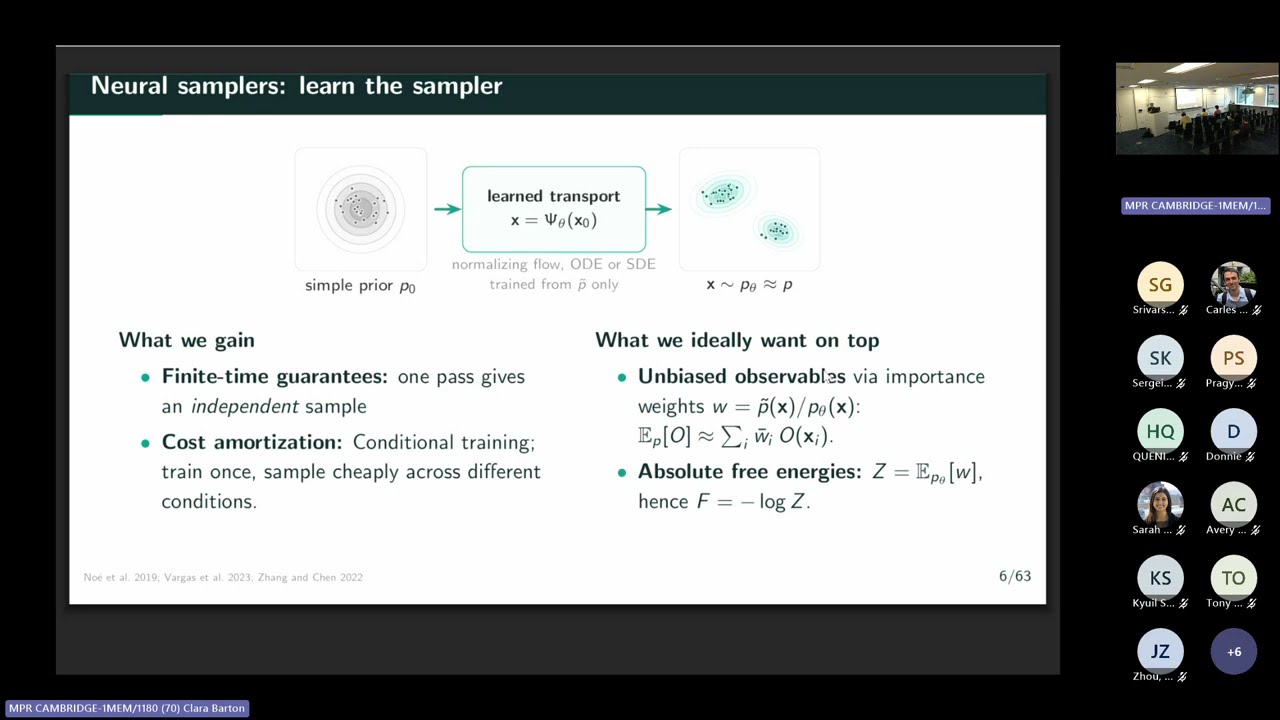
Denis Blessing presents scalable training of diffusion samplers via fixed point score matching: a unifying framework for learning Boltzmann-type distributions from energy evaluations alone, with applications to amorphous materials, alloy phase diagrams, and reinforcement learning with flow policies.
Robots That Predict the Future: Dyna-2 & Physical AI — Jason Ma, Dyna Robotics
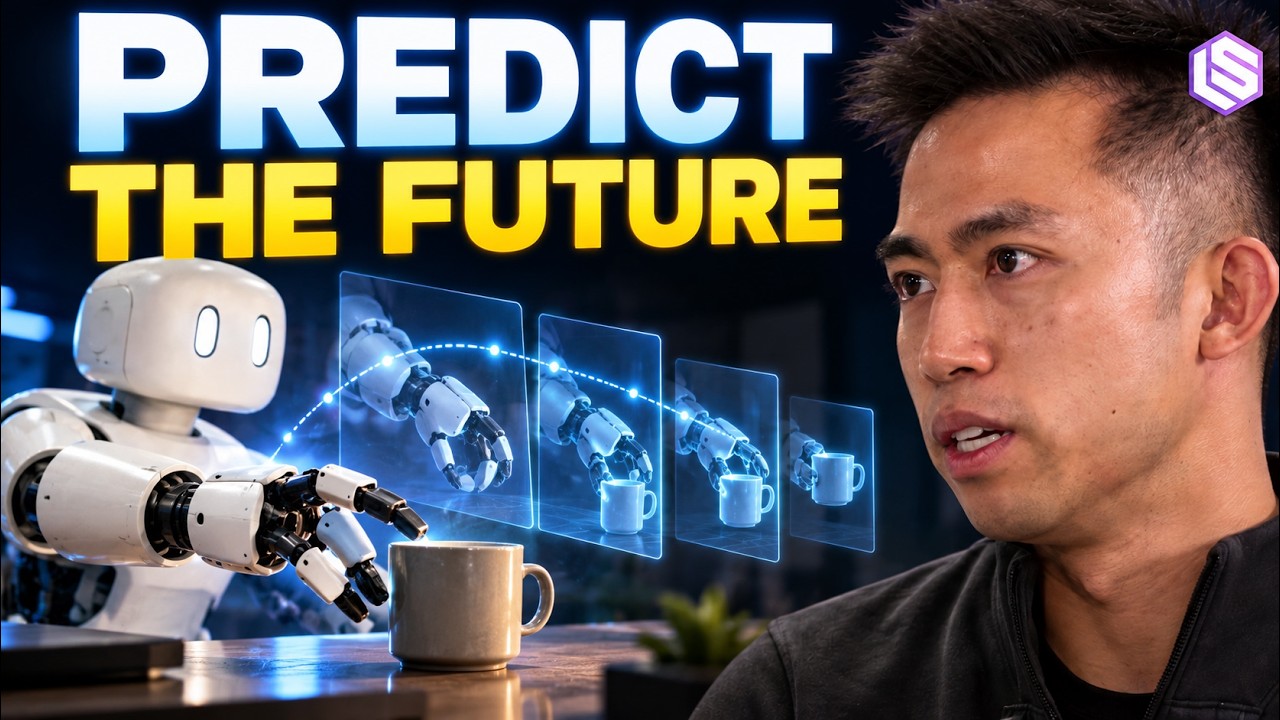
Dyna Robotics is pioneering physical AI with Dyna-2, a world-action model trained on over a million hours of human video, predicting future states and generating robot actions. Co-founder Jason Ma explains how this enables robots to learn new tasks from minimal demonstrations, tackles the robotics data bottleneck with synthetic data and self-improving models, and details their full-stack approach, including custom semi-humanoid hardware for real-world deployments at Din Tai Fung. The discussion delves into diffusion transformers, agentic harnesses for hour-long workflows, the "Bitter Lesson" of scaling data, and the distinction between world-action models and VLAs, all driven by a deployment-first research culture.
When Talking Becomes the Main Way We Use Computers — Pavan Muddireddy
Mistral AI's Voxtral suite represents a significant advancement in voice AI, moving beyond traditional cascaded systems towards more integrated and efficient audio understanding and generation. Pavankumar Reddy Muddireddy of Mistral AI details Voxtral Chat's audio-native architecture, which directly feeds continuous audio embeddings into a text LLM for rich context. He explains Voxtral TTS's use of continuous latents and flow matching for high-fidelity speech synthesis. The discussion also covers critical challenges like speaker diarization, the use of Direct Preference Optimization (DPO) to correct model hallucinations, and the enduring relevance of specialized model cascades in real-world enterprise deployments for their adaptability and control, emphasizing that voice typically thrives alongside a screen, not in isolation.
PhylaFlow: Hybrid flow matching in phylogenetic tree space
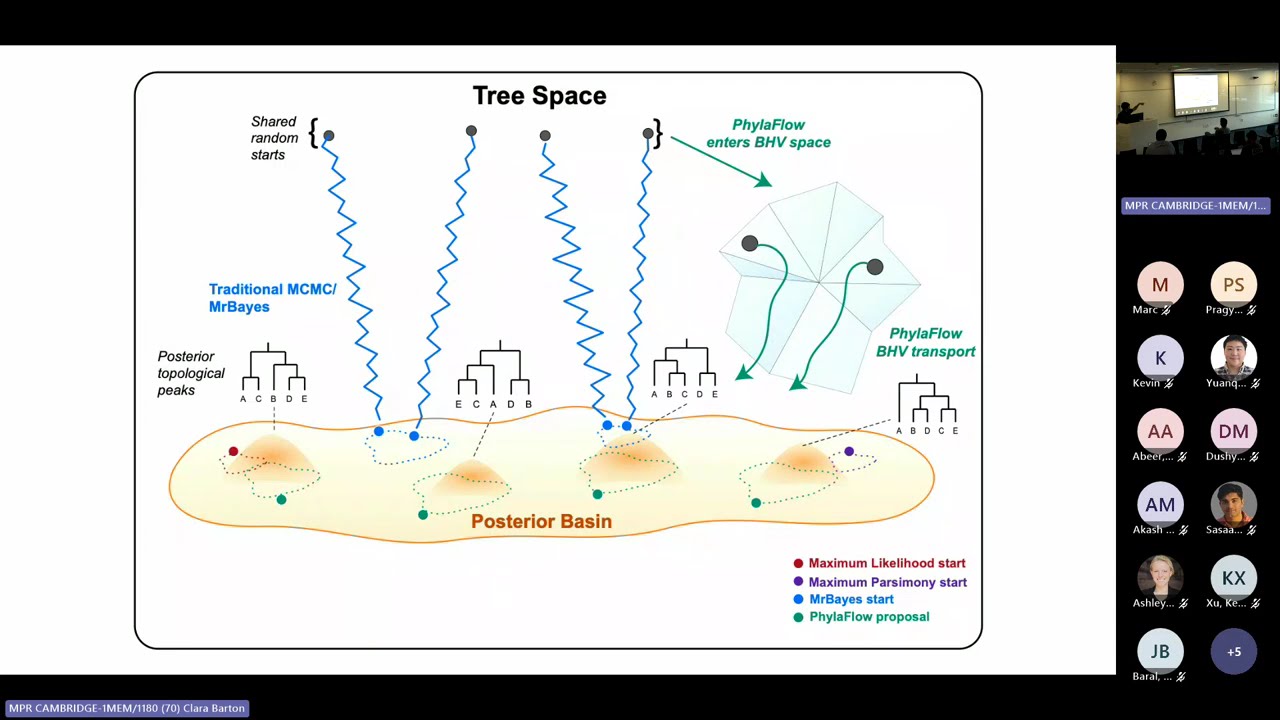
PhylaFlow is a hybrid flow-matching framework that navigates Billera–Holmes–Vogtmann (BHV) tree space to accelerate Bayesian phylogenetic inference. By learning geodesic paths from random trees to posterior samples, PhylaFlow efficiently initializes MCMC chains, drastically reducing the "burn-in" time. A PhylaFlow-MCMC variant, which guides MrBayes move acceptance, significantly outperforms traditional methods and even existing machine learning baselines for posterior sampling, achieving better results within the same computational budget. The work also explores conditioning on sequence embeddings, aiming for a future phylogenetics foundation model capable of zero-shot inference.
Binomial Flows: Denoising and flow matching for discrete ordinal data
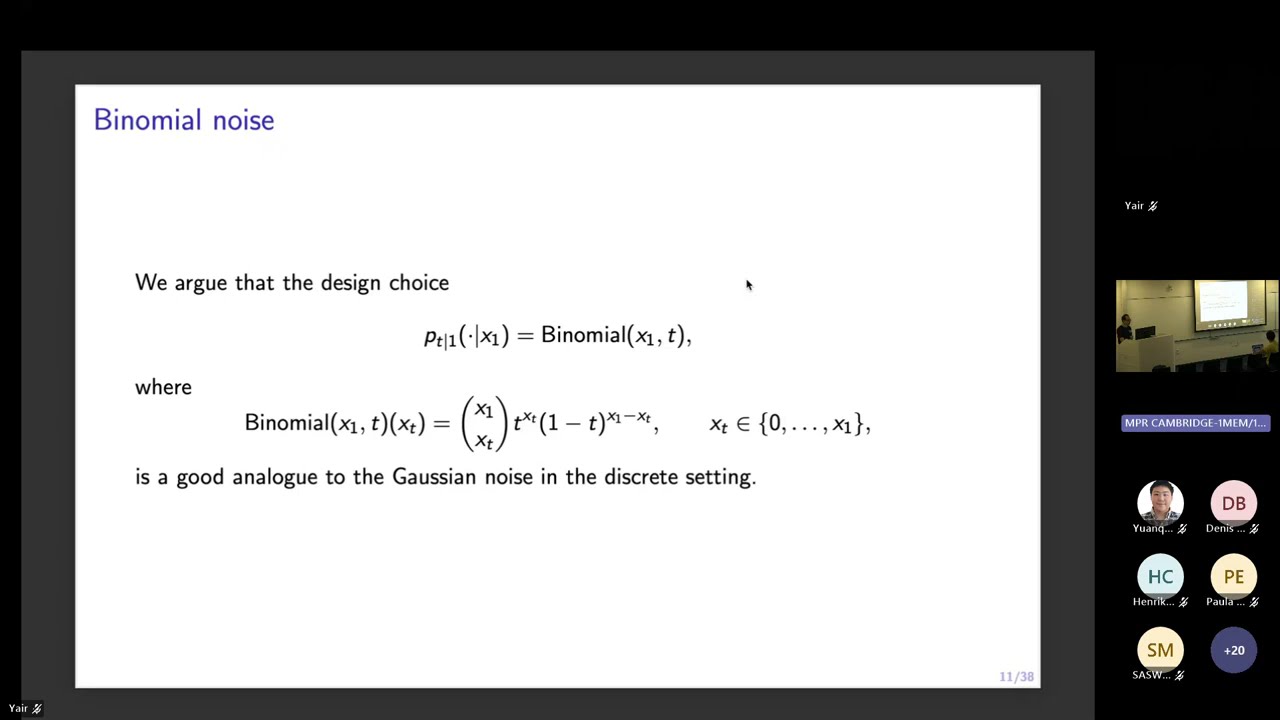
Shenfeld presents binomial flows, a discrete analogue of Tweedie-based diffusion for ordinal, non-negative integer data. The method pairs binomial thinning for noising with a Poisson-type continuous-time Markov chain whose rate is expressed through a learned denoiser, enabling training with MSE, sampling, and exact likelihood estimation. Results include the best reported CIFAR-10 FID among ordinal discrete diffusion models, obtained by adapting the EDM framework.
From Tokens to Cells: Foundation Models for Single-Cell Biology - Akram Baharlouei, Altos Labs
Akram Baharlouei from Altos Labs discusses the engineering hurdles in developing foundation models for single-cell biology. The talk covers the importance of single-cell analysis for cellular rejuvenation and drug discovery, the complexities and challenges of single-cell data (particularly RNA-seq), and a comparative analysis of current foundation model approaches, highlighting the limitations of transformer-based models and the potential of flow matching techniques like PrimeFlow.