Better AI Starts With Better Verification
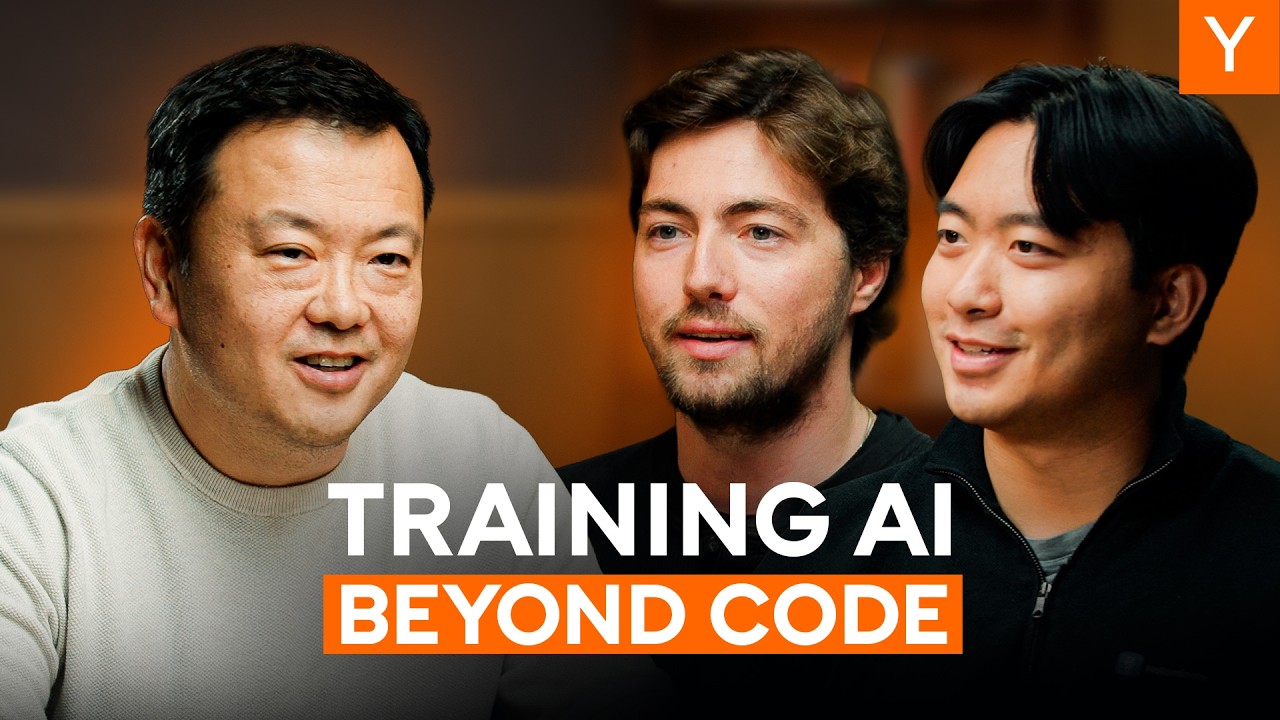
Halluminate, a Y Combinator S25 company, builds RL environments and benchmarks that teach AI models to do non-coding knowledge work, starting with financial services. In this fireside with YC Partner Jon Xu, co-founders Jerry Wu and Wyatt Marshall trace their pivot from evals to training environments, explain why verification quality matters more than task volume, and outline a roadmap toward multi-agent simulated companies. They also address reward hacking, alignment as an industry-wide responsibility, and what they look for in new hires.
Origins: From Evals to Training Environments
The founders, Jerry Wu and Wyatt Marshall, describe Halluminate’s start as an evaluation company. Jerry had worked at Capital One Labs, where his team was training one of the early AI agents for finance and kept running into the same problem: how to verify, test, and benchmark quality and efficiency. That pain point became the seed for Halluminate. Their early work centered on computer-use and browser-use evals, partnering with browser agent companies such as Skyvern and Browser Use. Testing web agents on tasks like flight booking forced them to build simulated environments (a mock Google Flights, a shopping site, a checkout flow). They realized that building these environments was hard but valuable, and that the same infrastructure could serve post-training, not just evaluation. Early 2025 scaling results from RL and reasoning models like DeepSeek pushed them to pivot toward producing high-quality post-training environments for model builders.
The team then narrowed from general computer use to non-coding knowledge work. Their reasoning was that coding and computer use were crowded, while most of the world’s labor is non-coding, and models were still far behind there. The gap, they argued, was a shortage of training environments, data, and benchmarks for those domains.
What an RL Environment Actually Is
Wyatt and Jerry give a clean definition. An RL environment gives an agent an objective (a prompt or problem statement), a place to act (a computer, browser, or terminal), and a way to evaluate the result. In evals, that evaluation is the score. In post-training, it becomes the reward signal in the training pipeline. The loop itself is simple. What makes knowledge work hard is verification. In coding, unit tests answer the question, and in math a Lean proof either compiles. Financial work has no such crisp checker.
Their example is an LBO modeling task. The agent receives a half-built Excel model with some pieces missing or broken, plus supporting context. It must complete the model, and the output is compared against a golden spreadsheet. The verifier checks whether the right formulas sit in the right cells, whether the data came from the right sources, and whether formatting follows the checklist. These are the things a real banker would care about, and together they yield a holistic score.
Quality Over Volume, and Why Verification Is the Core
The conversation turns to the trade-off between scale and quality. The founders are emphatic that environment quality directly determines the quality of the post-trained model, so “fewer that are better” beats a large pile of weak environments. Verification is the most important part of quality. A flawed verifier teaches the model the wrong thing. Either the agent gets credit it did not earn, or it solves a task correctly and is not rewarded. Either failure mode produces a model learning the wrong behavior.
On reward hacking, they distinguish the dramatic cases, like an agent breaking out of its sandbox or finding an answer key, from softer ones. The softer ones are the more relevant risk in finance. An agent might jump straight to the answer without showing the work, which a real analyst would never be allowed to do. The verifier should refuse credit in that case. Their remedy is quality assurance with subject-matter experts, making sure tasks are aligned and that verifier scores match what an expert would award. They say bluntly that you cannot skip this step if you want good tasks.
Why Finance, and What Comes Next
Finance was chosen as the starting vertical for several reasons. It is one of the largest knowledge-work service industries by headcount and value, and it is reasonably verifiable, which suits RL. It also contains many subdomains, including investment banking, private equity, and equity research. The founders believe that excelling at financial reasoning will generalize to consulting, accounting, FP&A, insurance, and other knowledge-work areas, since these workflows share a common capability curriculum.
They describe a “Moore’s law of RL environments”: the complexity and scope of training environments roughly double every 6 to 8 months, which tracks the growth in model intelligence. Their projection is that environments will move from single-app tasks (PowerPoint, Excel, email) to multi-agent teams doing large chunks of work, and eventually to simulated companies, industries, and even governments. In that picture, agents learn to be autonomous operators and co-workers in the economy. Labs and enterprises would rent or purchase time in these environments.
Alignment, Safety, and Hiring
On alignment, Jerry and Wyatt argue that many of the safety incidents in recent reports, including the Hugging Face case they cite, trace back to poor-quality data and poorly built RL environments. Poorly built sandboxes and weak process verification are part of the problem. They frame alignment as an industry-wide responsibility, especially for data and environment companies, and not something reserved for a lab’s safety team.
On hiring, they describe environment building as a supply chain that spans research, engineering, data operations, and financing. They are hiring generalist operators who can work across product and ops, research staff with deep experience in post-training and benchmarks, and platform and infrastructure engineers to host simulations, which they call a thorny problem. Their hiring principle is agency and the ability to solve problems with AI tooling, regardless of background.