Llms

How Supabase Became One Of The Fastest Growing DevTool Companies In The World

How Supabase Became One Of The Fastest Growing DevTool Companies In The World

Supabase CEO Paul Copplestone details how a frustrating Firebase migration sparked an open-source side project that grew into a decacorn. He explains the strategic choice of PostgreSQL and open source, the evolution of developer experience to achieve 5-second time-to-value, and the transformative impact of AI agents, which now launch millions of Supabase databases monthly. The conversation also covers the challenges and advantages of a fully distributed workforce and the future bet on 'self-driving databases' to address the complex 'operate' stage of AI-driven development.
Why Agentic Systems Need Ontologies — Frank Coyle, UC Berkeley

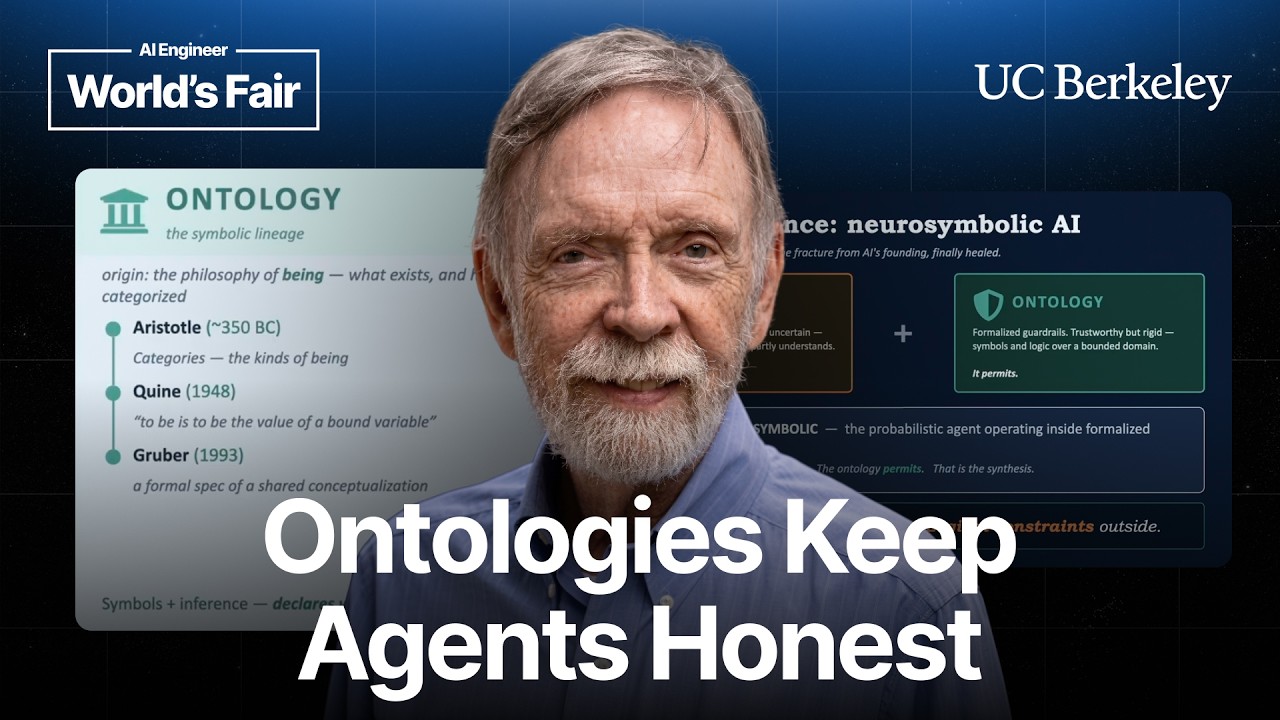
Why Agentic Systems Need Ontologies — Frank Coyle, UC Berkeley

Frank Coyle discusses the inherent flaws of purely probabilistic LLMs in agentic systems and proposes a neuro-symbolic solution. He advocates for wrapping LLM tool-use loops with external ontologies and validation mechanisms (like RDFS, OWL, and Pydantic) to provide logical guardrails, preventing common, critical errors that probabilistic reasoning alone cannot reliably avoid.

2026 State of AI Engineering — Barr Yaron, Amplify Partners

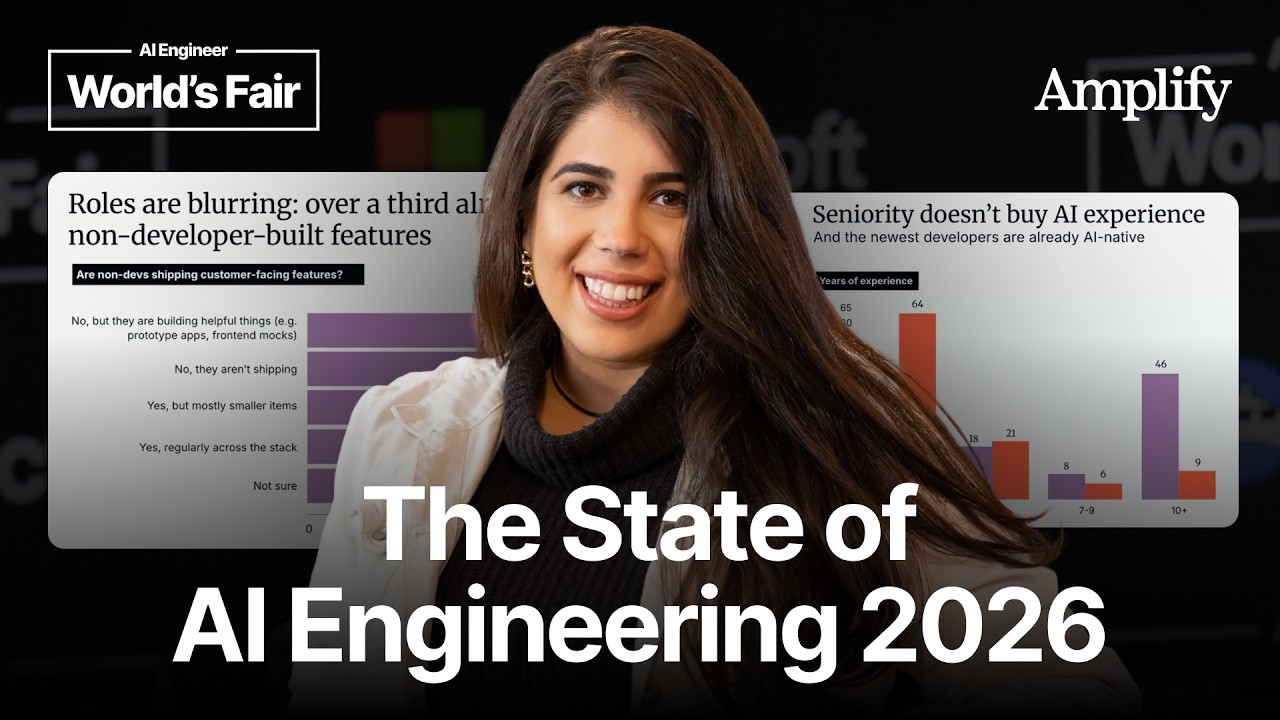
2026 State of AI Engineering — Barr Yaron, Amplify Partners

Barr Yaron's 2026 AI engineering survey reveals key trends: audio and image generation are rapidly gaining traction, while cost is now a primary engineering constraint. Agents are evolving to take actions within systems, but control mechanisms remain primitive. Evaluation (eval) is still the top infrastructure challenge. AI positively impacts job satisfaction and experimentation but also raises concerns about technical skill erosion and non-developers shipping code, fundamentally changing engineering culture. Predictions include a likely AGI declaration within five years and a shift away from Transformers as state-of-the-art.

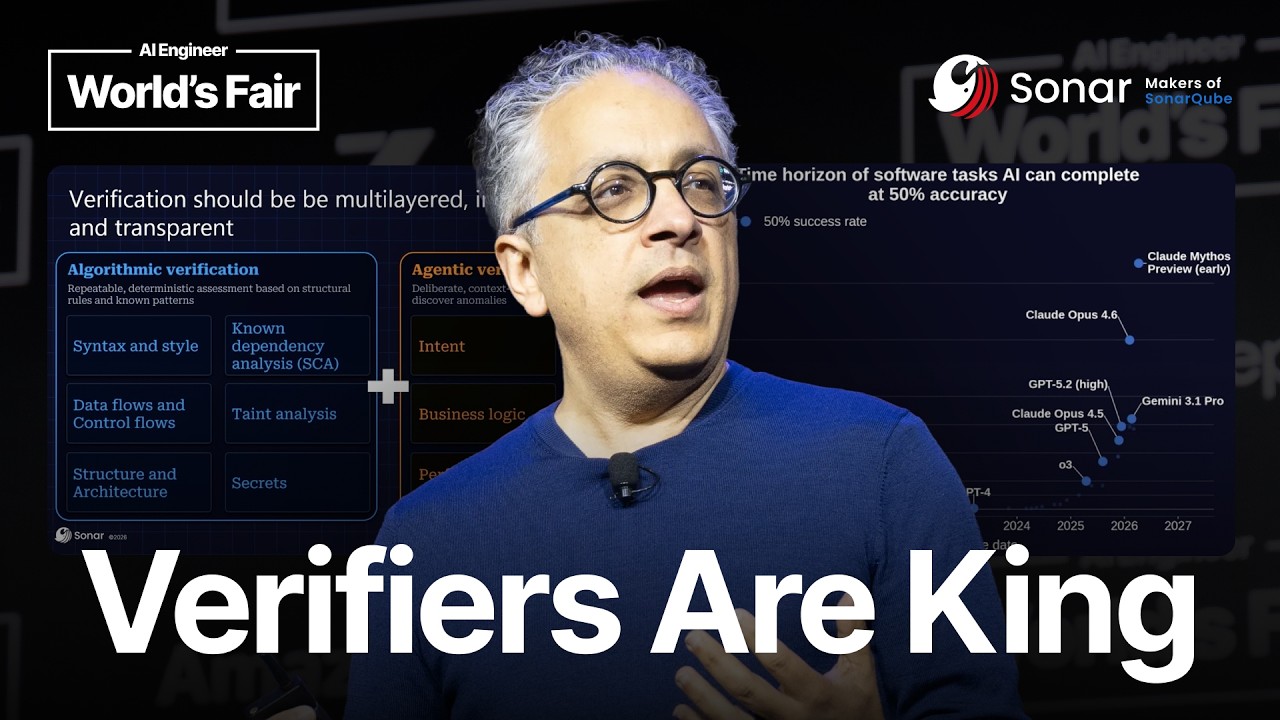
In the Land of AI Agents, the Verifiers Are King — Tariq Shaukat, Sonar

In the Land of AI Agents, the Verifiers Are King — Tariq Shaukat, Sonar

This talk addresses the critical challenge of verification in AI agent development, moving beyond generation to ensure correctness. It highlights the problem of "AI slop" and the "productivity paradox" of AI coding agents, where initial velocity gains are offset by increased technical debt and quality issues. The speaker introduces the AC/DC (Agent-Centric Development Cycle) framework comprising three stages: Guide (providing context and constraints), Verify (zero-trust, multi-layered verification using both algorithmic and agentic methods), and Solve (active code maintenance to control technical debt). This systems-level approach, integrating verification across agentic, CI, and code maintenance loops, significantly reduces issues and transforms AI into a reliable enterprise asset.

Imagination Engineering — Eve Bouffard, Head of Design, Y Combinator

Imagination Engineering — Eve Bouffard, Head of Design, Y Combinator

Eve Bouffard of Y Combinator introduces "Imagination Engineering," arguing that powerful AI shifts the human challenge from execution to ideation. She showcases personal experiments like an AI-generated website from her public thoughts, a tool visualizing historical geniuses, and custom productivity aids. Bouffard highlights AI's role as a "rocket ship for the mind," enabling rapid learning and software creation on demand.

Computer-Use 2.0: Agents Just Got Multi-Cursor — Francesco Bonacci, Cua

Computer-Use 2.0: Agents Just Got Multi-Cursor — Francesco Bonacci, Cua

This talk introduces cua driver, an open-source tool enabling AI agents to interact with computer GUIs in the background across macOS, Windows, and Linux by leveraging accessibility APIs. It details CUABench, a robust evaluation framework with over 130 verifiable tasks designed to benchmark and ensure the trustworthiness of computer-using agents, revealing current limitations in complex tasks like circuit design. Finally, it presents cua fleet, an infrastructure solution that optimizes GPU utilization and reduces costs for RL training of these agents by dynamically managing sandbox environments.