In the Land of AI Agents, the Verifiers Are King — Tariq Shaukat, Sonar
This talk addresses the critical challenge of verification in AI agent development, moving beyond generation to ensure correctness. It highlights the problem of "AI slop" and the "productivity paradox" of AI coding agents, where initial velocity gains are offset by increased technical debt and quality issues. The speaker introduces the AC/DC (Agent-Centric Development Cycle) framework comprising three stages: Guide (providing context and constraints), Verify (zero-trust, multi-layered verification using both algorithmic and agentic methods), and Solve (active code maintenance to control technical debt). This systems-level approach, integrating verification across agentic, CI, and code maintenance loops, significantly reduces issues and transforms AI into a reliable enterprise asset.
The AI Verification Challenge: Beyond Generation
Tariq Shaukat, CEO of Sonar, highlights a critical challenge in the age of AI: the shift from mere code generation to rigorous verification. While the promise of AGI is immense, enterprises frequently encounter “AI slop”—plausible but incorrect outputs from AI models. This leads to significant issues, such as retractions from professional services firms (e.g., KPMG, EY) and legal troubles from fabricated citations. This pervasive problem underscores a fundamental question: how can we extract reliable value from AI in a production environment when correctness is not guaranteed?
The Productivity Paradox of AI Coding Agents
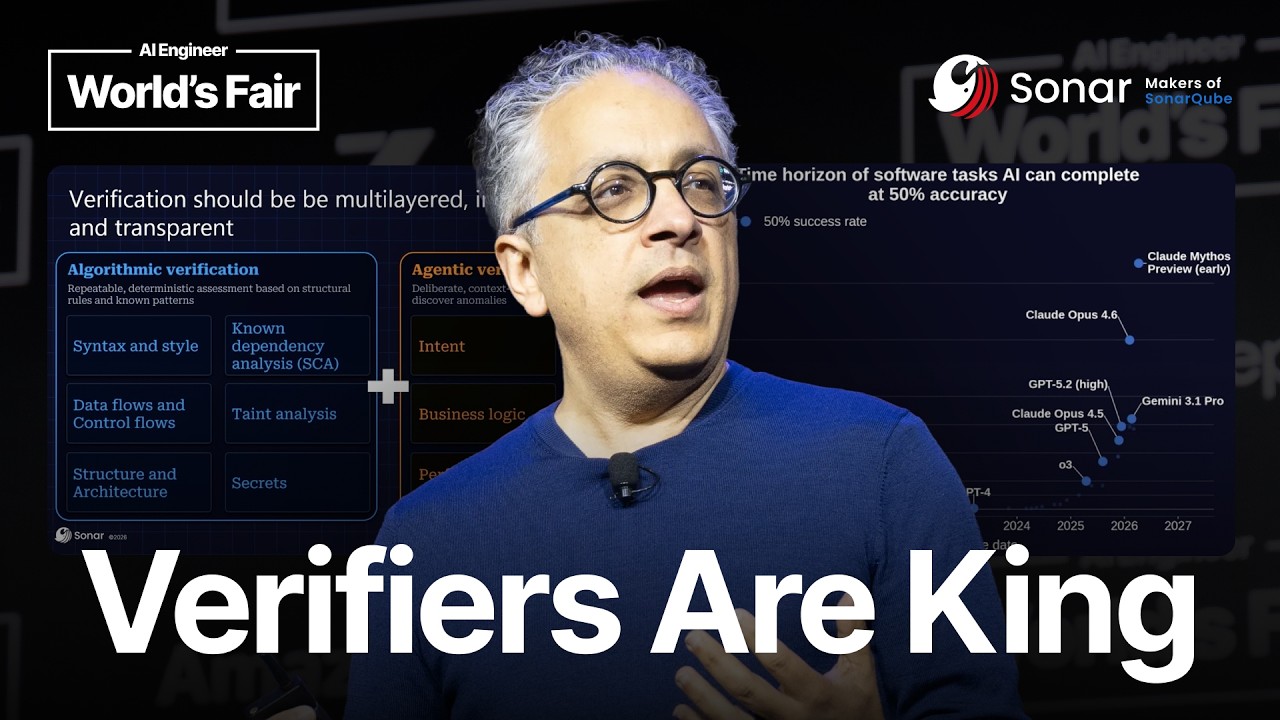
Data, particularly from Mythos models, indicates rapid advancements in AI coding agents’ ability to complete tasks. The latest Mythos model could reportedly complete tasks equivalent to 16-18 hours of human effort. However, this capability comes with a crucial caveat: a mere 50% success rate. Improving accuracy to 80% drastically reduces the task completion time to about 3.5 hours, yet even this level of accuracy is often insufficient for enterprise-grade reliability, given the potential for problematic code.
Sonar’s own benchmarking, which involves testing models against over 4,000 problems, reveals that while state-of-the-art models excel in functional correctness, they consistently produce:
- High and often variable code complexity (though GPT-4o shows some improvement).
- Bugs.
- Security vulnerabilities.
A Carnegie Mellon study further elucidates the “productivity paradox” of AI coding agents:
- Initial deployments often yield a significant 3-5x boost in velocity.
- This productivity surge typically dissipates within three months, returning to pre-agent levels.
- The primary cause for this decline is a substantial increase in security, maintainability, and reliability issues, alongside rising code complexity. This rapid accumulation of technical debt creates new bottlenecks, negating initial gains.
This data suggests that while individual code snippets can be proven correct, large, interconnected software systems, laden with existing dependencies and technical debt, remain complex and prone to errors. Therefore, rigorous verification is not an afterthought but a central, integrated requirement.
The AC/DC Framework: Guide, Verify, Solve
To address these challenges, Sonar proposes the Agent-Centric Development Cycle (AC/DC) framework. This framework is designed to embed verification directly into the software development lifecycle when utilizing AI agents, comprising three core disciplines:
1. Guide: Context and Constraints (Preemptive Verification)
The “Guide” stage aims to enhance agent effectiveness and reduce token consumption by providing explicit direction:
- Context: Equipping agents with a deep understanding of the existing codebase (potentially millions or billions of lines of code) through architectural awareness and semantic navigation maps.
- Constraints: Clearly defining coding guidelines, approved and disapproved dependencies, coding standards, guardrails, and the intended architectural direction. This extends beyond merely understanding the current state to guiding towards a desired future state.
This preemptive approach functions as a form of verification, significantly improving agent effectiveness and leading to over a 30% reduction in token consumption.
2. Verify: Zero-Trust, Multi-Layered Verification
This stage forms the core of active verification, built on two key principles:
- Zero-Trust: Acknowledging the inherent biases and unique characteristics of every AI model, necessitating the use of diverse models and techniques to ensure comprehensive code safety, reliability, and security.
- Multi-Layered: Recognizing software’s inherent complexity, this approach combines:
- Algorithmic Verification: Automated analysis of data flows, control flows, known patterns, and secrets.
- Agentic Verification: AI-driven analysis focusing on understanding intent, business logic, and identifying “unknown unknowns.”
The synergistic combination of these techniques yields tangible results: customers implementing a multi-layered verification approach report a 44% reduction in AI-derived production outages.
3. Solve: Maintenance Loops and Technical Debt Control
Accelerated code generation inevitably leads to an explosion of technical debt. The “Solve” stage emphasizes proactive, verified code maintenance:
- Active Discipline: Implementing continuous processes for verified code maintenance, often involving remediation agents.
- Clean Code for Agents: Agents operate significantly more efficiently on clean codebases, requiring fewer tokens, less reasoning, and less energy. Maintaining a clean codebase eases the agent’s task, leading to compounding benefits over time.
Systems-Level Thinking: Embedding Verification in SDLC
Shaukat emphasizes that these three stages must be integrated into a cohesive system within the Software Development Life Cycle. This involves three interconnected loops, with verification at their core:
- Agentic Loop (Inner Loop Verification): Provides agents with context, constraints, and in-loop verification as code is generated, enabling immediate problem detection and fixing.
- CI Verification Loop: Leverages the combined power of algorithmic and agentic verification for rapid, multi-layered review of pull requests.
- Code Maintenance Loop (Quality Gates): Utilizes evaluations and quality gates to ensure continuous adherence to standards and foster ongoing improvement, thereby preventing a downward spiral into technical debt.
This compounding system reinforces positive outcomes. Large financial institutions adopting this Guide, Verify, Solve approach within their agentic workflows have achieved a remarkable 92% reduction in issues, demonstrating how disciplined verification transforms AI from a source of