The AI School Kids Love More Than Vacation | Alpha School's Joe Liemandt
Alpha School principal Joe Liemandt and Horowitz Andreessen Academy co-founder Gagan Biyani discuss how AI-powered learning could compress core academics into two hours a day, freeing the rest of school for teamwork, entrepreneurship, and real-world building, and what that model means for K-12 families, higher education, and the next generation of builders.
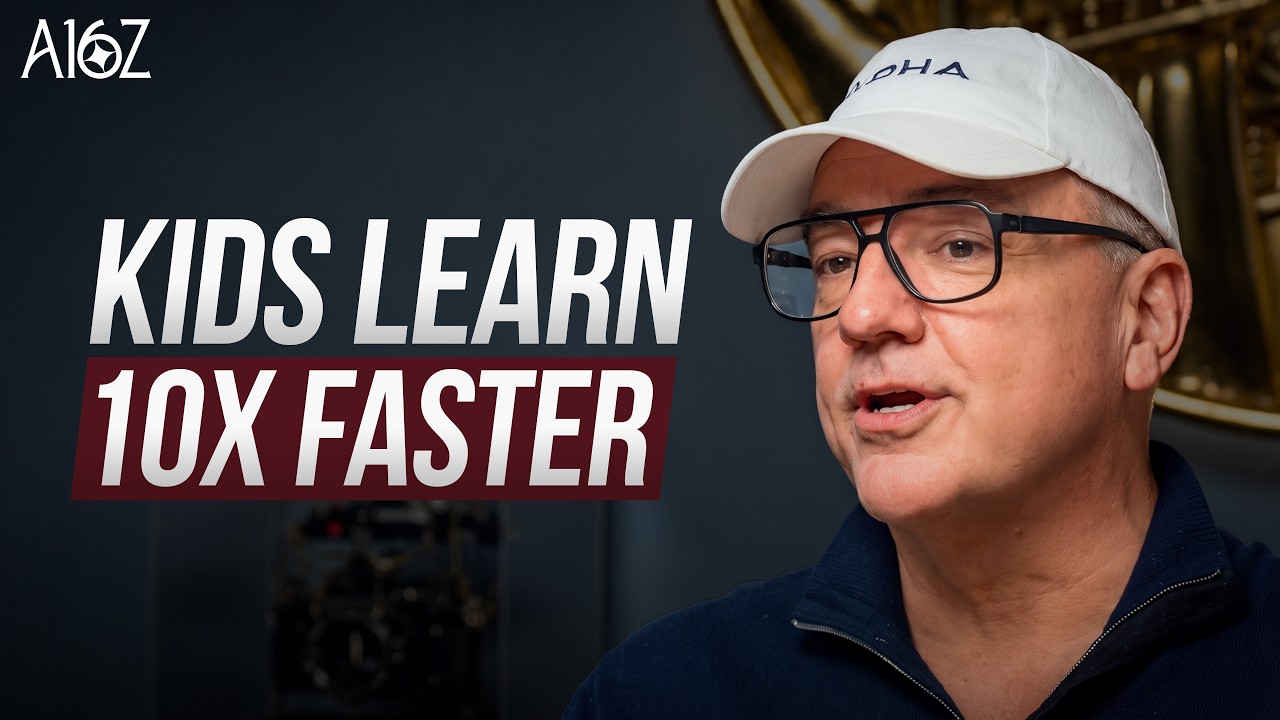
Joe Liemandt argues that AI-driven learning science makes it possible to teach children roughly ten times faster than the classroom model that has dominated for a century. In his view, the real question is not how to fill the freed-up time with more academics, but how to redesign the school day around the skills traditional schooling struggles to teach: agency, teamwork, entrepreneurship, communication, and doing hard things.
A learning engine built on cognitive science
Alpha’s model rests on the combination of cognitive science, learning science, and LLMs. Once a learning engine can teach a child in a fraction of the time, the obvious next question is what to do with the rest of the day. Alpha’s answer is that students learn roughly twice as much in two hours of core academics as they would in six hours of classroom instruction plus homework. Compounded over years, Liemandt says, that advantage puts students in the top 1 percent regardless of where they start. The academic engine also personalizes instruction. A student who is behind can receive a scaffolding lesson from an earlier grade level, and a student who is ahead can move quickly through material, so age grade stops being the constraint on learning.
The central design principle is the 80 to 85 percent zone. If a student gets everything right, the work is too easy and nothing is being learned. If a student fails more than a third of the time, they disengage, as any video game designer knows. A teacher with thirty students cannot keep every child in that zone continuously, but a learning engine can supply an unending stream of questions calibrated to exactly that difficulty.
Motivation as the core design problem
Liemandt is emphatic that edtech has historically failed in schools because it was bolted onto an unchanged day. The test he uses with school leaders is simple: are you willing to redesign your school day so kids love it more than vacation? Half of Alpha’s students say they would rather attend school than go on vacation, and at one campus that figure reaches 65 percent. He pushes back on the assumption that this must mean Disneyland-style play. Kids want hard things, and they want to do them with their friends. The point is not that school is easy or fun in a shallow way. It is that rigor, when paired with purpose and peers, is what children find engaging.
The approach also reframes failure. American schooling is time-based, so once a child falls behind, the rest of the year becomes punishment. Alpha’s system removes that trap by making progress depend on mastery rather than the calendar.
Teaching the skills school forgets
Alpha organizes the rest of the day around five life-skill categories: leadership and teamwork, entrepreneurship and financial literacy, socialization and relationship building, storytelling and public speaking, and grit and hard work. These are delivered through group projects with adult mentors, and Liemandt argues they should be treated with the same rigor as physics or math.
He contends that conventional group projects teach the opposite of teamwork, since one person does the work while others sit back. Alpha measures teamwork directly. In an escape-room exercise, students are miked up, and AI analyzes their language to determine how much of it uplifts teammates versus pushing their own ideas. Students must reach 85 percent team-oriented behavior to pass an eight-week workshop, and they complete the escape room about three times faster when they cooperate. Liemandt notes that half of MBA students fail a teamwork simulation at Wharton, which he sees as evidence that these skills are not being taught anywhere in the traditional pipeline. Fourth and fifth graders at Alpha are required to pass that same simulation.
Lessons for higher education
Gagan Biyani, co-founder of Horowitz Andreessen Academy, sees Alpha’s thesis as a template for higher education: redesign the system with modern tools and the outcomes, network, and character formation students seek can all improve. He stresses that the model must change at each age. A K-8 school, a high school, and a university require different designs, and copying one into another will not work. He also argues that university leaders are typically forced to spend most of their time on adult constituencies rather than students, which is why the student-centric approach is so rare.
Liemandt agrees that university must be reinvented, not abolished. He describes a group of more than seventy students from MIT, Stanford, and UT who interned at Alpha for a summer, working roughly eighty hours a week to build an educational LLM, research learning science, and develop ideas for reinventing university. They were not assigned textbooks. They learned by building, and they produced work they hoped to publish. Their verdict on their own universities was bleak: they were terrified that the first jobs their degrees were supposed to lead to would be automated away.
Biyani connects this to motivation. At eighteen, students are motivated by building things people use, earning money, and getting a job, so learning should be organized around those motivations. He recalls that large lecture attendance has collapsed, and that Alpha High’s first graduating class, all of whom earned top grades, described hundred-level lectures as a waste of time. What they valued was the small seminars, clubs, and the real-world activities surrounding the academic core. Liemandt observes that the academic component is the only thing a university formally provides, while the rest of the value is student-driven. He draws on his own experience at Stanford, where the most valuable parts were the people he met, the speakers who came through, and the projects he built with friends, which eventually became his company.
What parents need to believe
Liemandt says that among the tens of thousands of parents he has talked with, the shift is striking. Some families still want the direct path to an elite school, but an equal or greater number of Ivy-educated parents now say they do not want that path for their children and ask how the school will prepare them for a world that is changing.
To make the case, Liemandt draws on the early twentieth century, when most Americans had an eighth-grade education and roughly a third of the country worked on farms. When the tractor arrived, those jobs disappeared, and communities voted to raise taxes to fund high schools, an education most of them had never experienced. The parallel he draws is that parents today must accept a path they have not personally lived.
He also addresses risk. His advice is that parents should not evaluate Alpha against an idealized Ivy outcome but against the reality of their child’s trajectory. Liemandt points to families who initially thought Alpha was risky and now believe they should have enrolled earlier. He also notes that the first cohort is always self-selected: families who are already convinced and eager to go first. Early adopters tend to have the courage of their convictions, which makes the community around the school especially valuable. He notes that reluctant families can be destructive to a school whose model depends on full commitment. Clear product definition helps attract the right families and repel the wrong ones, and a clear model also makes it easier to keep quality high as the school grows.
Biyani adds that a single year away from college is far less risky than many imagine, since students can defer or reapply elsewhere. Liemandt describes his own path: he dropped out of college, started a company, and only later moved his children into Alpha, which he now admits was a mistake that cost two years. His own story, including a father who initially worried he would be lazy and later changed his mind, illustrates the broader point that students who are engaged in work they care about can change dramatically in a short time.
Agency, buy-in, and the value of struggle
The conversation keeps returning to buy-in. Liemandt describes his own schooling as a series of forced tasks he did not believe in, which bred rebellion. Designing the school around the student is meant to reduce that rebellion and increase commitment. Biyani observes that many people who received straight A’s struggle when structure disappears, while students who looked unmotivated in school can work hundred-hour weeks once they find what they care about. The aim is to create space early for young people to discover what they care about and become self-driven.
Liemandt expects employers to notice the difference. In his view, employers’ main complaints are not missing technical skills like coding but a lack of people skills, maturity, and systems thinking, which come from interacting with many people, building complex systems, handling rejection, and structuring work without being given a structure. These are precisely the human traits that AI cannot commoditize.
Alpha also includes a World School program in which students spend a year in Africa on service, signing a contract acknowledging it will be the hardest year of their lives. The school has also allocated a travel budget of $5,000 per student, and Liemandt hopes many will travel alone to lower-income countries, since the perspective gained there is valuable in business and in life.
Entrepreneurship and the question of what to study
Liemandt expects AI to shrink large corporations and produce an explosion of entrepreneurship. Entrepreneurship, in his view, is not a stroke of luck but a set of skills that can be taught. Alpha starts teaching earning, saving, spending, investing, and donating in kindergarten through a currency called alphas. Founder School, a specialized high school opened in August, guarantees that students will either earn a million dollars in profit while in high school or receive their tuition back. Students progress through scaffolded milestones of $100, $1,000, $10,000, $100,000, and then a million dollars. Some are moving so fast that the curriculum is running out. Founder School also puts relationships at the center. One fourteen-year-old cold-called Jensen Huang, received ninety seconds of feedback, and was told his qualification questions could have been answered through research. That kind of direct access to successful adults is treated as one of the most valuable parts of the education.
When asked what a student should study to be resilient to AI, Liemandt rejects the framing. The better question is what field a student is genuinely interested in. He argues that AI-native practitioners in any field will thrive, including mathematicians and coders who learn to work with new tools, while those who approach their careers defensively will struggle. Horowitz Andreessen Academy screens for students who want to be on offense, not defensive ones seeking safety. Liemandt notes that education has been a historically difficult market for founders, and he is still glad to be building in it, because being in the top 1 percent of any field is a durable path.
For Liemandt, the ultimate goal is to raise a generation that sees the future as something to build rather than something imposed on them. He hopes the students coming out of universities will be optimistically capable with AI and ready to build an awesome future. That, he says, is the job of educators: to go build that world.