Imagination Engineering — Eve Bouffard, Head of Design, Y Combinator
Eve Bouffard of Y Combinator introduces "Imagination Engineering," arguing that powerful AI shifts the human challenge from execution to ideation. She showcases personal experiments like an AI-generated website from her public thoughts, a tool visualizing historical geniuses, and custom productivity aids. Bouffard highlights AI's role as a "rocket ship for the mind," enabling rapid learning and software creation on demand.
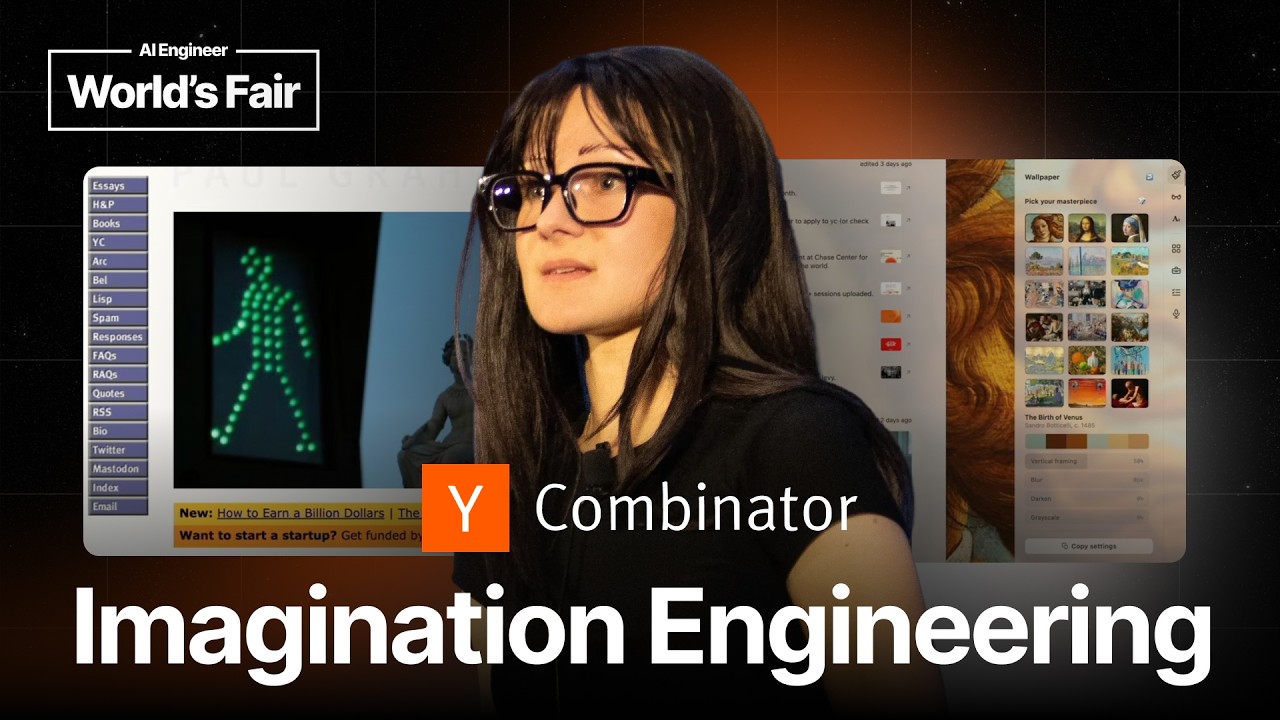
Eve Bouffard introduces the concept of Imagination Engineering, positing that with the exponential capabilities of advanced AI models like Fable, the primary human challenge shifts from technical execution to conceiving novel, ambitious ideas. She asserts that humans are entering a historical period akin to the Library of Alexandria, where the imperative is to consolidate existing knowledge and generate new insights for humanity.
Thinking in Public: The “Eve Thoughts” Experiment
Inspired by Paul Graham’s prolific public thinking and a colleague’s “Lewis Thoughts” Slack channel, Bouffard embarked on a “Thinking in Public” experiment. She created an “Eve Thoughts” channel in the YC Slack, brain-dumping her stream of consciousness for a week. Subsequently, she leveraged an AI model (Opus 4.8) to aggregate these raw thoughts and generate a personal, interactive website, efar.com, showcasing a “wonder and awe” for current technology. This website dynamically assimilated her interests, such as art, admired quotes, projects, media, and even books (including French titles), and integrated a custom design system, a voice on MD file distilled from her online writings, and a design language for the site.
Software on Demand: AI as a Custom Tool Creator
Bouffard demonstrates AI’s capability to build bespoke tools and enhance workflows on the fly:
- Dynamic Website Customization: The efar.com site picked up on her affinity for design tools like Paper and its ‘sheeters’, allowing her to apply cloud-compatible shaders to the background, customize fonts, typefaces, and width, and even translate content into various languages. The AI also generated a detailed
toolkitchecklist for website completion and an automatically updating design system. - “Shape of Minds” Project: Built in a single morning using Opus 4.8, this interactive visualization tool maps commonalities and unique characteristics across different dimensions (thinking, obsessions, quirks, origins, routine, output, worldview, habits, knowledge) of historical geniuses. Designed in celebration of the Fable 5 campaign (with butterflies extracted as design components), it highlights interesting patterns, such as the prevalence of naps among great minds and many being childless. A dedicated glossary in Markdown (
MD) was created for agents to easily parse the information. - Personalized Emoji Picker: To enhance daily productivity and communication, Bouffard created a custom emoji picker for Slack, offering a more efficient way to find and copy specific emojis compared to standard interfaces.
AI: A “Rocket Ship for the Mind”
Bouffard powerfully articulates that current AI tools serve as a “rocket ship for the mind,” enabling unprecedented learning speeds. Quoting the sentiment that “computers are the bicycle of their minds,” she emphasizes that “with Fable and these insanely capable models it’s like a rocket ship for the minds; it’s no longer a bicycle.” She advocates for asking AI agents to generate summarized reports on complex topics (e.g., “10 principles of good design,” “Renaissance patronage”) to rapidly deepen understanding. This capability, combined with emerging technologies like cloud workspaces, suggests a future where users can “spin off a bunch of agents on the go” to process information and build tools efficiently.
Bouffard concludes by stating that “whatever stream of consciousness you have, you should just ask an agent to do it for you.” She also showcased an automatically generated backlog of website changes, demonstrating how AI can track and evolve project development. She encourages the audience to experiment with models, reinforcing the call to “live in the future and then build what’s missing.”