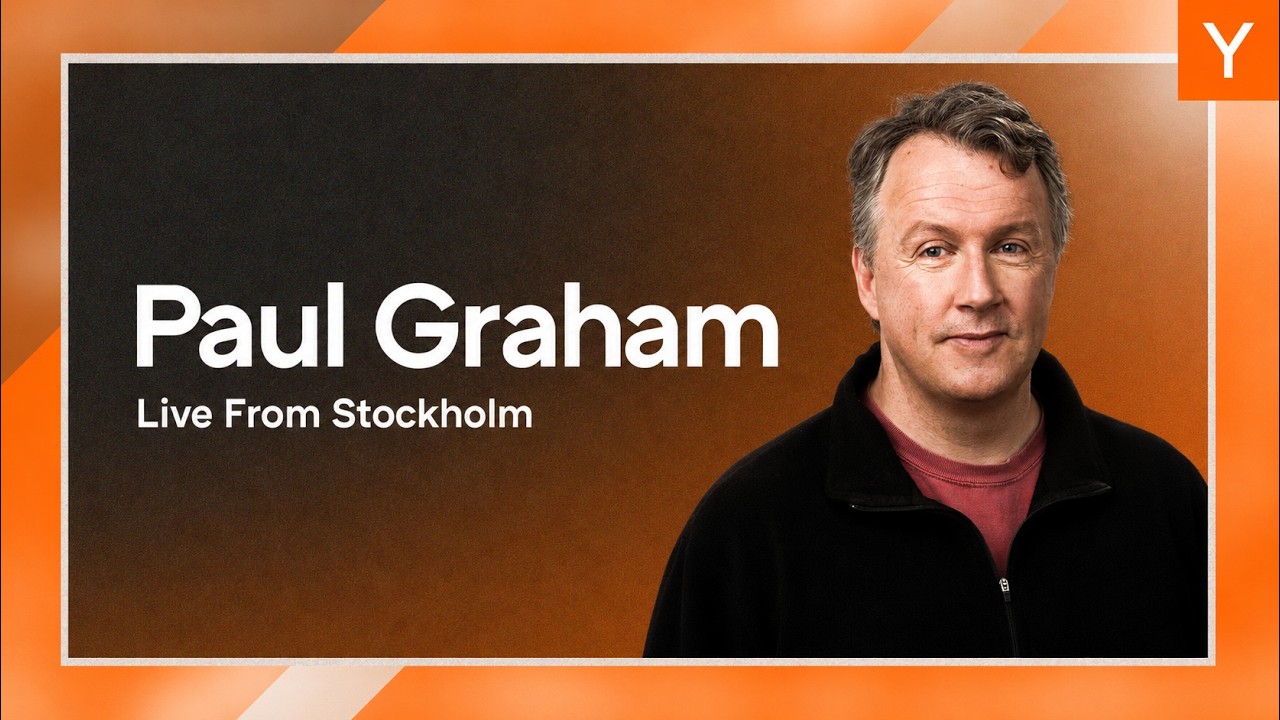
Paul Graham, Founder of Y Combinator, Live from Stockholm
Paul Graham discusses the strategic importance for startup founders to immerse themselves in Silicon Valley's unique ecosystem and how this temporary migration is the key to fostering a thriving startup hub in Stockholm, potentially making it the "Silicon Valley of Europe".
For ambitious individuals in any field, there is almost always a global center of excellence—Paris for painting in 1870, Hollywood for movies in 1950. For startups, that center is Silicon Valley. The advice for any serious founder is unequivocal: you should go. Even a temporary stay is invaluable. This logic transcends borders; just as one would move from a small village to a capital city to find a community, a founder must go to the global capital of their industry.
The Case for Silicon Valley
Moving to a major hub like Silicon Valley provides several distinct advantages, shifting not only what is available for you but, more importantly, what happens to you.
The Power of Concentration
The primary benefit is access to the best peers. The talent pool is not only larger but also of a higher caliber. This concentration of talent is intoxicating and creates an environment ripe for innovation.
A practical and profound benefit of this density is the increase in serendipitous meetings. It’s a recurring theme in the biographies of great people: a chance encounter that changes everything. These unplanned meetings may be more valuable than planned ones for several reasons:
- Volume: There are simply more opportunities for unplanned interactions.
- Openness: Planned meetings can be conservative, filtering out outlier ideas. Serendipity allows for more radical connections.
- Selection: Unplanned conversations have a natural filter; you can quickly gauge mutual interest and decide whether to continue, leading to more potent collaborations.
Accelerated Progress
Things move faster in the Valley. The people are more confident and decisive, and they create a culture of mutual encouragement and competition. This environment pushes founders to act on their ideas rather than letting them languish.
A special case of this acceleration is seen in fundraising. Investors in Silicon Valley decide much faster than their European counterparts, driven by intense competition. An investor who identifies a promising startup cannot afford to wait, because the better the startup, the more likely another investor will act first.
Gaining Respect and Perspective
Moving to the center, even briefly, changes perceptions. Investors outside Silicon Valley often implicitly view local startups as second-rate. By going to the Valley, you reverse this bias and instantly rise in their estimation.
The story of Dropbox illustrates this perfectly. A Boston-based VC firm offered advice but no money for a year. When Dropbox went to Silicon Valley and attracted interest from Sequoia, the Boston firm’s opinion changed so drastically that they faxed a term sheet with a blank valuation, desperate to invest. It was too late.
The most significant advantage, however, is the internal shift. By measuring yourself against the “big fish” like Brian Chesky or Sam Altman, you gain a new perspective.
“He’s not a different species from me. I could do what he did if I worked that hard.”
This realization transforms an impossible goal into a difficult but achievable one. It sets a new, higher standard for what you must do to succeed.
The Pay-It-Forward Culture
Silicon Valley operates on a unique “pay-it-forward” culture that is distinct from ordinary politeness. People are surprisingly helpful, often ending conversations with, “What can I do to help you?”
This custom evolved because, in a place where people can go from “nobody to billionaire” so quickly, being helpful to everyone can lead to powerful friendships and alliances. Today, it’s an ingrained behavior. This creates a positive-sum environment where the total amount of help and favors continuously grows, benefiting the entire ecosystem.
How Stockholm Can Thrive as a Startup Hub
The strategy for making Stockholm a thriving startup hub is directly linked to the advice for individual founders: go to Silicon Valley for a period, and then come back.
This approach strengthens the local ecosystem in three key ways:
- Better Startups: Founders return with invaluable experience, raising the average quality of startups in Stockholm.
- Imported Capital: They often bring investment from Silicon Valley VCs with them.
- Imported Culture: They bring back the Silicon Valley culture, which is optimized for startups. This culture, with its high-trust and ambitious nature, is highly compatible with Swedish culture.
Y Combinator is presented as the optimal path for this temporary immersion. YC is designed to be a concentrated version of Silicon Valley, packing the density of founders, the culture of helpfulness, and the speed of investment into a four-to-six-month program.
The Path to Becoming Europe’s Silicon Valley
While data shows that YC startups that return home are about half as likely to become unicorns, this shouldn’t be discouraging. The data is affected by selection bias, valuation differences, and the fact that half of a billion-dollar outcome is still a monumental success. Furthermore, personal priorities, such as where you want to raise a family, eventually outweigh purely financial metrics.
The title of “Silicon Valley of Europe” is still available. The key ingredients are not size or central location—Mountain View was a backwater when it became the epicenter of the semiconductor industry. All that is needed is a place where founders want to live and a critical mass of those founders. Stockholm already has the first ingredient; the second may be closer than anyone thinks.