2026 State of AI Engineering — Barr Yaron, Amplify Partners
Barr Yaron's 2026 AI engineering survey reveals key trends: audio and image generation are rapidly gaining traction, while cost is now a primary engineering constraint. Agents are evolving to take actions within systems, but control mechanisms remain primitive. Evaluation (eval) is still the top infrastructure challenge. AI positively impacts job satisfaction and experimentation but also raises concerns about technical skill erosion and non-developers shipping code, fundamentally changing engineering culture. Predictions include a likely AGI declaration within five years and a shift away from Transformers as state-of-the-art.
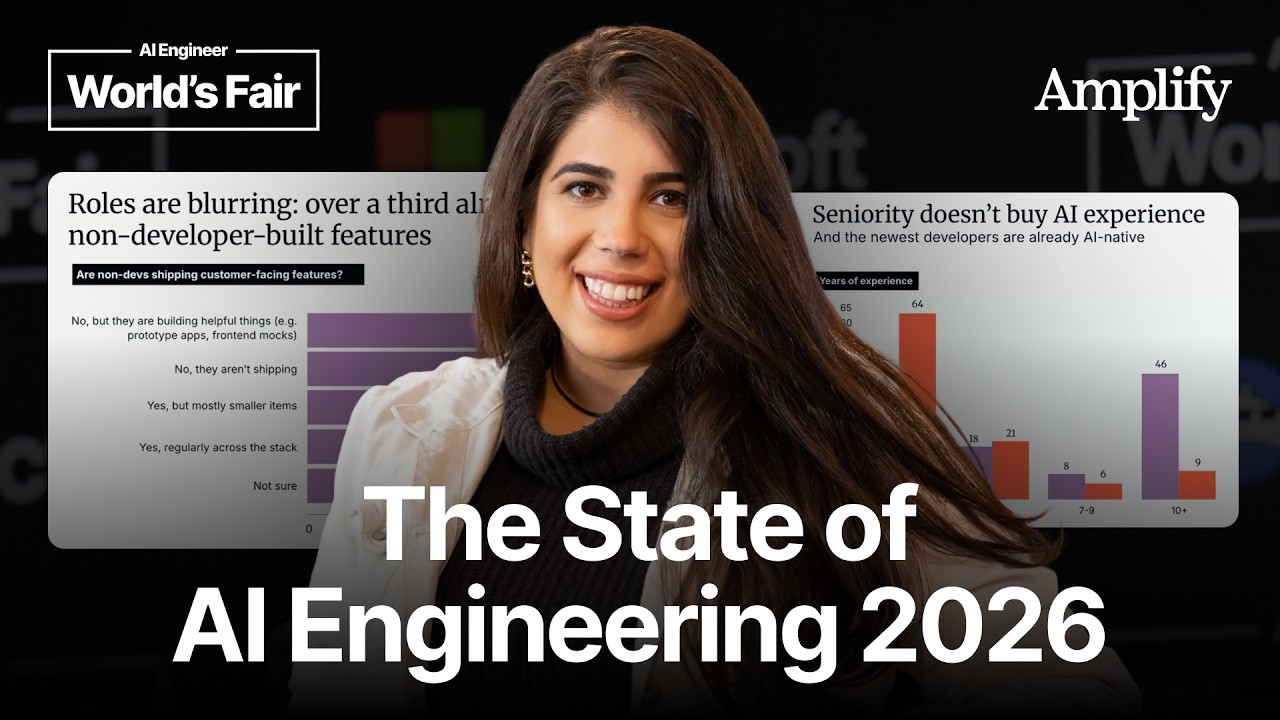
Barr Yaron’s annual AI engineering survey for 2026 reveals significant shifts in the AI landscape, driven by evolving workforce dynamics, modality adoption, model strategies, and the burgeoning agentic workflows.
The AI Engineering Workforce
AI engineering is increasingly seen as a discipline rather than a job title, encompassing various roles from founders to product people. The survey, with 1,048 respondents, highlights a trend where senior engineers are new to AI, with over half of those with 10+ years of software experience having 3 years or less in AI. Conversely, the median new engineer has nearly as much AI experience as the median 10-year software veteran, indicating a new generation that has never known software without AI.
Modality Adoption Trends
While text modalities continue to dominate in active building, there’s a strong and accelerating interest in others:
- Audio shows the highest “intent to adopt” for the second consecutive year, with 56% of non-users planning to adopt it (up from 37% last year).
- Image generation has seen the most significant jump in active use, doubling from 18% to 36% of respondents. This surge is attributed to improved models like Nano Banana and Chat GPT images 2.0, making it a practical tool for real work rather than just generating “cursed hands.”
Model Strategy and Selection
The discussion around open-weight versus closed models is prevalent, but survey data shows a more nuanced reality:
- 94% of teams use closed models, while 45% use open-weight models. Crucially, over 90% of those using open-weight models also use closed models, suggesting open-weight models primarily augment rather than replace closed alternatives.
- Model choice is not primarily driven by open vs. closed status (a top-three consideration for only 5% of respondents). Instead, the top considerations are quality, agentic capabilities (like tool calling), and cost. Reliability, while important, is often a threshold requirement rather than a primary differentiator.
- Organizations are moving towards standardization of AI platforms and tools, but not necessarily models. Most teams use multiple models (87%), often routing by task type or comparing outputs. However, over half of respondents report their organizations are standardizing on fewer AI tools.
Cost as a First-Class Engineering Constraint
“Cost is now a first-class engineering constraint,” directly impacting AI usage. Approximately 75% of respondents adjust their AI usage based on cost, with 40% regularly and 36% sometimes doing so. This is a significant shift from 12 months prior. Consequently, cost and token usage are now monitored like an SLA (Service Level Agreement) in production, second only to quality.
The Rise of Agentic Workflows
Agents are rapidly evolving beyond simple tasks:
- Agent adoption has roughly doubled, with 95% of respondents reporting agent usage.
- The most significant shift is in agent permissions: 89% of teams using agents now grant them write access, a substantial increase from 52% last year. This means “Agents are no longer reading, summarizing, drafting—they’re taking actions inside of systems.”
- Control mechanisms are still primitive, relying heavily on human-in-the-loop approvals and gating permissions. Common agent failure points include hallucination and losing context mid-task, frustrating two-thirds of users.
Infrastructure Challenges and Build vs. Buy
“Eval” (evaluation of AI outputs) remains the biggest challenge in the stack for yet another year. While it leads, the margin is thin, indicating diverse infrastructure problems across the industry.
- Build vs. Buy: Inference and model serving is the layer most frequently bought by teams. In contrast, prompt management is largely built in-house (61%), alongside other product-logic components like RAG and custom eval. Fine-tuning is largely “not yet” adopted, with existing users locked into their current build/buy choice.
Impact on Engineering Culture and Teams
AI is profoundly affecting engineering teams:
- Overwhelmingly positive impact (97%): The primary benefit is not just speed, but “cheaper failure, more experimentation, more prototypes, more bets,” making trying new things nearly free.
- Negative downstream effects (90%): The increased experimentation comes with a higher review burden and concerns about the erosion of deep technical skills and understanding of the codebase due to cheap code generation.
- Blurring of roles: 81% report AI blurring the lines between engineers, product, design, and marketing. Crucially, “shipping software is not gated on being an engineer anymore.” Over a third of teams have non-developers shipping features, including 17% regularly shipping customer-facing features, challenging traditional software development paradigms.
Future Bets and Predictions
Respondents offered several predictions:
- Job Satisfaction & Liabilities: 76% report increased job satisfaction due to AI, but 59% fear today’s AI code creates long-term liabilities.
- Software Engineering’s Future: Only one-third consider software engineering a “solved problem.”
- AGI Declaration: 67% expect a leading lab to declare AGI within the next five years (focusing on the announcement, not necessarily the achievement).
- Transformers’ Dominance: Only 9% believe Transformers will still be state-of-the-art in 5 years.
- Compute Location: The most divisive question: 36% expect more AI compute in space, 38% do not, highlighting uncertainty about future infrastructure deployment. Overall, it’s an exciting time to be an AI engineer, with ongoing rapid evolution.
The full report is available for further details.