Model deployment

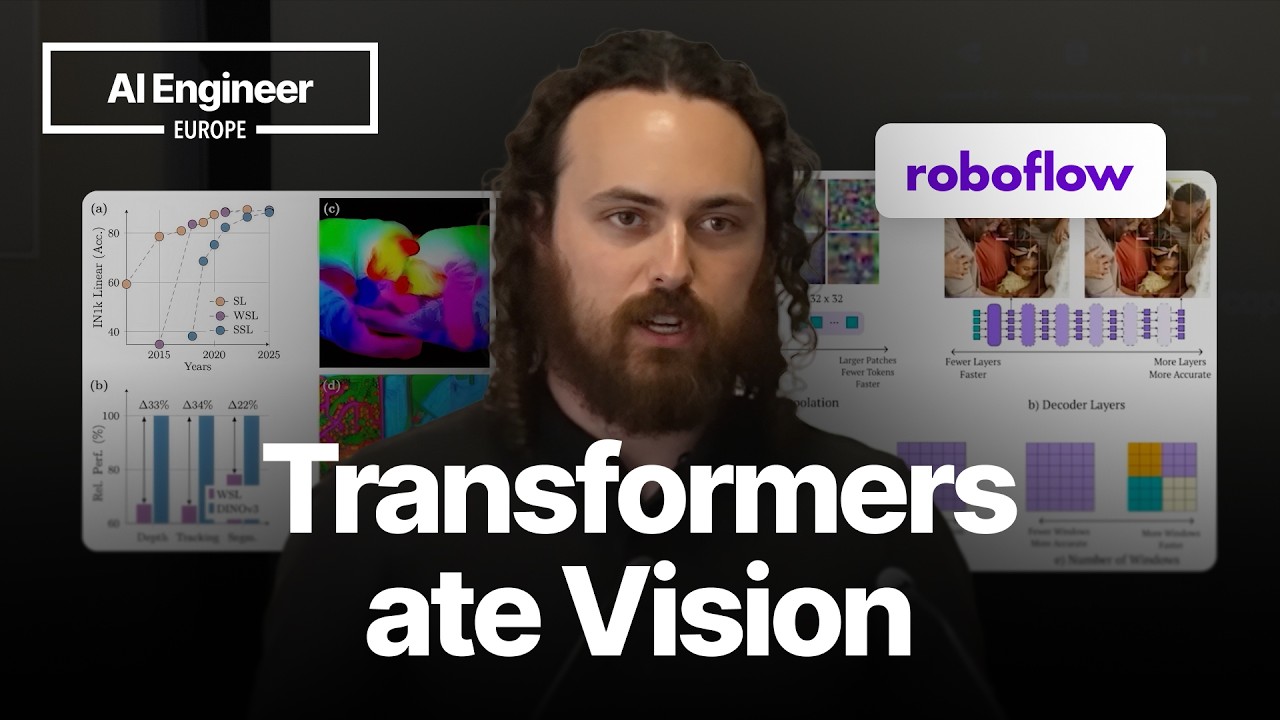
How Transformers Finally Ate Vision – Isaac Robinson, Roboflow

How Transformers Finally Ate Vision – Isaac Robinson, Roboflow

Isaac Robinson from Roboflow explains why Vision Transformers (ViTs), despite their initial disadvantages in computational complexity and lack of inductive bias, ultimately surpassed Convolutional Neural Networks (CNNs) for computer vision tasks. The talk covers the critical roles of massive, ViT-specific pre-training methods like MAE and DINO, the architectural evolution through models like Swin, ConvNeXt, and Hiera, and optimizations borrowed from the LLM ecosystem. It culminates in a discussion on the practical deployment challenges of large foundation models like SAM and how Neural Architecture Search can bridge the gap.

Compilers in the Age of LLMs — Yusuf Olokoba, Muna

Compilers in the Age of LLMs — Yusuf Olokoba, Muna

Yusuf Olokoba, founder of Muna, details a compiler-based approach to transform Python AI functions into self-contained native binaries. This talk explores the technical pipeline, including custom AST-based tracing, type propagation, and the strategic use of LLMs for code generation, enabling a universal, OpenAI-style client for running any model on any platform.

The CEO Behind the Fastest-Growing AI Inference Company | Tuhin Srivastava

The CEO Behind the Fastest-Growing AI Inference Company | Tuhin Srivastava

Tuhin Srivastava, CEO of Baseten, joins Gradient Dissent to discuss the core challenges of AI inference, from infrastructure and runtime bottlenecks to the practical differences between vLLM, TensorRT-LLM, and SGLang. He shares how Baseten navigated years of searching for a market before the explosion of large-scale models, emphasizing a company-building philosophy focused on avoiding premature scaling and "burning the boats" to chase the biggest opportunities.