Posts

Imagination Engineering — Eve Bouffard, Head of Design, Y Combinator

Imagination Engineering — Eve Bouffard, Head of Design, Y Combinator

Eve Bouffard of Y Combinator introduces "Imagination Engineering," arguing that powerful AI shifts the human challenge from execution to ideation. She showcases personal experiments like an AI-generated website from her public thoughts, a tool visualizing historical geniuses, and custom productivity aids. Bouffard highlights AI's role as a "rocket ship for the mind," enabling rapid learning and software creation on demand.
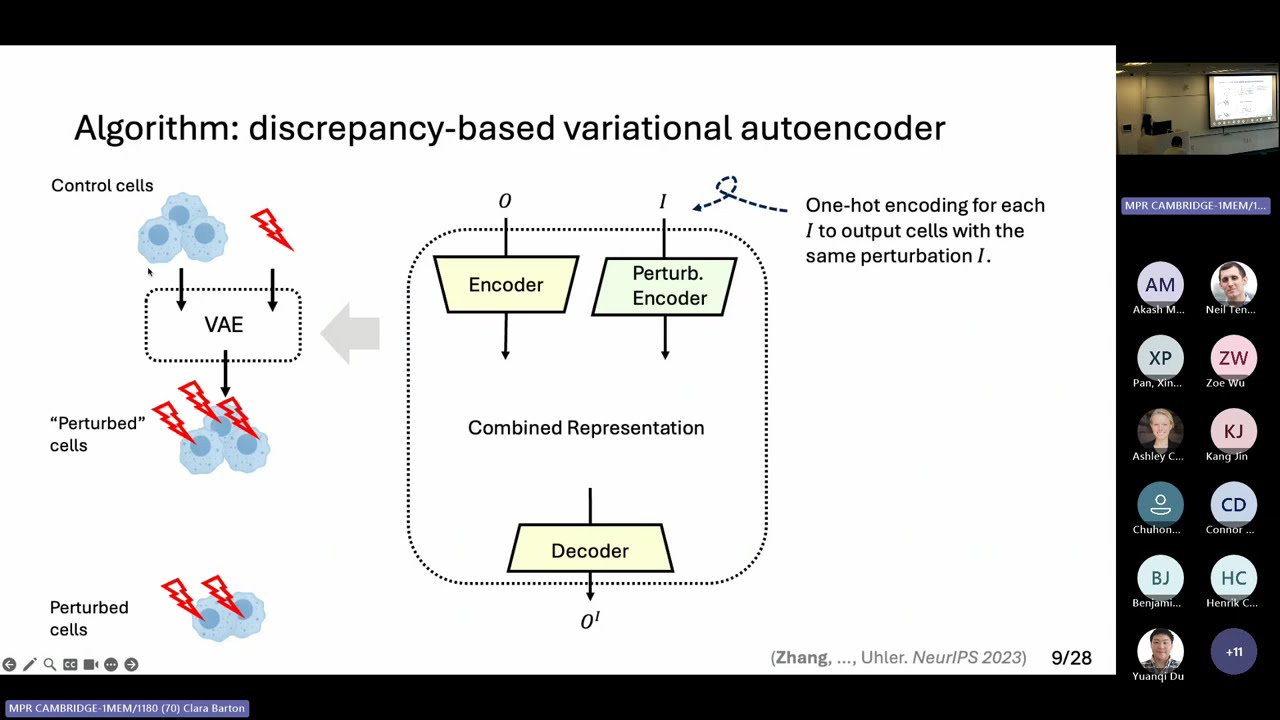
Learning Genetic Perturbation Effects at Single-Cell Resolution for Virtual Cells

Learning Genetic Perturbation Effects at Single-Cell Resolution for Virtual Cells

Jiaqi Zhang's talk focuses on advancing causal discovery and perturbational modeling for gene networks, crucial for therapeutic insights. She introduces theoretical guarantees for learning latent causal variables and presents MORPH, a VAE-based framework that predicts the effects of novel and combinatorial gene perturbations by integrating diverse prior biological knowledge and using distributional loss for training. The model has demonstrated success in guiding experimental design, including identifying novel T-cell regulators for cancer immunotherapy, highlighting its potential to accelerate biological discovery and drug development.

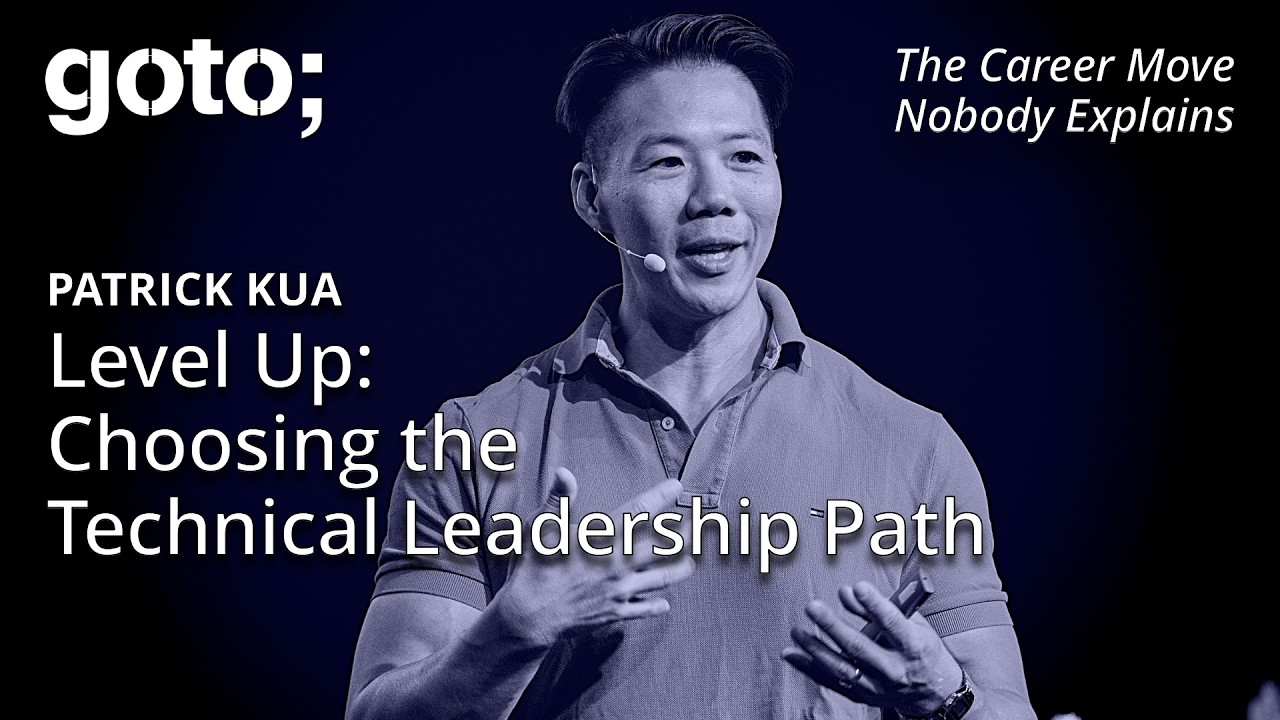
Level Up: Choosing The Technical Leadership Path • Patrick Kua • GOTO 2025

Level Up: Choosing The Technical Leadership Path • Patrick Kua • GOTO 2025

Patrick Kua explores the essence of technical leadership, emphasizing its critical role in overcoming organizational misalignment and accidental complexity, drawing from real-world examples. He introduces a "Trident Model" for career growth, differentiating technical leadership from individual contribution and management. The talk highlights compelling reasons for engineers to embrace leadership, such as shaping team environments, influencing product direction, and solving complex "people-system" problems. Finally, Kua provides a practical five-step recipe for aspiring leaders to start demonstrating impact through ownership, sponsorship, and delivering tangible value.

Has AI Finally Cracked Time Series Forecasting?

Has AI Finally Cracked Time Series Forecasting?

Ameet Talwalkar, CMU professor and Datadog's Chief Scientist, traces the journey of time series foundation models from early skepticism to their current impact. He details Datadog's Toto V1 and V2, highlighting breakthroughs in zero-shot performance, scaling, and the crucial role of data mix. The discussion extends to the vision of 'world models' for observability, integrating diverse data for self-healing software systems, and concludes with insights on open-weights models and AI's transformative effect on computer science and academic research.

Computer-Use 2.0: Agents Just Got Multi-Cursor — Francesco Bonacci, Cua

Computer-Use 2.0: Agents Just Got Multi-Cursor — Francesco Bonacci, Cua

This talk introduces cua driver, an open-source tool enabling AI agents to interact with computer GUIs in the background across macOS, Windows, and Linux by leveraging accessibility APIs. It details CUABench, a robust evaluation framework with over 130 verifiable tasks designed to benchmark and ensure the trustworthiness of computer-using agents, revealing current limitations in complex tasks like circuit design. Finally, it presents cua fleet, an infrastructure solution that optimizes GPU utilization and reduces costs for RL training of these agents by dynamically managing sandbox environments.

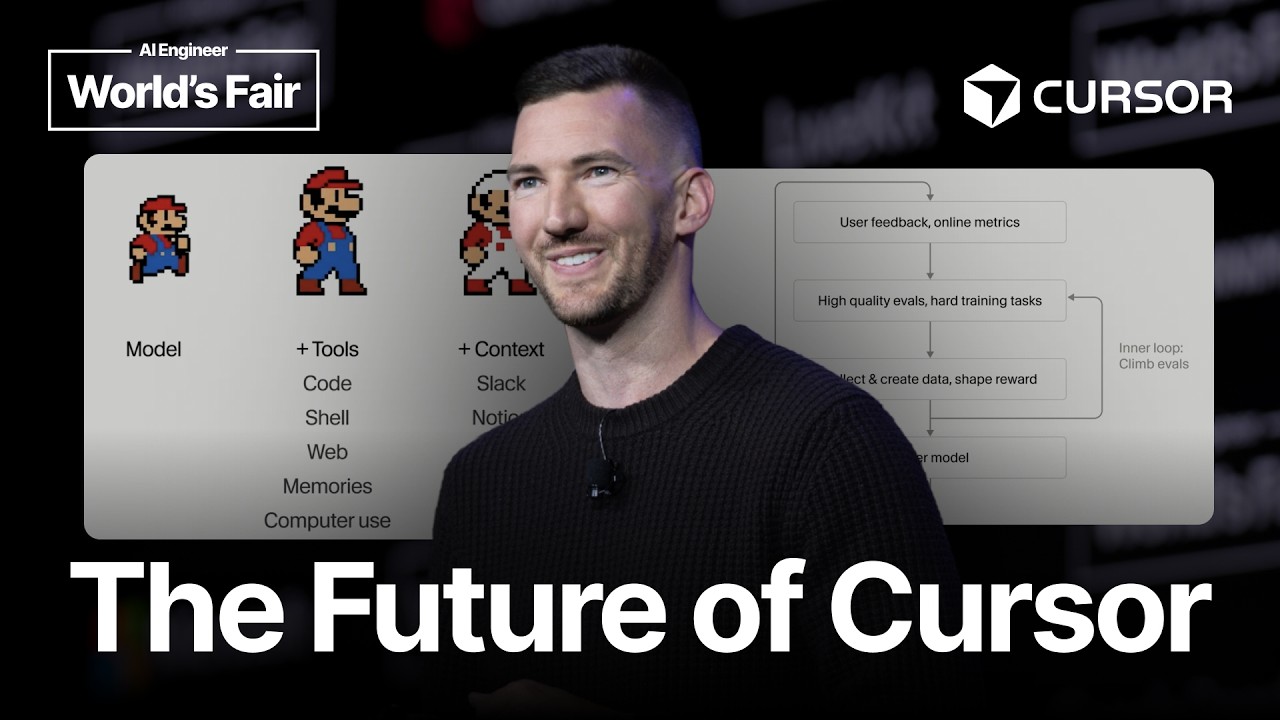
Recursive Model Improvement — Lee Robinson, Cursor, SpaceXAI

Recursive Model Improvement — Lee Robinson, Cursor, SpaceXAI

Lee Robinson of Cursor outlines a comprehensive strategy for recursive AI model improvement, centered on a two-loop training framework. He details how Cursor enhances both user-feedback-driven outer loops and high-quality evaluation inner loops, introducing novel methods like textual feedback and addressing reward hacking. The discussion extends to scaling compute infrastructure through partnerships with SpaceX, Colossus, and Terafab, and leveraging agent-based automation to streamline research and foster a future where models continuously train and improve themselves.