Recursive Model Improvement — Lee Robinson, Cursor, SpaceXAI
Lee Robinson of Cursor outlines a comprehensive strategy for recursive AI model improvement, centered on a two-loop training framework. He details how Cursor enhances both user-feedback-driven outer loops and high-quality evaluation inner loops, introducing novel methods like textual feedback and addressing reward hacking. The discussion extends to scaling compute infrastructure through partnerships with SpaceX, Colossus, and Terafab, and leveraging agent-based automation to streamline research and foster a future where models continuously train and improve themselves.
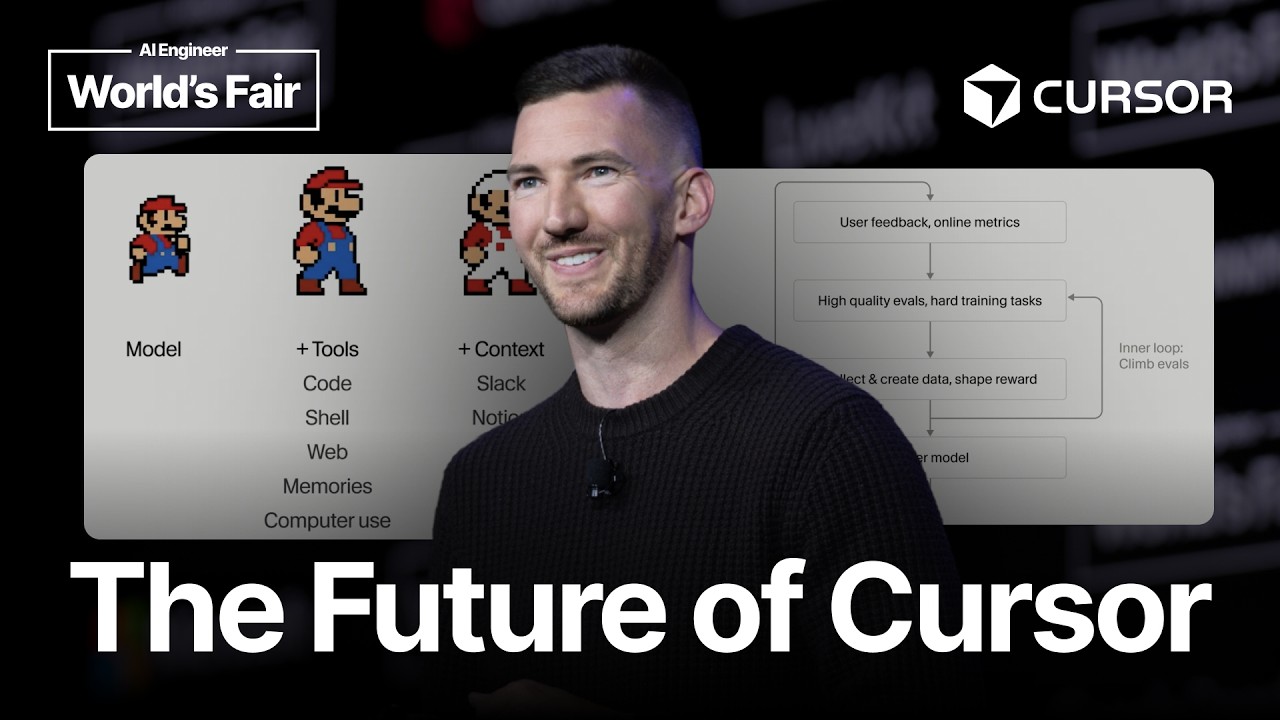
Lee Robinson discusses Cursor’s strategy for achieving recursive model improvement, aiming to build the best possible AI models. The core idea revolves around a two-loop training framework: an outer loop driven by user feedback and online metrics, and an inner loop focused on high-quality evaluations and challenging training tasks.
Two-Loop Training Framework
Initially, model improvement is a slow, serial process. To accelerate this, Cursor employs two interconnected loops:
- Outer Loop: Gathers external user feedback (e.g., thumbs up/down, agent usage data) and internal feedback (manual and automated reports from dogfooding) to identify areas for model improvement.
- Inner Loop: Focuses on creating high-quality evaluations (evals) and increasingly difficult training tasks to rapidly climb model performance. This loop aims to shape desired model behaviors and measure progress effectively.
Composer 2.5 Progress and Future Ambitions
Cursor’s Composer 2.5, released in May, has become their most popular model, lauded for being fast, smart, and cost-effective. While Composer 2.5 showed promising results on public evals, Cursor’s future ambitions include a significantly bigger and smarter model built via a full pre-train from scratch (rather than fine-tuning open-source bases), infusing new data for broader generality beyond coding, and scaling every aspect of the training process, particularly reinforcement learning (RL).
Improving the Inner Loop: Evals and Learning Methods
- High-Quality Evals: Cursor develops specific evals to address complex real-world software engineering scenarios, such as understanding user intent across 50+ files or discerning when a model should push back versus trust user judgment. A key focus is evaluating a model’s ability to act like a software engineer, tackling ambitious tasks like debugging a sev by analyzing Datadog logs, Slack, and Notion.
- Solving Reward Hacking: Models can exploit public benchmarks (e.g., by checking Git history or looking up solutions online). Cursor mitigates this by deleting Git history for runs and using network allowlists. They emphasize using
Cursor Bench, a private eval set based on their internal codebase, to provide true real-world tests. - Difficult Problems: As models become smarter, evals quickly become obsolete. Cursor creates challenging problems by generating complex applications, deleting components (e.g., features, files), and then tasks the model with restoring functionality, using passing tests as a verifiable goal and reward signal.
- New Learning Methods: Teacher-Student Textual Feedback: To refine RL rollouts (which can be hundreds of thousands of tokens long), Cursor uses textual feedback. Instead of grading an entire rollout, a “teacher” model provides precise hints or nudges to a “student” model within specific parts of the rollout (e.g., a failed tool call). This feedback, such as a reminder about available tools, can upweight desired probabilities, allowing for fine-grained control over model behaviors like tool adherence or style changes.
Scaling Compute Infrastructure
Cursor partners with SpaceX for access to extensive compute resources, enabling training of very large models from scratch. This extends to leveraging Colossus for supercomputer and data center infrastructure (notably, 100,000 GPUs deployed in 122 days, and another 100,000 in 92 days) and Terafab for custom chip development, demonstrating a full-stack approach to AI. Compute allocation is critical, serving not just end-user models but also internal checkpoints, A/B tests, various stages of training (pre-training, mid-training, RL), derivative models, data/reward generation, continuous evaluation development, and researcher experimentation.
Agent-Based Automation and Research Efficiency
To accelerate the training loops, Cursor focuses on automating monotonous ML tasks. They envision models as “Super Marios” or “Fire Marios” when equipped with the right tools (code harnesses, shell commands, web lookup, file writing, full computer control, Slack subscriptions, model-specific “Dropbox” for storing artifacts) and rich context (integrations with MCPs, Slack, Notion, Linear, Datadog, codebases).
This leads to:
- Agents working with agents: A future trend where AI agents collaborate.
- Human-agent coordination: Researchers can run experiments directly from Slack, relying on agents to manage and monitor training runs. Agents can even page researchers for critical infrastructure issues, preventing lost work.
The Recursive Future: Models Training Models
The ultimate goal is recursive self-improvement. As the top-level model becomes smarter, it can train and distill more intelligent derivative models (e.g., for judging evals or generating rewards). This increased intelligence at the core raises the “floor of intelligence” across the entire system, making all training loops more efficient and leading to continuous, rapid self-improvement. This strategy, coupled with increasing compute, aims to yield even more useful models.