Agent systems

Reinforcement Learning without Verifiable Rewards — Will Brown, Prime Intellect

Reinforcement Learning without Verifiable Rewards — Will Brown, Prime Intellect

Will Brown's talk addresses the critical challenge of applying Reinforcement Learning to real-world tasks where verifiable rewards are absent. He outlines how Primordial AI tackles this by leveraging environments as the core anchor for building reward signals. Key strategies include using LLMs as "judges," grounding tasks in production traces or document corpora, and employing "reverse direction" techniques to generate training data. Brown also details methods for calibrating task difficulty, identifying reward hacking, and fostering continual learning by treating model optimization as a science, emphasizing the use of compute to refine environmental signals and abstract human expertise.
Jeff Dean: The 1% Rule for Building in AI

Jeff Dean: The 1% Rule for Building in AI

Jeff Dean discusses the evolution of AI, drawing parallels between Google's past breakthroughs (like fitting search in RAM and the origin of TPUs) and current challenges. He emphasizes that AI is becoming an energy problem, driving the need for specialized inference hardware. Dean highlights 'context engineering' and multi-agent systems as crucial for long-running, complex AI tasks, and offers advice for startups on finding niches where they can outperform larger entities by focusing on specific domains, data, and models. He stresses the importance of clear specifications for agents and 'taste' in problem selection, encouraging founders to question fundamental assumptions and automate the scientific method to build 'AI that builds AI.'

Your Agent Didn't Fail. Your Harness Did. — Vinoth Govindarajan, OpenAI

Your Agent Didn't Fail. Your Harness Did. — Vinoth Govindarajan, OpenAI

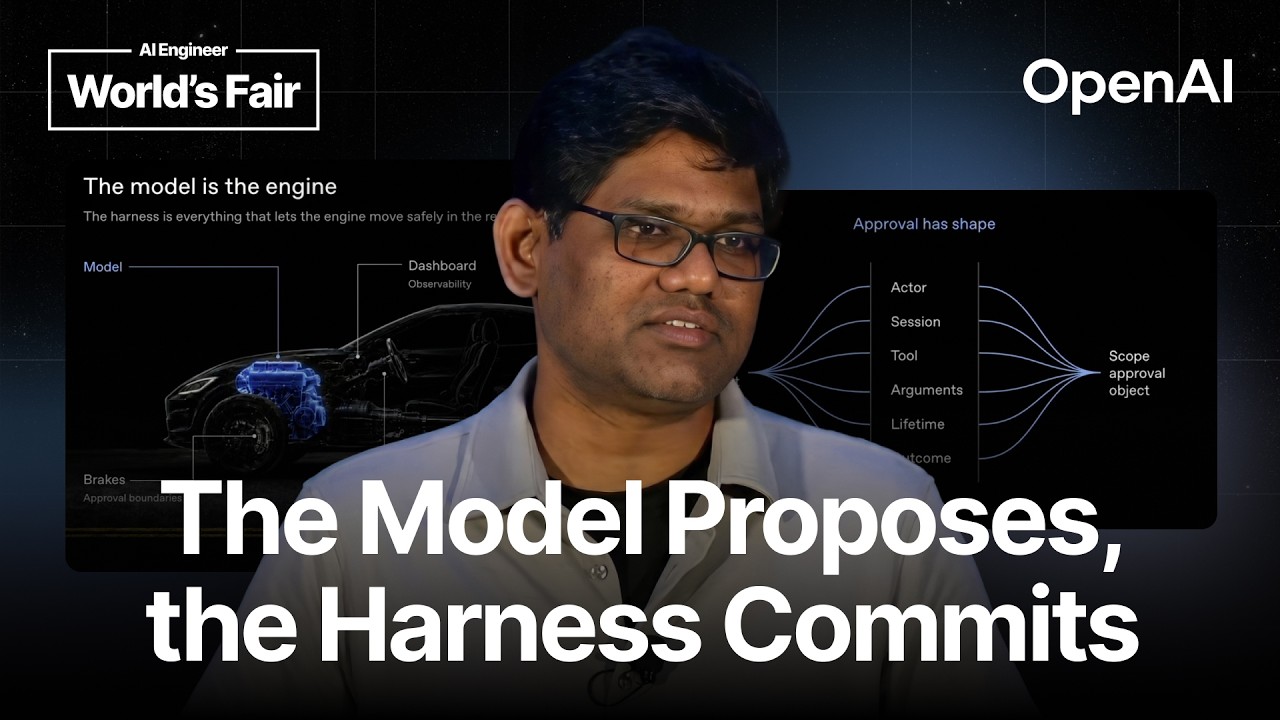
Vinoth Govindarajan's talk addresses critical 'harness failures' in AI agents, arguing these, rather than model errors, are the root cause of most production incidents. He introduces the core contract: 'A model proposes, the harness commits, and a receipt proves it,' and outlines five key boundaries (state ownership, ordering, deadlines, authority, user-visible proof) that lead to failures like silent success and incomplete reality. The talk culminates in a practical 'run receipt audit' with five questions to diagnose and ensure reliable agent behavior.

Agents Need Feature Flags - Sachin Gupta

Agents Need Feature Flags - Sachin Gupta

AI teams are deploying advanced agent systems without the fundamental safety mechanisms (feature flags, canaries, kill switches) that web teams adopted over a decade ago. This oversight leads to critical incidents like data deletion and financial loss. This talk introduces six agent-specific feature flag types—for prompts, tools, models, memory, autonomy, and sub-agents—and outlines a practical playbook for secure AI deployment, emphasizing the critical role of a pre-wired kill switch to manage the high blast radius of AI agents.

Recursive Model Improvement — Lee Robinson, Cursor, SpaceXAI

Recursive Model Improvement — Lee Robinson, Cursor, SpaceXAI

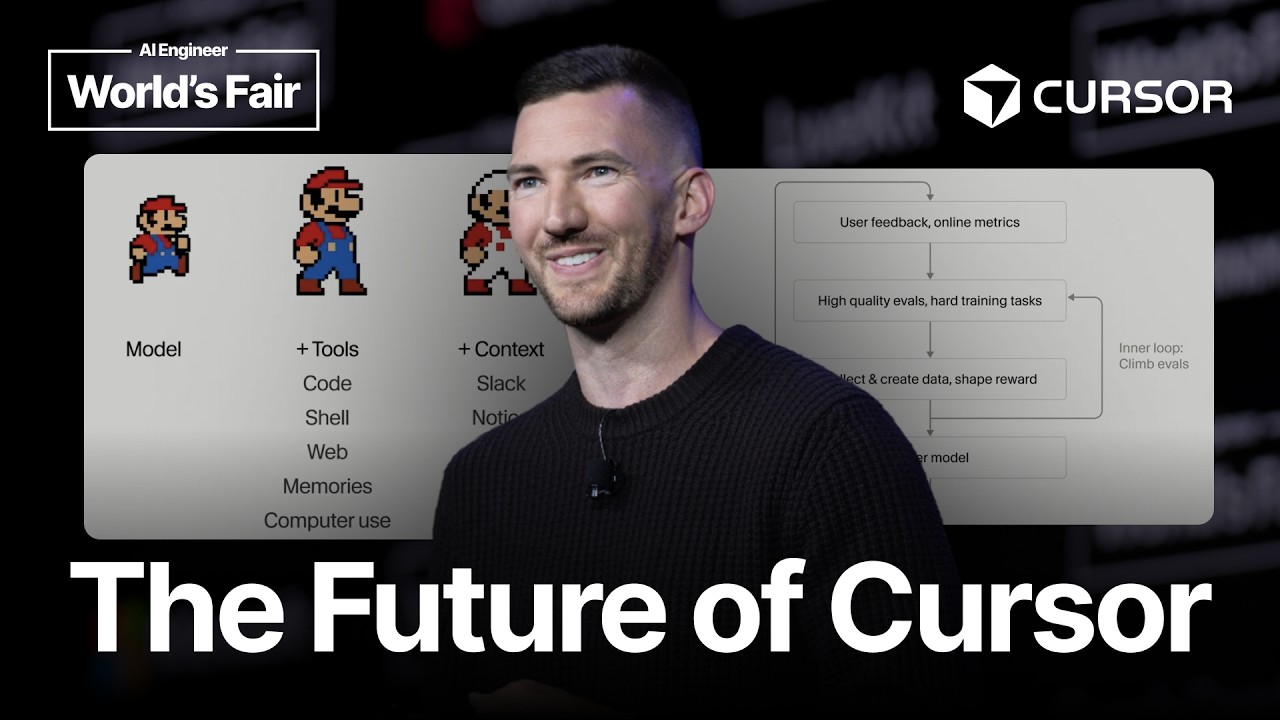
Lee Robinson of Cursor outlines a comprehensive strategy for recursive AI model improvement, centered on a two-loop training framework. He details how Cursor enhances both user-feedback-driven outer loops and high-quality evaluation inner loops, introducing novel methods like textual feedback and addressing reward hacking. The discussion extends to scaling compute infrastructure through partnerships with SpaceX, Colossus, and Terafab, and leveraging agent-based automation to streamline research and foster a future where models continuously train and improve themselves.

The Golden Age of AI Engineering — Alexander Embiricos & Romain Huet & Peter Steinberger, OpenAI

The Golden Age of AI Engineering — Alexander Embiricos & Romain Huet & Peter Steinberger, OpenAI

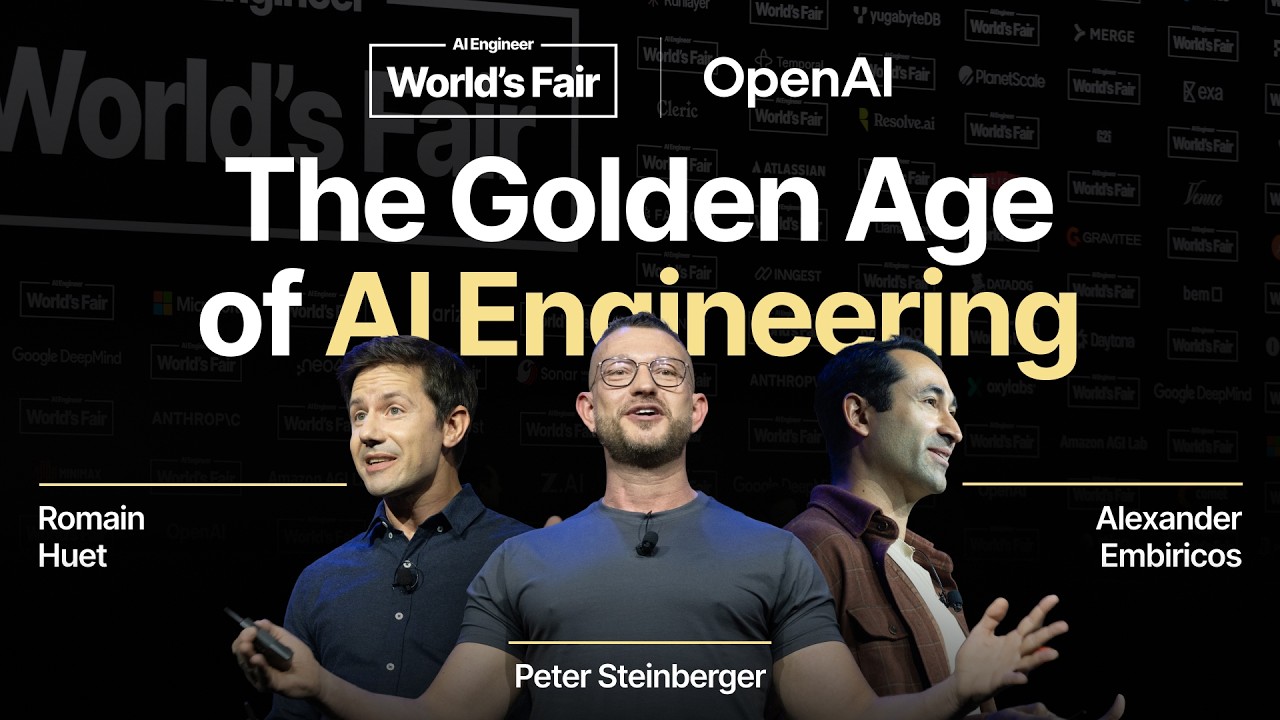
OpenAI's Romain Huet and Alexander Embiricos, joined by Peter Steinberger, outline the explosive progress of Codex at Dev Day 2024. They highlight the shift from manual coding to managing autonomous agents, enabled by rapid model iteration (every 6 weeks), open-source developer tools, and optimizations for cost-effectiveness ($1/M input tokens) and blazing inference speed (750 tokens/sec). The discussion centers on empowering AI engineers, not replacing them, by evolving agent capabilities, fostering an open ecosystem, and addressing future challenges like seamless local/cloud task execution and human attention as the new bottleneck in agent orchestration.