Why We Rebuilt Microsoft Office From Scratch for AI Agents - Yijia Liang, Compound AI
Yijia Liang, founder of Compound and former finance analyst, explains why personal agents succeeded and what finance needs beyond them: multiplayer agents with their own inboxes, a headless Office engine rebuilt with agents, and agent swarms that navigate massive data rooms and models while keeping every output grounded in citations.
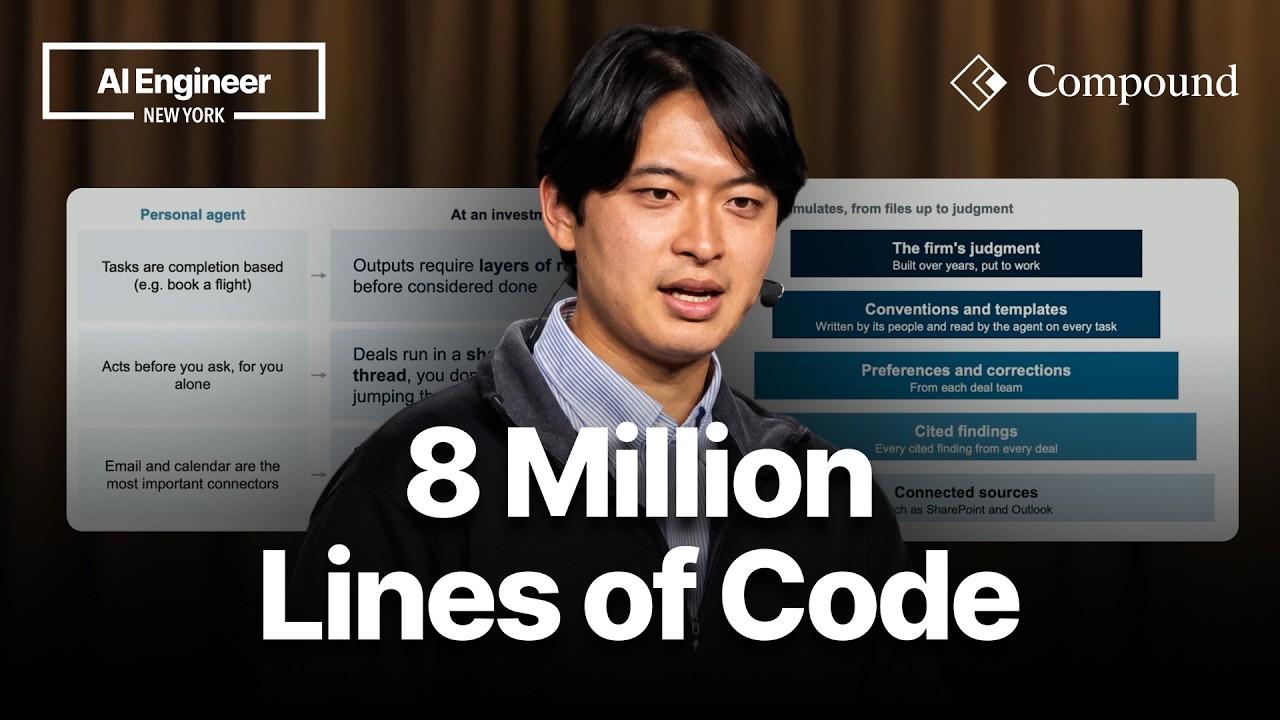
Why personal agents took off and why finance is harder
Personal agents gained traction over the past few months for three reasons: they run reliably in the background, they act proactively without being asked, and they connect to the systems of context that matter, such as email, drive, and calendar. Finance lacks these conditions out of the box. A background task like booking a restaurant maps to something much heavier in buy-side work: turning a data room into a fully prepared set of IC models, slides, and memos. That process normally takes four weeks of iteration and review and can be compressed into a few days. Proactivity is also constrained, since a managing director does not want an agent running around and burning tokens without input. The relevant context is far bigger than an inbox. A single data room can hold 15,000 files, and a firm’s SharePoint or Box can contain petabytes of unstructured data accumulated over decades.
Compound’s approach addresses three problems: multiplayer collaboration, running long tasks in parallel in the background, and managing context at scale.
Multiplayer agents with their own inboxes
Deal work rarely happens in single-player workflows. Most institutions today use ChatGPT or Claude through a plugin or web app, producing outputs that then travel by downloading files, attaching them to emails, uploading them to Teams, and asking for feedback. The goal is to get everyone who matters on a deal onto the same thread, talking to one agent that holds the shared context of the workstream.
Because institutional finance runs through Outlook, with email chains often 20 messages deep, every agent at Compound comes with its own inbox. Designing that is non-trivial. Authentication has to ensure that everyone on a thread has read and write access, and privacy matters because deal work is almost always under NDA. Beyond access, the agent has to feel like a human teammate. If several people email in quick succession, it should not flood the group with acknowledgements, so the design deliberately adds latency.
Rebuilding Office from scratch
Scaling to many parallel tasks exposed the limits of existing options. Desktop plugins for Excel, PowerPoint, and Word were not enough. Neither were computer-use agents running in virtual machines or off-the-shelf engines such as openpyxl and commercial alternatives. As coding agents drove down the cost of software, the team decided to build its own Office engine.
The work was framed as an objective function: recreate Office at full fidelity, use Office itself as the oracle, and run agent loops against real files, both from public corpora and from internally created ones. For Excel, the team started from the open-source IronCalc project and grew it into an 800,000-line Rust implementation, a faster, one-for-one replica of the product. The same method was applied to PowerPoint and Word, with rendering comparisons ensuring pixel-level fidelity. In total the effort consumed 1.5 trillion input and output tokens and produced over 8 million lines of code. The fidelity requirement is strict because these firms only trust what they can download and send, so what appears in Compound should match what appears in Office after download.
Headless engines: speed, richer editing, and self-checking
A headless engine is not bound to a single CPU the way desktop Excel, PowerPoint, or Word are, so tasks can run in parallel far faster. Complex models can be built in much less time, and a 20 MB workbook recalculates roughly four times faster. This matters because analysts expect agent output at human quality, but at much lower cost and much higher throughput.
Owning the editor also enables a richer collaborative experience. The slide deck presented in the talk was built by dropping comments into Compound. The agent produced a first draft, and each formatting comment was applied in turn, with the feedback encoding years of consulting and investing experience about what makes a good slide. Multiple team members can comment in the same document, so a team of five can work through a 100-page deck in an afternoon rather than spend weeks in revision rounds.
Finally, an owned engine makes a full write, render, check, and fix loop possible. Libraries like openpyxl offer no render for verifying formatting, so the model has to guess and rely on partial parsing, such as checking whether a cell has a particular color or font. Microsoft’s own interfaces expose very little to automation. With its own engine, the system can iterate rapidly on formatting and accuracy, which matters for complex models that take hours to build.
Managing context at breadth and depth
Buy-side context has both breadth and depth. For breadth, the approach borrows from coding agents. Rather than indexing everything in a vector database, which is reserved for very specific use cases, agents read files directly through grep or similar tools. A lead agent slices the directory into parts, swarms of agents return findings, and the process iterates until the output meets requirements. Every finding is grounded in citations to its source document, so an analyst can trace each number on screen back to a figure they can trust.
For depth, consider a 30 MB model with around 2 million formulas and several sensitivity tables that can take minutes to recalculate. A general-purpose assistant would write code against openpyxl and print out the entire model for the LLM to read, which is slow and expensive. Because Compound has its own Excel engine, it can lay the workbook out in a structured, easy-to-process format and expose a richer set of APIs and tools for the agent. That improves both accuracy and speed.
The broader aim is to spare people from hunting for files and re-explaining how things should be done. Analysts should spend their time on judgment: whether a deal is actually good, and whether the model and presentation will hold up to a VP’s scrutiny. The context stack runs from connected sources such as SharePoint and Outlook connectors, to citation-grounded findings, to firm-specific preferences and company knowledge, since every firm’s model structure and deal process differ.
From copilot to autopilot
Off-the-shelf tools already handle some finance tasks well, such as spreading comps. Longer tasks, like drafting a 50-page IC presentation or building a model exactly the way a private equity or hedge fund professional wants it, still keep people in a copilot role, hand-holding each step. The comparison drawn is to when Opus 4.5 launched and developers shifted from using code assistants for the next line toward delegating ambitious tasks, trusting the output once there were sufficient checks and tests. The argument is that finance needs similar verification infrastructure before deal teams can drop in a data room, trust the outputs, and multiply the number of deals they evaluate roughly tenfold.
Enterprise agents are coming to finance. The speaker sees the adoption curve at an inflection point, with teams gradually moving from copilots to autopilots.