Financial services

Inside Arca's Long-Horizon Agents That Run the Business - Aman Singh, Arca

Inside Arca's Long-Horizon Agents That Run the Business - Aman Singh, Arca

Arca, an AI-native financial services firm, runs its client business through long-horizon agents that own goals end to end across days of stop-start work. Aman Singh, who leads AI there, explains the signal system, operational context, harness, persistent memory, and shared spaces that let agents pull in people at the right moment, and why steering agents becomes the way to steer the business.
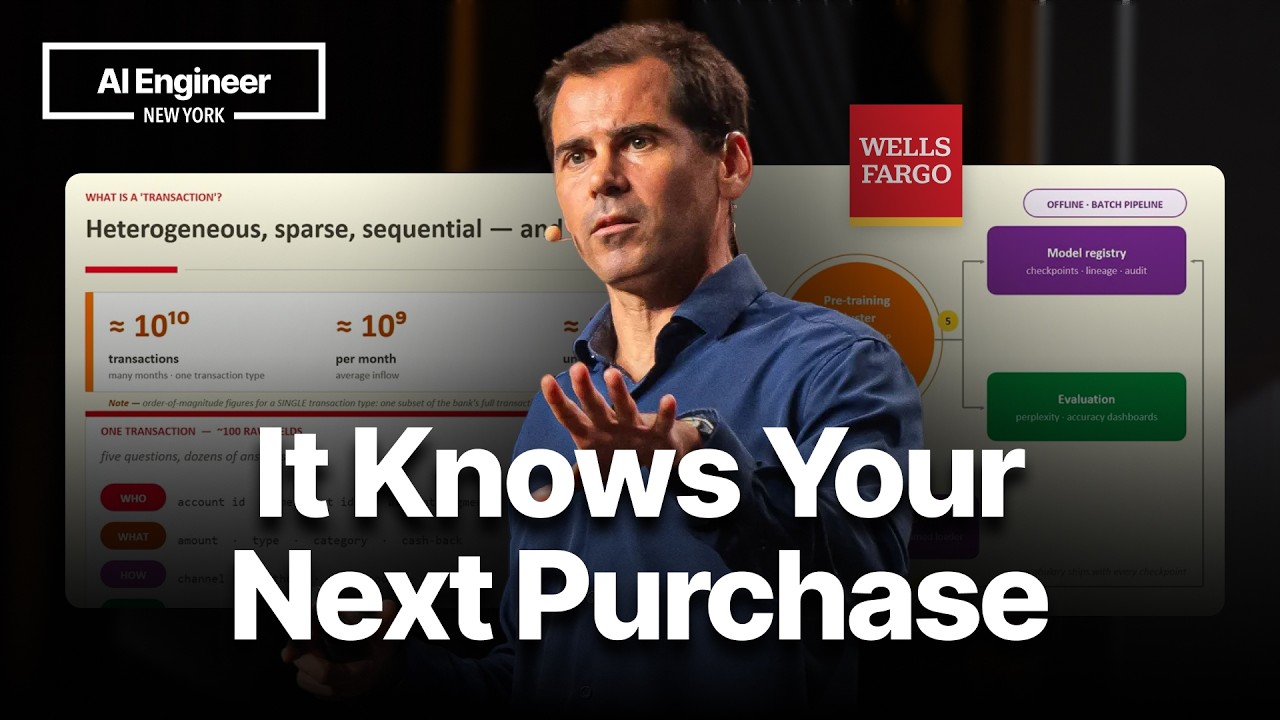
A Bank Trained Its Own Foundation Model to Catch Fraud — Freddy Lecue, Wells Fargo

A Bank Trained Its Own Foundation Model to Catch Fraud — Freddy Lecue, Wells Fargo

Wells Fargo pre-trained a transformer from scratch on billions of customer transactions rather than words, then fine-tuned it for fraud detection, credit decisions, anti-money laundering and marketing. The talk covers how tabular transaction data was tokenized, the model's size and training setup, and results that beat the production XGBoost fraud model on both detection and false positives while meeting real-time latency requirements.

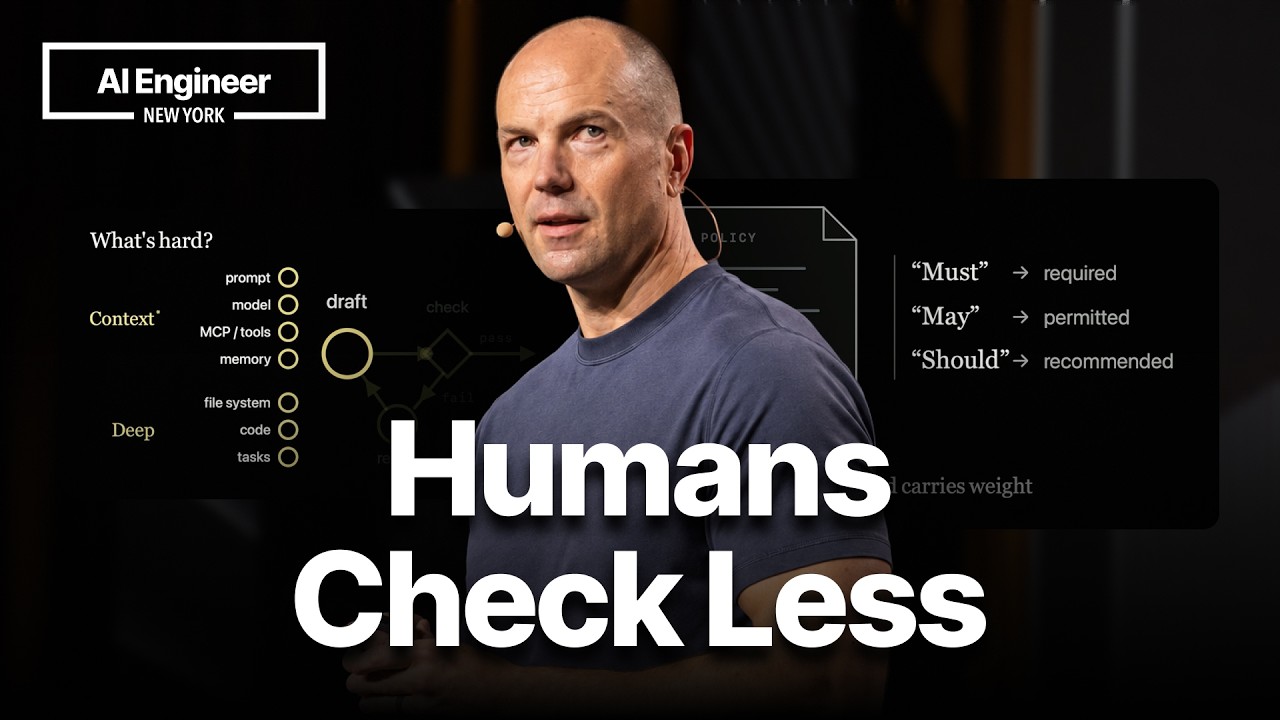
How to Know When an AI Agent Can Work Unsupervised — Evan Kormos, Coinbase

How to Know When an AI Agent Can Work Unsupervised — Evan Kormos, Coinbase

Evan Kormos of Coinbase presents a practical framework for bringing AI agents into policy-driven, regulated workflows. He models processes as DAGs with loops inside each node, argues that a loop is only as trustworthy as its check, and shows how evals and traces create a new confidence mechanism. Agents then move through supervised, sampled, and exception-only stages.

Judge a Transaction by the Company It Keeps — Somya Rai & MD Sharique, EXL

Judge a Transaction by the Company It Keeps — Somya Rai & MD Sharique, EXL

EXL developed an advanced fraud detection system that augments XGBoost with Graph Neural Network (GNN) embeddings. Traditional tabular models struggle to capture fraud signals residing in transaction neighborhoods. The system's innovative design includes meticulous sampling strategies, disjoint monthly graph construction for leakage control, and a GraphSAGE architecture that aggregates mean, max, and standard deviation of neighbor features to detect subtle fraud patterns. Emphasizing explainability for regulatory compliance and analyst trust, it also features a highly optimized serving architecture achieving 3ms P99 latency, pivoting to edge prediction to reduce cache footprint from 60GB to 2-3GB. This led to a 27-33% relative lift in true positive rates and a projected $65 million incremental fraud capture.

The Defender's Window at enterprise scale with Standard Chartered

The Defender's Window at enterprise scale with Standard Chartered

Matt Weaver from OpenAI and Reuben Athaide from Standard Chartered discuss how the bank uses OpenAI Daybreak to address the shrinking "defenders window" by focusing on contextual AI analysis of attack paths, fostering cross-functional trust, and leveraging AI for proactive, scalable security in a complex global environment.

How Kepler Built Verifiable AI for Financial Services — Vinoo Ganesh

How Kepler Built Verifiable AI for Financial Services — Vinoo Ganesh

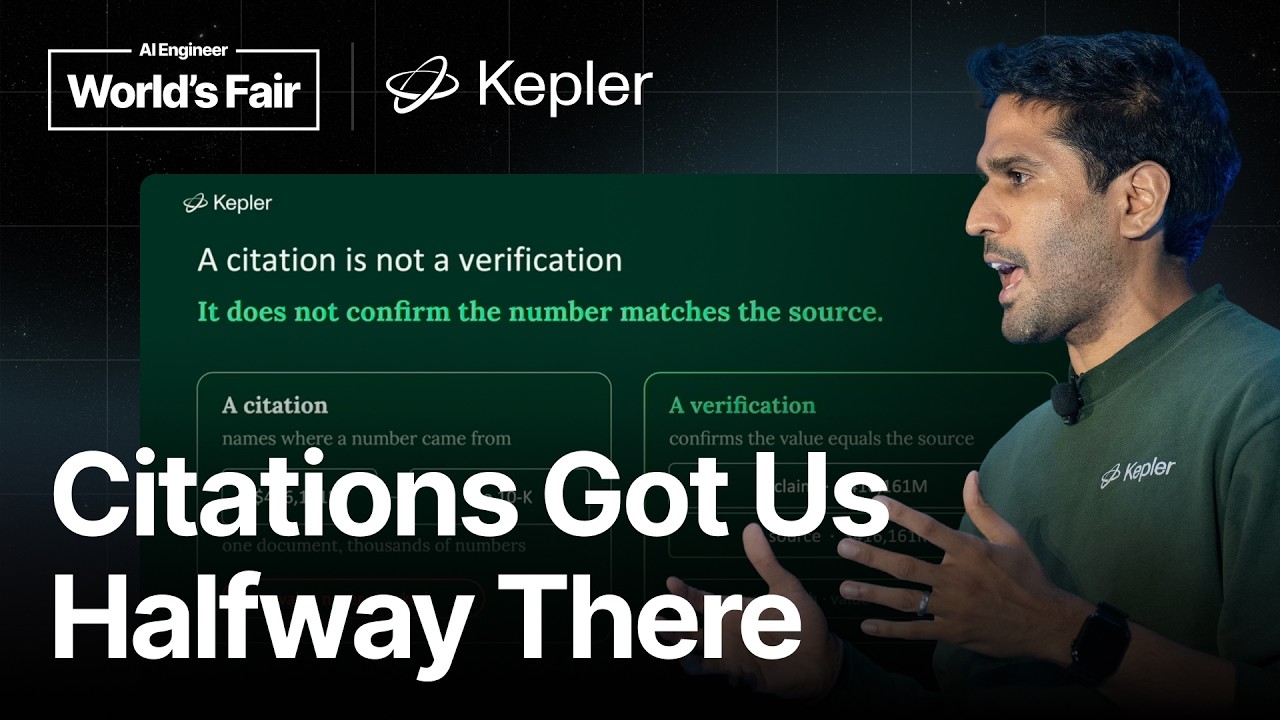
Vinoo Ganesh, CEO of Kepler, discusses building verifiable AI for financial services. He argues that while LLMs are powerful probability machines, they are unreliable for deterministic financial tasks. Kepler's solution involves a deterministic substrate that wraps AI, based on three tenets: atomic provenance (AI references, not creates, numbers), scope determinism (AI decides what to compute, but deterministic tools perform the math), and derivation chains (traceable calculation paths for derived figures). This ensures numerical accuracy, verifiability, and traceability, moving beyond simple citations to true proof of work.