Inside Arca's Long-Horizon Agents That Run the Business - Aman Singh, Arca
Arca, an AI-native financial services firm, runs its client business through long-horizon agents that own goals end to end across days of stop-start work. Aman Singh, who leads AI there, explains the signal system, operational context, harness, persistent memory, and shared spaces that let agents pull in people at the right moment, and why steering agents becomes the way to steer the business.
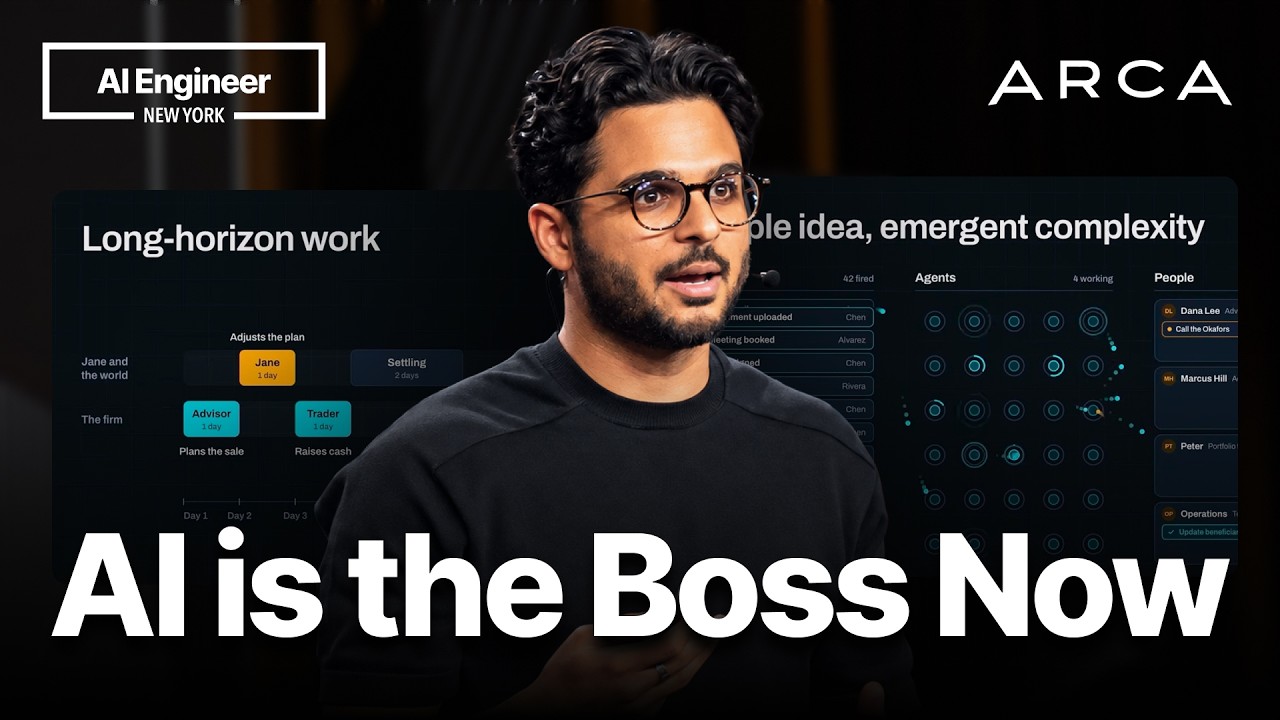
Arca describes itself as an AI-native financial services firm, and it draws the distinction carefully. Many companies bolt AI onto existing workflows from a co-pilot position. At Arca, agents execute the decisions that shape client outcomes. Arca is not a SaaS company selling software to other firms. It is an applied AI company running a services business in wealth management, covering financial planning, tax planning, asset management, and investment advice for clients ranging from technology executives planning early retirement to first-time millionaires buying a house.
Long-horizon work, not long-running work
Long-running agents grind through tokens for hours or days. Financial services work is long-horizon instead: a single client goal spans about ten days, moves in fits and starts, and passes through many actors, decision points, and handoffs. Progress depends on external events such as settlement times and bank transfers, so an agent cannot simply compute its way to the answer.
A worked example makes this concrete. A client named Jane faces a large tax bill due April 15, and the goal is to raise the cash in the most tax-efficient way. An advisor analyzes statements and tax implications, a trader liquidates assets that take days to settle, and operations triggers an ACH transfer that itself takes days to land. Multiplied across many clients, this human choreography scales poorly. Arca set out to solve that by taking people off the critical path.
Agents own the outcome end to end
Rather than assigning agents tasks inside a human process, Arca gave agents ownership of the whole outcome. Three components make this work. Signals from the external world keep agents aware of what is happening. Operational context tells them what the industry does in a given situation. A harness supplies tools, guardrails, and persistent memory that carry work across long periods. Collaboration with people is the fourth piece, and it is designed to be deliberate rather than constant.
Following a single signal
The journey of one email shows the system at work. Jane’s email is one of many signals, alongside phone calls, documents, meetings, custodian events, and market movements, that background agents continuously evaluate to advance work. When a signal arrives, the agent consults the harness for relevant knowledge, checks deep client memory (for example, a note never to touch Jane’s Apple position, based on a call eight months earlier), and runs the financial computation in a sandbox.
The agent then produces a plan. The plan cannot execute without people, so the agent builds a space: a shared surface where the plan lives, where several people can chat with the agent about its status, and where the agent pulls in whoever is needed for a given step. Here, a person approves the plan and the email to Jane. What follows is a chain of open questions. Has Jane replied, and what does her answer mean for the plan?
Agents watch the world so people don’t have to
Instead of keeping someone babysitting the goal for days, agents register interest in events. An agent can say, let me know when Jane responds, or let me know when the ACH lands. The signal system routes each event to every agent that registered interest in it. If an expected signal never arrives, agents can wake themselves on a schedule to check progress.
The real world is messy. Jane may never reply, or an in-person meeting may surface information that changes the plan. Human actions inside the product count as signals too. Adding information in the UI, rescheduling a calendar event, or marking a task complete all wake up an agent. Agents also message each other. A background agent that reads a new fact can notify another agent to update the space, such as changing the requirement from $100,000 to $80,000. The work adapts because signals flow through the system, not because someone manually re-plans it.
People enter at the right moment. An agent that has consulted operational context may determine that the next step requires the trader, and that person receives a task at that point.
The primitives of long-horizon work
The architecture follows what people actually do at work. They stay aware of what is happening, which is the job of the signal system. They know what to do next, which is the operational context. They perform and track the work, which is the harness. They hold state over time, which is persistent memory. And they bring in the right people at the right time, which is the space. The idea is simple on its face, but emergent complexity grows quickly. Hundreds of signals arrive at once, tasks land on people’s plates, and agents coordinate with one another.
Over the past six months, the work has focused on closing context gaps so agents are fully informed, improving the precision of when and whom to pull in, and deciding what belongs where. Future-facing items go into agent memory, while items actionable now become tasks. Because Arca is itself the firm, it has also standardized how work happens internally and encoded that operational context into agent state. Colleagues who use the product generate rich reasoning traces that serve as evaluations for improving the system.
Agents prompt people, and steer the business
The thesis is that agents should drive the business. When people log in at Arca, they find tasks already prepared for them. The email has been read, the document reviewed, and about 90 percent of the work done, and they are pulled in only when action is needed. The aim is a firm where agents prompt people more than people prompt agents.
The Jane email is itself presented as a failure of proactivity, since Jane should never have had to write at all. In an AI-native firm, a new business goal, such as preparing each client’s tax situation every January and reaching out before anyone asks, can simply be added to the agents’ goals. The agents then run the analyses in January and surface one-click approval emails with complete plans for every client. Steering the business becomes a matter of steering the agents.
That is the line the speaker draws between using AI tools and being AI native. A company that is AI native can steer its business by steering its agents, and that is the ambition Arca is pursuing.