How Kepler Built Verifiable AI for Financial Services — Vinoo Ganesh
Vinoo Ganesh, CEO of Kepler, discusses building verifiable AI for financial services. He argues that while LLMs are powerful probability machines, they are unreliable for deterministic financial tasks. Kepler's solution involves a deterministic substrate that wraps AI, based on three tenets: atomic provenance (AI references, not creates, numbers), scope determinism (AI decides what to compute, but deterministic tools perform the math), and derivation chains (traceable calculation paths for derived figures). This ensures numerical accuracy, verifiability, and traceability, moving beyond simple citations to true proof of work.
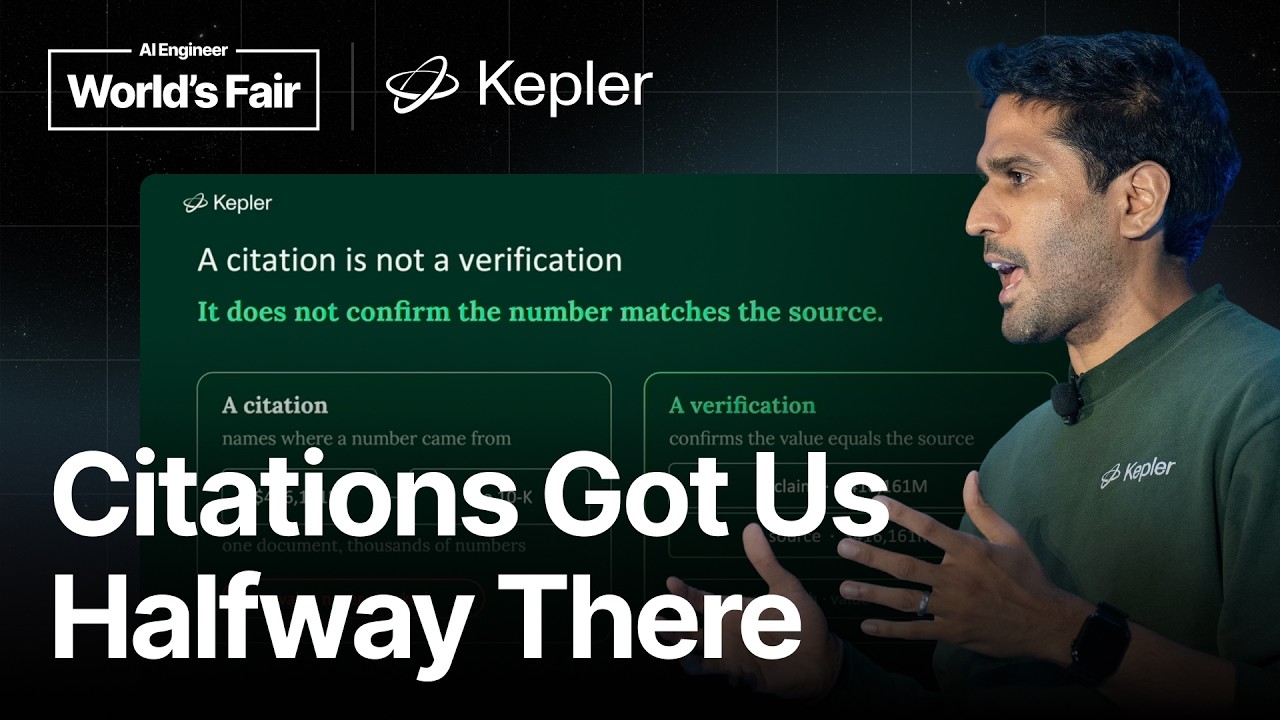
Vinoo Ganesh, CEO and co-founder of Kepler, presents a critical perspective on the current state of AI in financial services, advocating for verifiable AI as an indispensable component for producing trustworthy work products. He asserts that while AI is poised to revolutionize content generation, the fundamental challenge lies in its verifiability, especially in finance where numerical accuracy and traceability are paramount.
Ganesh highlights that current AI discussions often prioritize “token maxing” and content production, neglecting the crucial aspect of trust. He emphasizes that Large Language Models (LLMs) are probability machines, adept at next-token prediction but inherently unreliable for deterministic tasks such such as arithmetic, which are the backbone of financial operations. He rejects the notion that evaluations can make non-deterministic LLMs deterministic, stating, “Evals are not verifiable. You cannot take a non-deterministic LLM and eval your way to something deterministic.”
He draws parallels with other industries—software development with CICD and code reviews, medicine with pharmacists verifying prescriptions, aviation with co-pilots—all of which incorporate robust verification layers. Finance, however, often relies on an “overworked VP” as its primary check, leading to analysts working excessive hours. The speaker notes that existing financial tools like Bloomberg and FactSet are read-only, serving to displace culpability rather than providing verifiable, traceable information. He argues that current AI’s ability to produce confident answers without meaningful work product verification is a significant gap, especially given regulatory demands (SEC, OCC) for traceable decisions.
Ganesh distinguishes between citation (showing where information came from, an after-the-fact audit) and verification (a deterministic, repeatable, numerically verifiable mechanism that proves a number is correct). He stresses that verification is not about absolute “ground truth” but about ensuring outputs align with an organization’s specific rules and philosophies.
Kepler’s Solution: The Deterministic Substrate
Kepler’s approach treats the AI model not as the sole answer but as one component within a larger, deterministic substrate. The core contention is that “you cannot use AI to produce verifiable work product in finance without augmenting it with a deterministic substrate.” This system models AI like an “overworked VP,” grounding it with a risk threshold and verifiability. Kepler’s solution is built on three core tenets:
- Atomic Provenance: The model does not directly write or manipulate numbers; instead, it generates a reference to where the number originated. Specialized, deterministic tools (like databases) then handle the actual writing and reading of numerical data with high fidelity. Any number that cannot be independently verified through a deterministic check is automatically stripped out, ensuring only validated data persists. This differs from probabilistic models checking each other; it’s a canonical process of extraction, persistence, and verification.
- Scope Determinism: The LLM excels at reasoning and planning (e.g., understanding what net margin is and where to find the data), but it never performs the actual computation. Ganesh quips, “Why would I run 1 + 1 through a multi-billion parameter model instead of one CPU cycle?” Kepler splits the non-deterministic tasks (reasoning, planning) handled by the model from the deterministic tasks (math, data extraction) handled by code. The deterministic platform pulls information from sources like PDFs or XBRL and persists it outside the model’s direct influence, leading to numerically accurate and cost-effective results.
- Derivation Chains (Reconciliation): For derived figures or ratios that don’t directly appear in filings (e.g., gross margin, EBITDA adjustments), a comprehensive chain of events tracks every step and transformation applied to produce the final number. This allows for replayable and rewindable verification, ensuring that the calculation aligns with specific organizational methodologies and rules, acknowledging that different firms may calculate the same metrics uniquely.
This grounded system ensures that the model only produces data points it is allowed to (from structured filings, numerical data) and never extracts from less reliable sources like raw prose or tables. The result is the ability to consolidate financial statements with every number tied to its source, eliminating hallucinated rows in financial models and moving towards “zero invented securities.”
Broader Implications and Future Vision
Ganesh argues that this paradigm extends beyond finance to any domain requiring verifiable data, such as legal case management (preventing hallucinated citations) or drug discovery (avoiding missed compounds). He compares the current state of AI to the pre-SSL era of e-commerce, where widespread adoption hinges on establishing trust and verifiability. He criticizes the trend of “token maxing,” advocating for using “the right tool for the right job”—often a simple CPU cycle over a multi-billion parameter model for deterministic tasks.
Ultimately, while AI makes producing work products “nearly free,” the “reading problem” (verification) remains open. Citations are only half the battle; the next frontier is full verifiability and provability, where the work product itself serves as proof, akin to unit tests and code reviews in software development. Kepler’s customers are most excited about AI serving as an “AI analyst”—automating repeatable, painful tasks like listening to earnings calls or assembling initial financial models—thereby giving expensive human analysts back their time.