Learning Genetic Perturbation Effects at Single-Cell Resolution for Virtual Cells
Jiaqi Zhang's talk focuses on advancing causal discovery and perturbational modeling for gene networks, crucial for therapeutic insights. She introduces theoretical guarantees for learning latent causal variables and presents MORPH, a VAE-based framework that predicts the effects of novel and combinatorial gene perturbations by integrating diverse prior biological knowledge and using distributional loss for training. The model has demonstrated success in guiding experimental design, including identifying novel T-cell regulators for cancer immunotherapy, highlighting its potential to accelerate biological discovery and drug development.
Jiaqi Zhang’s talk addresses the intricate challenge of understanding complex causal mechanisms within gene networks, which is paramount for therapeutic discovery. While advanced biotechnologies like perturb-seq and optical pool screens enable large-scale, single-cell gene perturbations, the resulting high-dimensional data is expensive to acquire and difficult to interpret. Current deep learning approaches often struggle with predicting the effects of unseen perturbations, sometimes being outperformed by simpler linear baselines due to issues with out-of-distribution generalization.
Zhang’s work tackles these challenges through three main contributions:
1. Causal Representation Learning with Identifiability Guarantees
Challenges in Causal Discovery
Traditional causal discovery algorithms, such as the PC algorithm, face limitations when applied to large, complex gene regulatory networks. Their accuracy decreases, and computational costs skyrocket as the number of variables (genes) increases. Furthermore, high-dimensional observational data often doesn’t consist of meaningful ‘causal units.’ For instance, in imaging data, individual pixels are not causal variables; instead, latent causal variables need to be identified first.
Optimizing Conditional Independence Tests
Causal structure learning typically involves performing conditional independence tests on observational data to infer the underlying graph. Prior methods required a number of tests exponential in the maximum degree (D) of the graph, making them impractical for dense biological networks. Zhang’s research established a tighter lower bound for these tests, demonstrating that the required number is exponential in the maximum undirected clique size (S) of the graph, not its maximum degree. Since S is often significantly smaller than D in biological networks (e.g., D~1500 vs. S~12 in a C. elegans network), this theoretical advancement allows for more computationally efficient and accurate causal structure learning.
Identifiability of Latent Causal Variables
The work defines observational data (O) as a function (F) of latent causal variables (X) sampled from a control distribution (P). Perturbational data (O_IK) uses the same mapping F but with X_IK sampled from a perturbed distribution (P_IK), where P_IK only reflects targeted changes and downstream propagation. This framework suggests that ‘similar’ genes are those explained by modulating the same latent variable X with a shared mapping F. Unlike Independent Component Analysis (ICA), which struggles with identifiability even in simple cases, the availability of perturbational data enables much stronger identifiability. Under specific assumptions (sufficient perturbations, faithfulness, and a constrained class for F), the model can uniquely identify the targets of perturbations and their underlying causal structure (up to permutations).
2. Predictive Perturbational Modeling (MORPH Framework)
Addressing the Prediction Problem
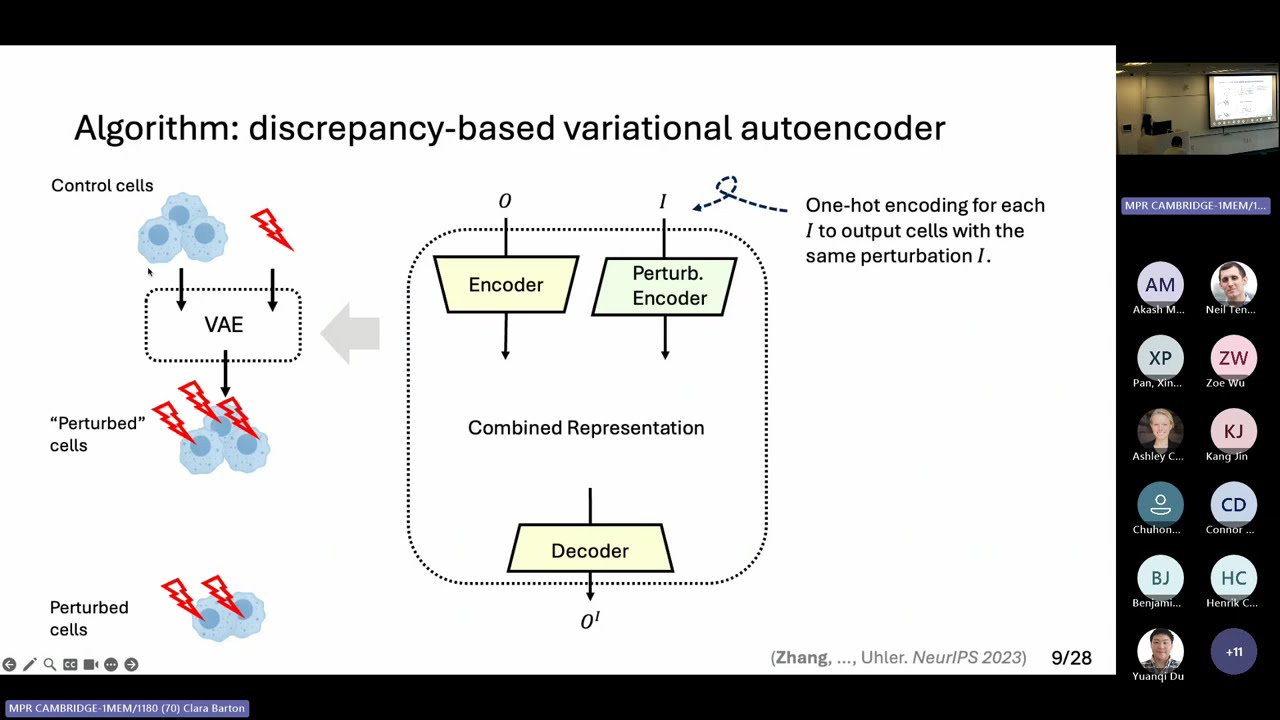
To predict the effects of unseen perturbations, Zhang developed MORPH (Modular framework for predicting Responses to Perturbational cHanges). This VAE-based architecture takes a control cell representation and a perturbation indicator as input to generate a perturbed cell. A key innovation is the use of a distributional loss, specifically Maximum Mean Discrepancy (MMD), for training. This circumvents the challenge of unpaired single-cell measurements (where a cell cannot be observed before and after perturbation) by comparing distributions of generated and ground-truth perturbed cell batches.
Combinatorial Perturbation Prediction
MORPH can predict the effects of combinatorial perturbations (e.g., gene I1 and I2 together) in a zero-shot manner. This is achieved by encoding both individual perturbations and propagating their effects compositionally to downstream variables, a mechanism supported by causal theory. This capability has been validated on cancer cell data, showing strong agreement between predicted and actual cell distributions.
Integrating Prior Biological Knowledge for Unseen Perturbations
To address entirely unseen single-gene perturbations (which would correspond to an unknown one-hot encoding), MORPH incorporates prior biological knowledge to generate meaningful gene embeddings. Four types of priors were explored:
- Control Gene Expression: Embeddings based on co-expression patterns in control cells.
- Single-Cell Foundation Models: Pre-trained models providing gene embeddings from diverse observational single-cell contexts.
- Language Models (GPT): Embeddings derived from textual descriptions of genes (e.g., NCBI, Gene Card descriptions) by large language models, capturing summarized literature information.
- Dependency Maps: Viability scores from gene knockouts in cancer cell lines, reflecting perturbation effects in specific biological contexts.
While all priors provided value, embeddings from Dependency Maps (context-specific perturbational data) often performed best in cancer cell screens, outperforming even advanced language models. This highlights that the most informative priors often originate from similar perturbational data, even if from different contexts or cheaper modalities. Overall, MORPH, by combining MMD training with informative priors, significantly outperforms simple baselines and earlier deep learning methods across various metrics.
Modularity and Multi-Modal Applications
MORPH’s modular design allows for interchangeable components, including various prior embedding types and different input/output modalities. For example, it has been successfully applied to predict infection stage proportions in Ebola virus-infected HeLa cells using optical pool screen imaging features, processed by a Vision Transformer, demonstrating its versatility beyond transcriptomic data.
3. Improving Future Experimental Design
Target Nomination for Drug Discovery
MORPH can guide experimental design by nominating optimal targets. In a semi-synthetic simulation involving Ebola virus infection, MORPH (trained on 3,000 perturbations) successfully identified top targets (e.g., RAB7A, CCDC115) among 15,000 unseen perturbations that were likely to lead to earlier infection stages, showcasing its potential to accelerate screening efforts.
Real-World Application: Cancer Immunotherapy
In collaboration with the Broad Institute, MORPH was applied to identify T-cell regulators for cancer immunotherapy. The goal was to bias immune cell states towards ‘progenitor states’ (associated with stronger cancer-killing capabilities). After training MORPH on 73 expert-selected gene perturbations in immune cells, the model predicted effects for unseen targets. Experimental validation demonstrated that MORPH successfully identified novel targets that, upon testing, exhibited better immunotherapy objective scores than some of the initial expert-selected targets, proving its utility in discovering non-obvious, highly effective therapeutic candidates.
Iterative Experimental Design and Acquisition Functions
The success of MORPH in guiding experiments emphasizes the value of an iterative approach to data collection. Future work focuses on developing ‘acquisition functions’ to optimally select the next batch of experiments. This includes strategies like using extreme event theory to identify perturbations that lead to rare but desired biological states, which are often critical for therapeutic development.
Outlook
The Cell Perturbation Prediction Challenge at the Broad Institute, co-led by Zhang, aims to further advance this field by hosting competitions where machine learning algorithms are developed and then validated in wet labs across various disease contexts (e.g., cancer immunity, obesity), bridging computational predictions with experimental outcomes.