The Next Breakthroughs in AI with Yossi Matias | The Google Research Podcast
Yossi Matias, VP and GM of Google Research, discusses how Google prototypes the future by inventing it, emphasizing the current "Golden Age of Research." Key themes include the seamless integration of AI through ambient intelligence and adaptive Generative UI, architectural advancements that push beyond scaling laws with techniques like Speculative Decoding, and multi-agent AI systems such as AI Co-Scientist and Empirical Research Assistance for accelerating scientific discovery. He also details Google Earth AI for crisis resilience and planetary intelligence, breakthroughs in healthcare diagnostics with MedGemma and the Google Health app, and milestones in quantum computing with the Willow chip, ultimately envisioning a future where AI amplifies human ingenuity and solves humanity's biggest challenges.
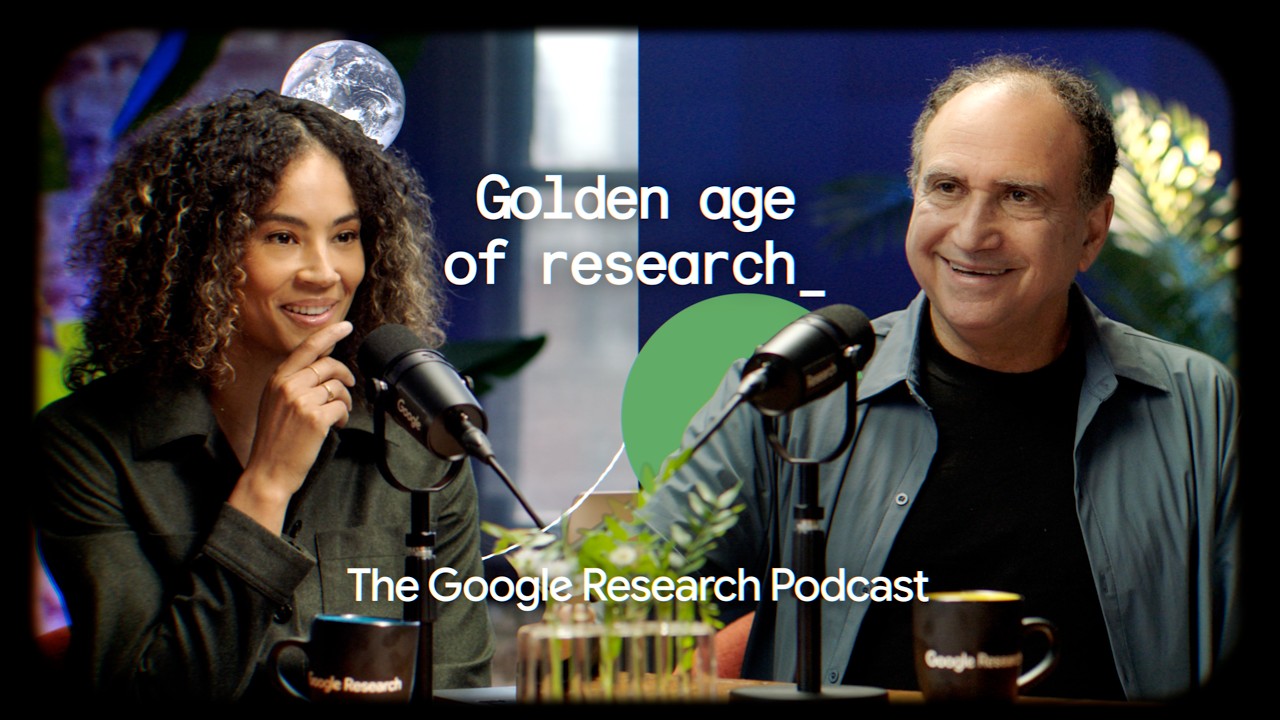
Yossi Matias, VP and GM of Google Research, describes the organization’s mission as inventing the future by pushing the boundaries of science and technology, addressing humanity’s biggest challenges. He characterizes the current era as the “Golden Age of Research,” where the gap between scientific theory and real-world impact has shrunk from decades to mere months.
Anticipating the Future, Not Extrapolating the Past
Google Research focuses on anticipating what’s next and actively making it possible, looking beyond immediate horizons. Breakthroughs serve as foundational layers for subsequent advancements. Matias recounts recognizing the potential of conversational AI a decade ago, leading to projects like Google Duplex, which now facilitates over a trillion business information views annually. The goal extends to removing modality barriers, enabling seamless communication across text, images, videos, and languages.
Ambient Intelligence and Generative UI: AI That Adapts to You
Ambient Intelligence posits a future where AI is so integrated and effective that it becomes invisible, taken for granted like electricity. This vision aligns with Arthur C. Clarke’s adage: “Any sufficiently advanced technology is indistinguishable from magic.”
Generative UI represents a paradigm shift in digital interaction. It moves beyond simply generating content to dynamically adapting the presentation of information to the user’s intent, context, and device. For instance, it can display images for visual learners, provide code for algorithmic queries, or explain complex concepts like quadratic equations through relatable examples like a basketball shot. The Learn Your Way experiment further explores adaptive educational interfaces, customizing content (e.g., gravity explained through soccer for a 10-year-old girl) based on age and interest.
Architectural Advancements Beyond Scaling Laws
Matias acknowledges discussions about the limits of current AI architectures but emphasizes that new techniques are constantly emerging. While addressing efficiency, factuality, and trustworthiness (a focus since 2021 with benchmarks published in 2022), the research extends to improving reasoning, multi-dimensional, and multi-modal capabilities. The Transformer architecture was a foundational innovation, and subsequent developments like Speculative Decoding have already shown 2x or more efficiency gains in LLM inference without quality loss, with hundreds of variations now emerging. The long-term goal is 10x, 100x, or even 1000x improvements through novel architectures.
Beyond language models, Google Research is developing World Models that integrate physics simulations, molecular, and biological data to gain deeper insights into complex systems. This continuous advancement is fueled by AI itself, which accelerates both research and AI development, creating a recursive improvement loop.
The Science Moment: AI for Accelerated Scientific Discovery
AI is profoundly transforming scientific discovery by assisting across the entire scientific method:
- AI Co-Scientist: A multi-agent system that autonomously searches scientific literature, generates, validates, and ranks hypotheses. Described as a “polymath in your pocket,” it can read across all disciplines. In one notable case, it generated a hypothesis in three days that took human researchers years to discover concerning antibiotic-resistant bacteria. This system empowers every researcher with a “virtual lab,” enabling them to ask bigger, more complex questions.
- Empirical Research Assistance (ERA): Leveraging Generative AI, ERA helps scientists find and build appropriate models for well-defined problems and inputs. Both AI Co-Scientist and ERA were published in Nature. They are part of Gemini for Science, which combines ERA with DeepMind’s AlphaEvolve to drive computational discovery across fields like cosmology, epidemiology, engineering, and economics.
- Scientists as Architects: AI amplifies human ingenuity, shifting the scientist’s role towards an “architect” who guides virtual labs. This implies a skills gap, as junior scientists will need to develop advanced judgment skills earlier to effectively leverage AI. Education systems must adapt to train scientists to operate in this new paradigm, emphasizing critical thinking and interdisciplinary knowledge. Matias notes that AI’s ability to connect disparate disciplines is where “a lot of the magic happens,” enabling insights that might not emerge from traditional siloed research.
Earth AI for Crisis Resilience and Planetary Intelligence
Google Research’s work in crisis resilience began with flood prediction, tackling a problem previously deemed “too difficult.” Initial research and pilots in India led to the Global Hydrologic Model (published in Nature), which learns from data-rich areas to predict floods in data-scarce regions. This system now provides 7-day flood predictions in 150 countries, covering 2 billion people via Flood Hub, enabling life-saving actions.
For complex challenges like flash floods, Google developed Groundsource, using Generative AI (Gemini) to process 20 years of news articles in multiple languages, identifying 2.6 million flash flood events. This created a crucial ground truth dataset, allowing the Flood Hub to offer urban flash flood predictions. The North Star for this work is simple: “Nobody should ever be surprised by a natural disaster.”
This vision expands to Google Earth AI, aiming for “planetary intelligence.” By integrating geospatial models, satellite imagery, and Population Dynamics (a foundational model of human movement), an AI-genetic layer allows users to ask complex questions about the planet. Examples include identifying vulnerable communities during disasters, predicting the spread of public health crises (e.g., cholera, measles with partners like Cooper/Smith and W.H.O.), and supporting business decisions. This platform represents an “onramp to the ambient intelligence layer” for the entire planet, enabling conversations with the world without needing to understand underlying epidemiological or geospatial models.
Healthcare: From Diagnostics to Personalized Health
AI’s impact on healthcare is transformative. Google Research trained language models to pass the US medical exam at an expert level (91% with multimodality), demonstrating AI’s ability to understand complex medical information. The HAI-DEF platform and MedGemma (an open-source medical LLM with over 5 million downloads) provide foundational models for others to build applications. An example includes a Ugandan healthcare worker using a MedGemma-powered app to provide life-saving advice in a remote village.
AI is also being integrated into clinical workflows. Research on diabetic retinopathy, initiated a decade ago, has led to over a million screenings in India and Thailand, preventing blindness. Collaborations with the NHS on mammography have shown AI can reduce missed diagnoses by 25% and save radiologists 40% of their time. Furthermore, LLMs are being explored to enhance the conversational aspect of medical diagnostics, providing trustworthy, empathetic, and assistive support to practitioners, as tested in collaboration with Included Health. The Google Health app leverages LLMs to provide personalized health insights from wearable sensor data, rigorously tested through research. Matias emphasizes that AI is not the ceiling but the “new floor” from which science and society can collectively advance.
Scientific Questions Defining the Next Decade
Matias believes we are still early in unlocking knowledge across all domains. Major scientific questions for the next decade include: understanding how the brain works, drug and material design, achieving predictable planetary understanding (eliminating natural disaster surprises), addressing food insecurity, and developing new energy solutions. Education is highlighted as critical, with AI empowering individuals to reach their full potential and teachers playing an even more vital role in inspiring students. AI will also significantly impact human creativity, providing tools for broader self-expression across various disciplines.
Quantum Computing: The Next Frontier
Quantum computing, with its longer “magic cycle” of research, is nearing a practical stage. Advances in error correction, exemplified by the Willow chip last year, are crucial. Quantum computers can solve certain problems exponentially faster than classical computers; one problem was solved 10 septillion times faster, and a “verified advantage” experiment showed a 13,000x speedup for the echo algorithm. While implications for cryptography (Shor’s algorithm) are known, the true potential lies in yet-undiscovered applications, particularly for generating knowledge to build AI models at the molecular level. Matias expects practical quantum computing within a few years, driving a “beautiful interaction” between hardware, software, and algorithms that will fuel innovation for decades to come.
Leading Research Teams Through the Impossible
Matias leads research by constantly asking: “What matters?” and “Where can we make the biggest progress?” The goal is to identify “step functions” – significant leaps rather than incremental improvements. Google Research benefits from world-class talent, robust infrastructure, and strong partnerships (academic, governmental, internal Google teams). The “magic cycle of research” involves iterating through research, applying it to reality, and then posing the next research question, always striving for impact-driven breakthroughs that look to the horizon.
- Tags:
- Generative AI
- LLMs
- Quantum Computing
- Human-Computer Interaction
- Scientific Discovery
- Speculative Decoding
- Machine Learning
- World Models
- Generative UI
- Healthcare AI
- Google Research
- Ambient Intelligence
- AI Co-Scientist
- Empirical Research Assistance
- Earth AI
- Flood Prediction
- Crisis Resilience
- MedGemma
- Willow Chip