AI Tech Stack | The Founders and Builders Architecting Product Market Fit | Creator's Cut | 2026 |4K
This panel discussion explores the evolving AI tech stack and its impact on product-market fit, ethical governance, and business transformation. Experts from Humana, Catenate, In-Telecom, and Spacer AI explain how AI-powered prompts are replacing static dashboards, detail multi-model API strategies for cost efficiency, and delve into the critical role of human-in-the-loop oversight for autonomous agents to ensure data security and responsible AI deployment. They emphasize that true value lies in domain expertise and solving real-world pain points, not just building 'shiny toys'.
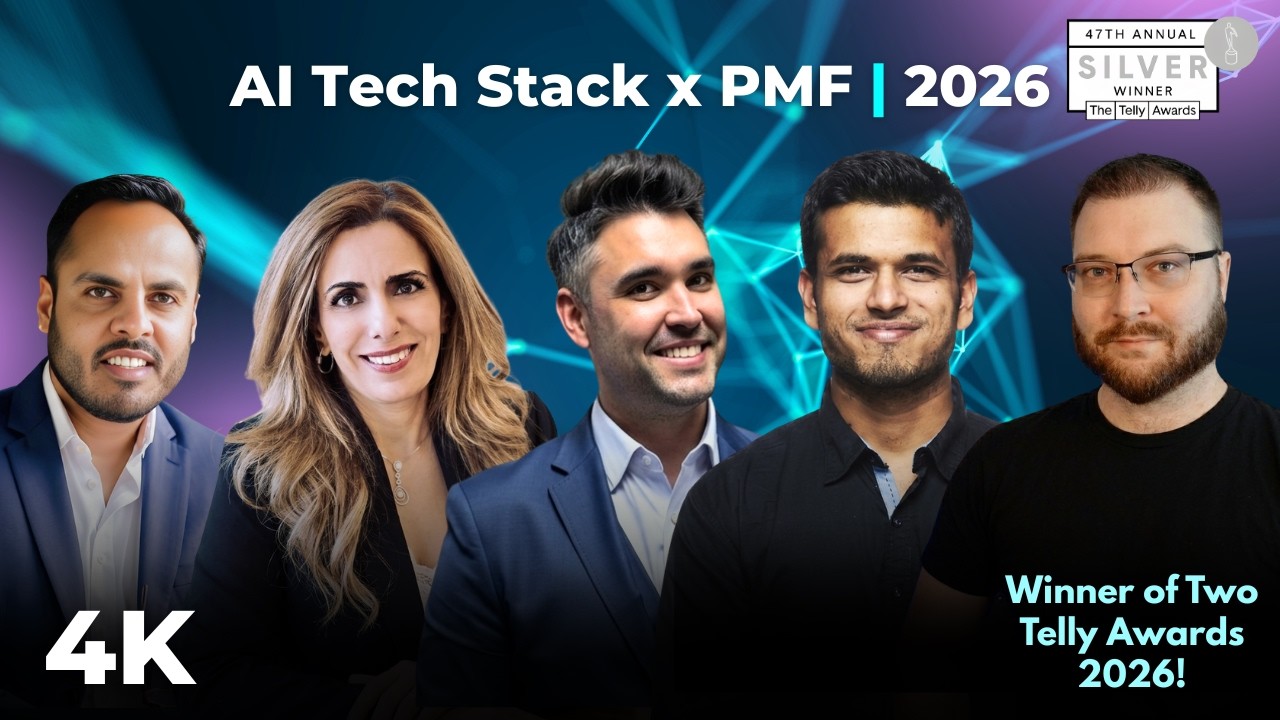
The discussion emphasizes that AI applications must solve genuine pain points to achieve product-market fit, moving beyond “science fair projects.” As host Sanjay Kalluvilayil states, “If nobody pays for what you built on a repeated basis, you have a science fair project.” Panelists share real-world insights into building AI-driven businesses, highlighting the strategic shifts required across various industries.
The Demise of Dashboards and the Rise of Prompt-Driven Insights
Dalia Powers, CIO of Humana, declares that “dashboards are going to be dead” by 2026. This is because, with a robust data infrastructure—including a data lakehouse, semantic layer, and ontology—prompts will enable on-the-fly generation of tailored information. Ben Bergeron, VP of Revenue at In-Telecom, echoes this, explaining how AI-driven insights from CRM data and marketing campaigns replace the need for static dashboards, providing real-time visibility and predictability. The focus shifts from maintaining thousands of reports to dynamically querying consistent data.
The Evolving AI Tech Stack and Multi-Model Strategy
The panelists detail their practical approaches to AI implementation:
- Claude Code for Rapid Development: Derrick Bozkurt, founder of Spacer AI, champions Claude Code for its ability to enable non-technical users to build applications and websites through prompt engineering. He outlines a structured setup for Claude Code, involving a global directory for rules, permission levels, skills (templated workflows), and memories, all managed through markdown files. This granular control allows for consistent results and tailored AI behavior.
- Multi-Model API Strategy: Sameer Ranjan, CTO of Catenate, reveals a “three-model API split” to optimize costs and functionality.
- OpenAI APIs are used for interpretation and generating explanations (e.g., resume matching with detailed rationales).
- Claude APIs excel at generating large documents (e.g., SOWs, NDAs) and significantly improve code generation accuracy when guided by markdown files (boosting accuracy from 64% to 97%).
- Gemini is preferred for highly transactional, cost-sensitive tasks due to its efficiency. A critical aspect of this multi-model approach is stringent data governance: explicitly instructing models “do not learn from our data” and safeguarding proprietary algorithms to maintain competitive advantage.
- Autonomous Agents and Security: Derrick discusses autonomous agents like OpenClaw and Hermes, which leverage AI to proactively accomplish tasks, plan, and execute. He stresses the paramount importance of security for these agents, recommending sandboxing and isolated environments to prevent data leaks or supply chain attacks. Users must implement “kill switches” and avoid exposing sensitive data like API keys or customer information until the technology matures.
AI in Industry: Telecom, IT, and Healthcare
The discussion highlights transformative AI applications:
- Telecom & IT: Ben Bergeron notes that AI is revitalizing the commoditized telecom industry by providing “tangible insights” from call centers, enabling better decision-making, client experience, and sales team coaching. In managed IT, AI automates L1/L2 support tasks, reducing costs and enabling self-service for clients. Physical security benefits from AI-powered surveillance, such as detecting PPE non-compliance using tools like Dragon Fruit.
- Healthcare: Dalia Powers explains AI’s long-standing role in healthcare (deterministic AI) and its accelerating impact with generative AI. Internal transformations involve optimizing operations, while external applications enhance patient and provider experiences. Examples include ambient listening to automatically transcribe clinician notes, freeing doctors to focus on patient interaction, and AI-assisted call centers that surface relevant information for agents, improving service quality and reducing burnout. Dalia cites Google’s 75% AI-generated code as an indicator of AI’s pervasive internal impact.
Ethical AI, Governance, and the Human in the Loop
A recurring theme is the necessity of human oversight and robust governance for responsible AI deployment:
- Claim Denials and Human Oversight: In healthcare, AI may “approve” cases, but “any denial then it gets escalated to a person.” Dalia asserts, “There is always a human in the room at this point” for claim denials, emphasizing that AI currently lacks the guardrails and regulatory backing to fully automate such critical decisions.
- Governance as a “License to Go Fast”: Dalia likens governance to “brakes in your car,” explaining that “every process we automate needs to start with human in the room until you actually make sure that you have all of the guard rails, all of the explainability, then you can move to human on the loop.” This iterative approach builds trust and ensures safe acceleration.
- LLM Bias and Discernment: Sameer cautions that “every LLM is super biased,” not in its answers, but “biased to pamper you.” This necessitates human discernment to evaluate the accuracy and truthfulness of AI outputs. Ben stresses the need for internal AI policies and ensuring vendor compliance to manage risks.
Essential Skills for the AI-Native Era
The panelists underline critical skills for professionals and organizations navigating the AI landscape:
- Domain Expertise is Irreplaceable: Sameer stresses that “every startup that is born in the last 5 years can be replaced by the newer model.” What remains irreplaceable is a founder’s or professional’s domain knowledge and functional expertise, which LLMs cannot replicate.
- Continuous Learning & Adaptability: Dalia advises “leaning in” and embracing continuous learning, as nobody truly knows AI’s full evolutionary path. Ben emphasizes curiosity, community engagement, and strong interpersonal skills as crucial differentiators in an information-overloaded world.
- Problem-Solving Focus: Derrick recommends identifying specific pain points and building AI solutions for them, even starting with simple tools like Claude Code. He advocates for automating repetitive tasks into “skills” or sub-agents to enhance personal productivity.
- Managing Token Cost: Sameer highlights the importance of understanding and managing input/output tokens to keep AI costs down, a critical factor for startups.
- The “Human First” Imperative: The discussion concludes by urging a “human in the loop” approach, especially for children learning with AI, to ensure fundamental skills are not eroded and that human judgment remains paramount. As Dalia notes, excessive reliance on AI can “decline” human ability to perform tasks independently.