Healthcare ai

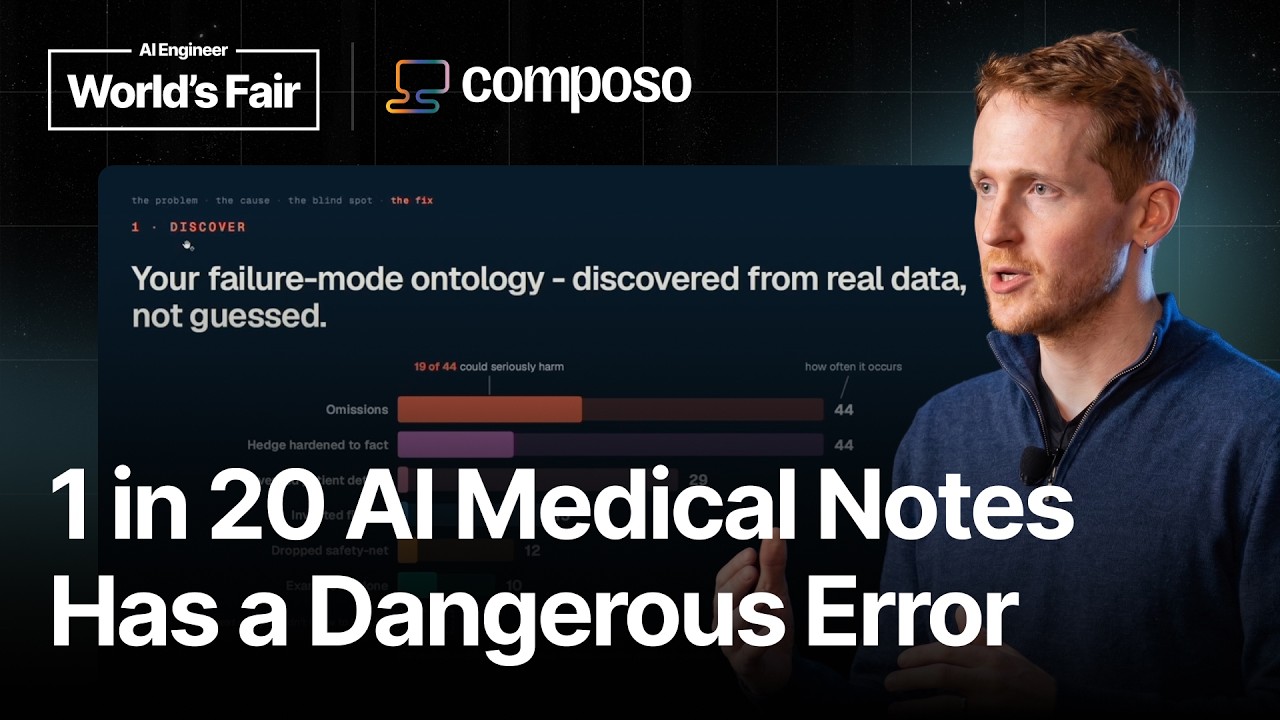
Inside 847 Production Clinical AI Notes — Sebastian Fox, Composo

Inside 847 Production Clinical AI Notes — Sebastian Fox, Composo

Sebastian Fox, a medical doctor and AI evaluation expert, dissects the critical problem of subtle yet dangerous errors in AI-generated clinical notes within high-stakes healthcare. He reveals why conventional AI verification methods fail to grasp the nuanced concept of "what matters" and introduces a novel, adaptive evaluation framework that continuously learns from real outputs and expert judgment to build a dynamic, case-specific standard for AI reliability.

Why Your Enterprise Tech Stack Isn’t Ready for AI Agents — Christopher Lovejoy & Saul Howard

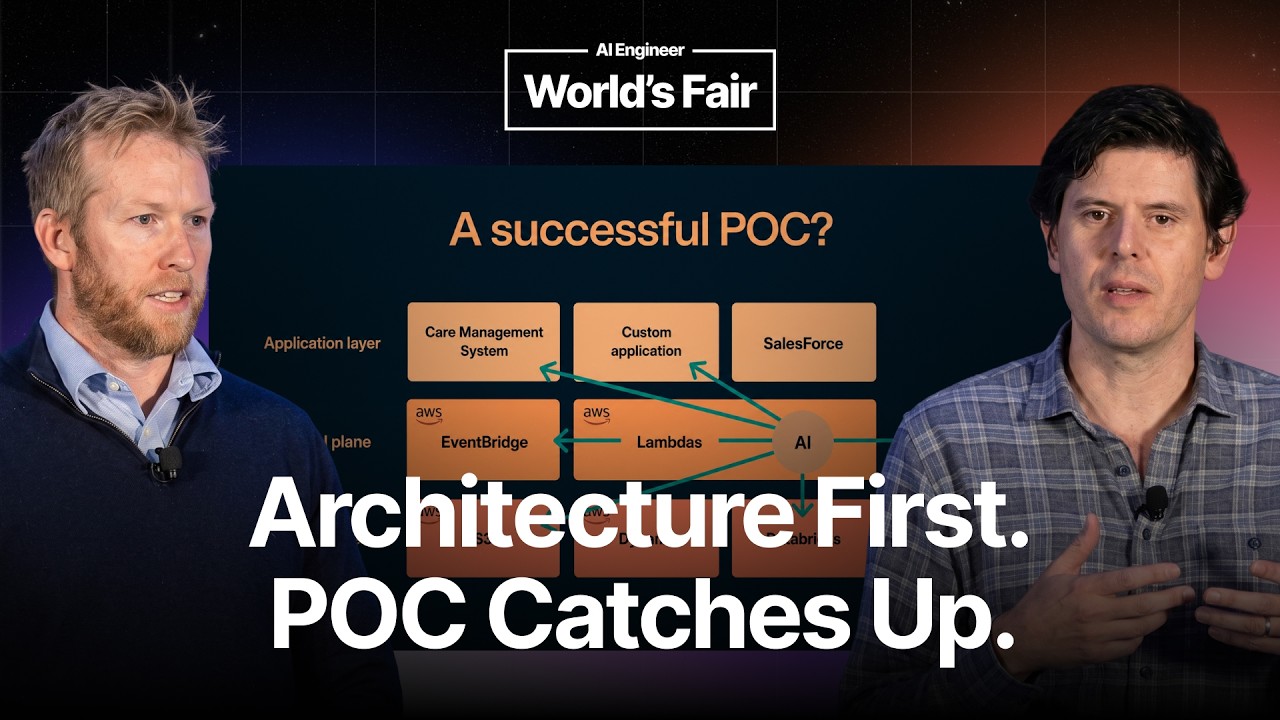
Why Your Enterprise Tech Stack Isn’t Ready for AI Agents — Christopher Lovejoy & Saul Howard

Chris Lovejoy and Saul Howard discuss the critical challenges of deploying AI agents in highly regulated enterprise environments, particularly healthcare. They advocate for a "constraints-first" architectural approach, proposing three core primitives – an immutable event log for auditability, schema-driven object storage for sensitive data, and human-agent equivalency for seamless escalation – which collectively enable privacy-preserving evaluations as a fundamental byproduct of the system design, rather than being an afterthought.

Healthcare’s Agent Bytecode: X12 as the Harness for AI Agents — Vasant Kearney, Onlay

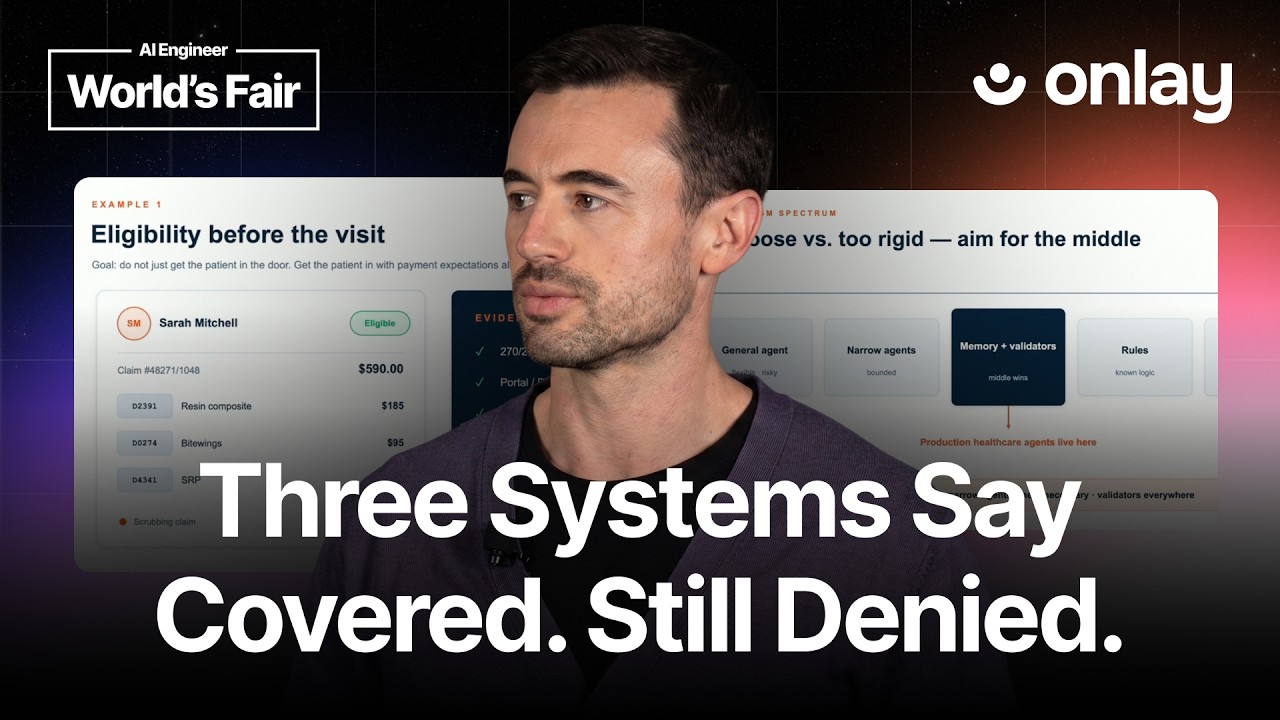
Healthcare’s Agent Bytecode: X12 as the Harness for AI Agents — Vasant Kearney, Onlay

Vasant Kearney presents a nuanced perspective on implementing AI in healthcare, particularly in insurance. He highlights that while AI is evolving rapidly, real-world application requires understanding that solving isolated problems doesn't equate to complex solutions. His core argument is the utility of X12 as a 'harness' for agentic AI, providing a structured, confining framework for LLMs in healthcare. This approach acknowledges that X12 defines the contract between providers and payers, and even phone calls can be seen as X12 transactions. However, he cautions that X12, or any payer data, isn't ground truth due to disparate system origins, necessitating an internal 'semi-correct' representation. Kearney advocates for a balanced "AI pilled and AI skeptical" stance, embracing AI's potential while remaining cautious about its inherent limitations, cost, and the necessity for robust system design and evaluation.

Why the Best AI Stories Aren't About AI  (with Steve Mock)

Why the Best AI Stories Aren't About AI (with Steve Mock)

Steve Mock, investor and entrepreneur, discusses aisavedme.org, a platform born from his father's question, "How does one use AI?". The site gathers real-world stories of AI's positive impact, revealing surprising human outcomes in healthcare, education, and personal fulfillment, often less about technology and more about connection. He also shares his unique no-code journey in building the site and his venture capital insights into the "data flywheel" and "vertical AI" as key to successful investments.

Multimodal & Embodied Intelligence (Pt 1), Panel on Multimodal AI: Progress, Pitfalls, Possibilities

Multimodal & Embodied Intelligence (Pt 1), Panel on Multimodal AI: Progress, Pitfalls, Possibilities

This session explored Multimodal and Embodied Intelligence, featuring talks on hybrid AI in robotics (classical vs. end-to-end), AI's role in healthcare (focusing on NCDs, deployment, and uncertainty modeling), and fundamental perception challenges in multimodal reasoning (using educational video QA and visual puzzles). A panel discussed the impact of foundation models, the blurred lines between AGI and human-like AI, critical deployment pitfalls (human factors, efficiency, architectural limits), and future directions, emphasizing task-specific models and the redefinition of 'foundation models.'

The AI Frontier: from FLOPs to Megawatts — Anjney Midha, AMP

The AI Frontier: from FLOPs to Megawatts — Anjney Midha, AMP

Anjney Midha unpacks the critical bottlenecks in AI scaling beyond just GPU acquisition, advocating for responsible infrastructure, community-aligned data centers, and an independent system operator model for compute. He discusses the perils of research hoarding, the rise of researcher CEOs, and how Anthropic's culture of "preparedness" and "output maxing" led to its success, while also highlighting his personal mission to use AI for precise end-of-life prediction.