Why Your Enterprise Tech Stack Isn’t Ready for AI Agents — Christopher Lovejoy & Saul Howard
Chris Lovejoy and Saul Howard discuss the critical challenges of deploying AI agents in highly regulated enterprise environments, particularly healthcare. They advocate for a "constraints-first" architectural approach, proposing three core primitives – an immutable event log for auditability, schema-driven object storage for sensitive data, and human-agent equivalency for seamless escalation – which collectively enable privacy-preserving evaluations as a fundamental byproduct of the system design, rather than being an afterthought.
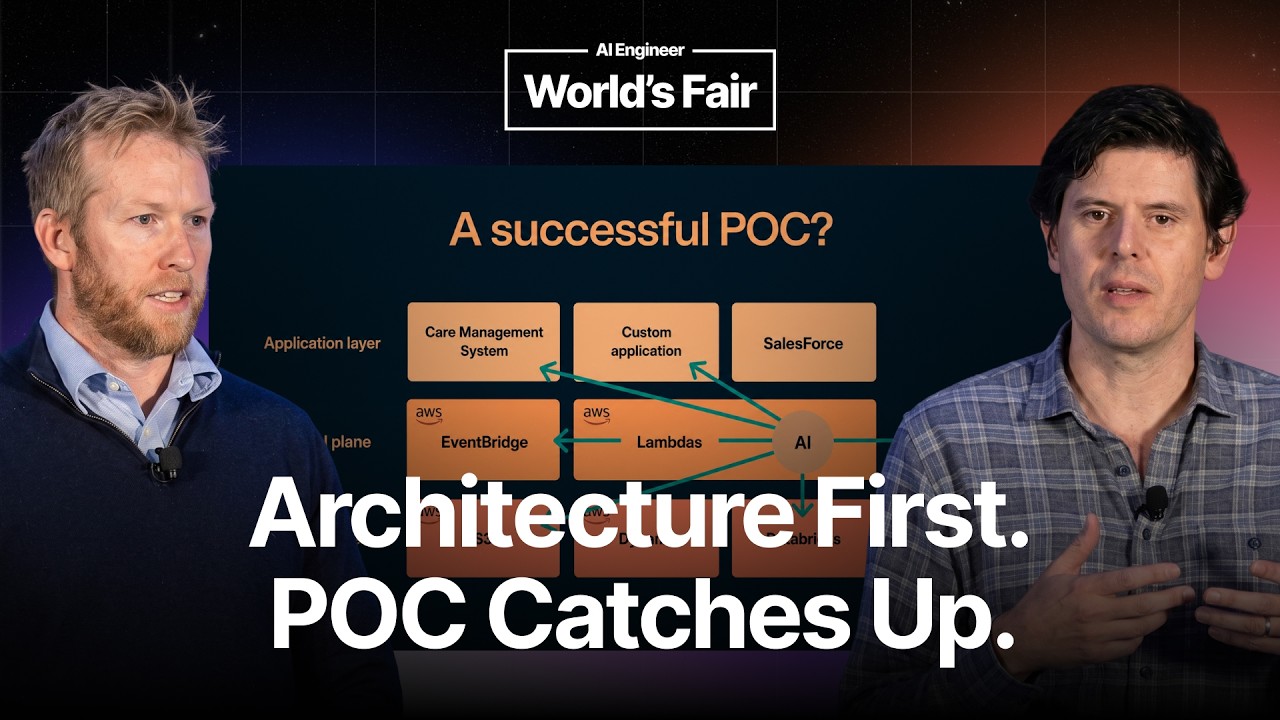
Christopher Lovejoy and Saul Howard from Anterior discuss the critical architectural principles for successfully deploying AI agents in highly regulated enterprise environments, particularly healthcare. They argue against the common pitfall of building a successful proof of concept (POC) and then attempting to bolt on compliance and security requirements, advocating instead for a “constraints-first” approach.
The “POC Trap” and Unanswered Questions
Many organizations experience a successful AI agent POC that meets accuracy targets, is fast, and cost-effective. However, when it comes to productionizing, critical questions arise that the initial POC often cannot answer:
- Audit Trail: Can every step, action, and data access be recorded for compliance (e.g., SOC 2, HITRUST, HIPAA)? This is distinct from a developer log; it must serve as a justifiable chain of evidence in a legal context.
- Sensitive Data Handling: How is protected health information (PHI) managed? How is zero trust enforced, and how are prompt injection risks mitigated?
- Escalation: How are decisions escalated to human review, especially when scenarios are dynamic and unpredictable?
- Evaluation (Evals): How can agents be continuously evaluated, especially on production data, given LLM non-determinism, data drift, and privacy concerns?
Architectural Primitives for Regulated AI Agents
Instead of retrofitting, the speakers propose three core architectural primitives that address these challenges by making auditability, data privacy, and escalation fall out of the system’s design:
1. Immutable Event Log for Auditability
- Concept: An append-only, timestamped, complete, and unified transaction log that acts as the single source of truth for all system events and agent actions.
- Benefit: Auditability becomes “trivial” because the storage model inherently provides a complete, unalterable record. It allows for reconstructing the exact state of the system at any given point in time.
- Trade-off: Writes are easy, but reads become more complex as they require reconstructing views from all events. However, this also allows for flexible, computed interpretations of raw data, which is beneficial in healthcare.
2. Schema-Driven Object Storage for Sensitive Data
- Concept: Sensitive data, such as PHI, is stored separately in schema-driven object storage, rather than directly within the event log. The event log only stores references (pointers) to these data blobs.
- Characteristics of Healthcare Data: It is complex, often unstructured and structured, large, and subject to strict access controls (e.g., role-based access control, R-BAC). Customers may also be unwilling to let their data leave their private environment.
- Benefits:
- Debugging without Data Exposure: Developers can debug agent behavior and retrace steps based on event logs and data schema without needing direct access to sensitive PHI.
- Zero Trust and Prompt Injection Mitigation: Object storage provides a natural enforcement point for zero trust principles. Agents access data via tokens at the point of use, preventing data from flowing freely and mitigating the “lethal trifecta” of prompt injection by segregating data access points from orchestration logic.
3. Human-Agent Equivalency for Dynamic Escalation
- Concept: The platform defines a broad “agent” type that encompasses both Large Language Models (LLMs) and human operators. This means any action an LLM can take, a human can also take.
- Challenges of Escalation: Escalation is dynamic and unpredictable. Humans and LLMs process context differently.
- Benefits:
- Seamless Escalation: Agents can seamlessly escalate to humans at any point in a workflow. The downstream system does not differentiate whether an action was performed by an LLM or a human.
- Unified Context Handling: Allows for defining a shared context definition, irrespective of whether an LLM (via prompts) or a human (via a UI) will consume it.
Evals as a Byproduct of Design
The presented primitives enable robust, privacy-preserving evaluations that emerge naturally from the system’s architecture:
- Immutable Ledger: Allows replaying agent actions at any past state, enabling precise experimentation (e.g., tweaking a prompt or model) and observing its direct impact with full historical context.
- Human-Agent Equivalency: Enables direct comparison; both an LLM agent and a human can perform a task, with the difference in outcomes serving as the evaluation score.
- Object Storage: Facilitates running evals directly on production data, even within a customer’s secure environment, without ever exposing the sensitive data to the agent’s core processing environment.
Conclusion: Constraints-First Architecture
The core takeaway is that successful enterprise AI architecture in regulated domains requires taking constraints seriously from the outset. By choosing what aspects of the system must remain simple (like auditability or data privacy) and designing primitives around them, organizations can build robust, scalable, and compliant AI systems that eventually achieve the accuracy seen in initial POCs, rather than creating brittle solutions by attempting to bolt on requirements later.