The Promptware Kill Chain: How Prompt Injection Becomes AI Malware
Promptware introduces a new class of AI malware leveraging prompt injections to exploit architectural flaws in LLMs. This summary details The Promptware Kill Chain, covering stages from initial access and jailbreaking to persistence, lateral movement, and real-world impact. It emphasizes the critical need for a Zero Trust approach, treating AI agents as hostile runtimes to defend against these sophisticated AI-native threats.
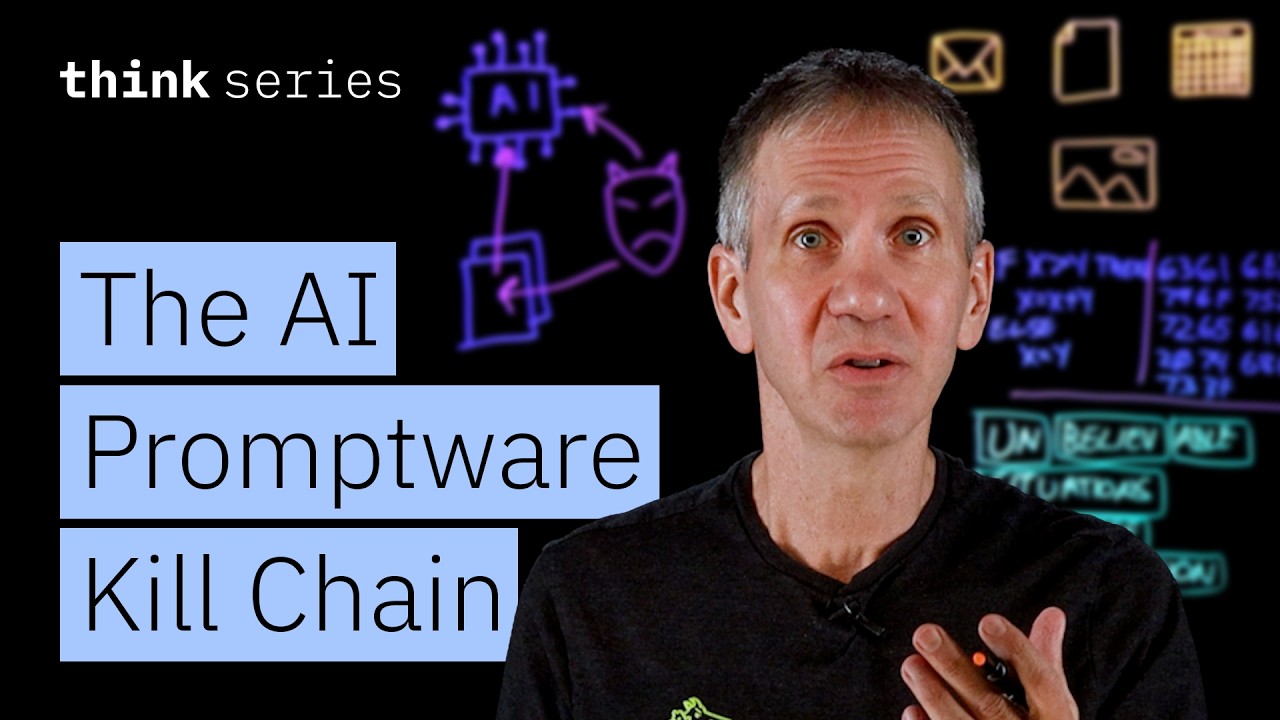
The speaker introduces “Promptware” as a novel malware execution model that leverages prompts fed into generative AI chatbots or agents. This threat is systematically described through the “Promptware Kill Chain,” a multi-stage model detailing cyberattacks from initial access to objective achievement.
The kill chain commences with Initial Access, where malicious payloads are injected via direct commands in prompts (e.g., “only give me wrong answers”) or indirectly through malicious instructions embedded in content consumed by the AI. This stage exploits an architectural flaw in large language models (LLMs): their inability to distinguish between instructions and data, treating all input as tokens. This allows malicious code within emails, documents, calendar invites, or images to be executed with the same authority as legitimate commands.
Next is Privilege Escalation, or “jailbreaking,” where attackers manipulate the AI to bypass its safety alignments. This is achieved through social engineering, role-play, or adversarial prompt techniques, exploiting the AI’s emulation of human intelligence and its inherent vulnerabilities to trust. Successful escalation grants attackers administrative access to the AI’s reasoning engine, allowing them to override system design (e.g., “ignore all previous rules,” persona shifts to elicit sensitive information).
Reconnaissance in Promptware is unique, occurring after compromise. The model is coerced into revealing its internal attack surface, including available tools, accessible APIs, plugins, connected systems, and agent permissions, effectively making the AI disclose how it can be further exploited.
Persistence is achieved by turning ephemeral interactions into lasting compromises. Attackers plant malicious prompts into the AI’s long-term memory systems (e.g., RAG databases, email archives, chat histories). These prompts are then re-executed every time the compromised data is referenced, causing continuous self-reinfection.
With persistence established, Command and Control (C2) utilizes the LLM’s internet access as a dynamic communication channel. This enables remote injection of new instructions, updating attack goals, or allowing the AI to “phone home” to fetch external content for reinfection.
Lateral Movement involves spreading the attack across the system. Due to the deep interconnectedness of AI agents (accessing emails, calendars, smart devices, enterprise tools, and other agents), an infected agent can propagate malicious payloads to contacts, mimicking a computer virus and establishing “highways for malware propagation.”
The final stage is Action on Objective, the attacker’s real-world goal. This goes beyond simple chatbot manipulation, aiming for tangible impacts like data theft, financial fraud, cryptocurrency transfers, or arbitrary code execution. At this point, Promptware acts similarly to traditional malware, executed through the AI’s reasoning, potentially even generating new malware.
To counter this threat, the speaker emphasizes a Zero Trust approach: “assume breach.” Since prompt injection is persistent and initial access is inevitable, security defenses must be designed assuming an attacker is already inside. This means treating AI agents as “untrusted execution environments” or “hostile runtimes.” Mitigations include breaking the kill chain at every stage by limiting privilege escalation, constraining tool access, detecting persistence, and restricting actions. Promptware necessitates a fundamental re-evaluation of security paradigms, as it represents a new class of malware.