Why companies are becoming a series of loops | Anish Acharya (a16z)
Anish Acharya, a General Partner at a16z, shares profound insights into the AI era. He debunks fears of a "permanent underclass," arguing that AI amplifies human agency and ambition. Anish introduces the concept of company building as creating cascading "loops" across all functions, with human intuition crucial for overcoming local maxima. He identifies the biggest consumer opportunity as "/loop, make me happier," focusing AI on fundamental human needs like connection and fun. He also discusses the nuances of model specialization, how moats are discovered rather than designed, the rising importance of distribution, and the potential for "expensive consumer software," offering actionable advice for product builders to embrace AI.
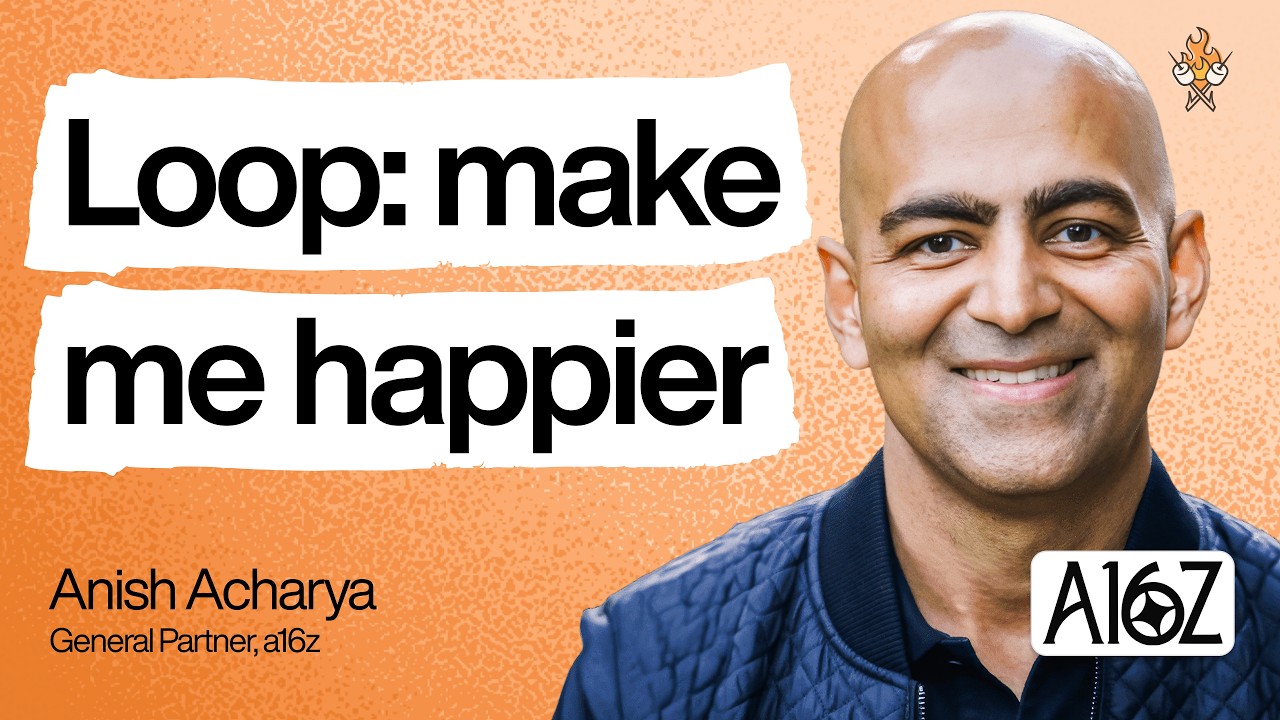
Anish Acharya, General Partner at Andreessen Horowitz (a16z), offers a deeply insightful perspective on the future of company building and consumer products in the age of AI. Drawing from his extensive background as a founder and product leader, Acharya presents a nuanced and optimistic view on AI’s transformative potential.
Dispelling Fears: AI, the “Permanent Underclass,” and Economic Diffusion
Acharya challenges the prevalent “permanent underclass” fear, labeling it a “funny dark fantasy.” He argues that the current tech era is more decentralized, with numerous players across every stack layer, unlike the winner-take-all dynamics of the mobile era. He points to empirical data showing job growth in fields like radiology and programming, which were predicted to decline. Acharya differentiates between “recursive self-improvement” (RSI) and “autocatalytic effects,” noting that current AI advancements are more about improving processes with new tech rather than runaway self-improvement. He posits that AI’s economic diffusion will be slower than often predicted, and many problems are not solely “intelligence-bound,” limiting AI’s immediate disruptive force in all sectors.
AI Adoption: Evolution Not Revolution for Every Company
Companies are adopting AI in varied ways. While many aim to leverage AI within existing structures (“swapping coal for electricity”), the most ambitious are completely reorganizing around AI, akin to redesigning factories for electricity. Acharya believes most employees are keen to embrace AI for leverage and self-improvement, citing examples like Kavak’s “Jedi Academy” training mechanics to build AI agents. He emphasizes that AI offers CEOs the chance to achieve vastly larger scales (e.g., a $40 trillion company instead of a $4 trillion one), with current challenges often revolving around roadmapping and ambition, not job displacement.
Company Building as a Series of Cascading Loops
A core concept introduced is that company building will increasingly involve creating a series of “loops.” Starting from agents (models in a loop with tools, memory), this extends to sets of agents doing tasks, then to loops across job functions (e.g., coding loops for bug fixes, growth loops for experiment generation and measurement), and eventually to business-level loops informing strategic decisions.
- The Role of Humans: Acharya stresses that humans remain critical. Loops facilitate climbing to “local maxima,” but human intuition and “out-of-distribution thinking” are necessary to identify and land at the base of the next hill. Humans will focus on sales, support, strategy, and managing exceptions.
- Examples: Engineering loops are leading the way, but growth teams could automate experiment generation, measurement, and deployment. Go-to-market teams can leverage AI to handle administrative tasks, freeing them for high-value interactions.
The Biggest Opportunity: “/loop, make me happier”
Acharya argues that the consumer market mistakenly overemphasizes productivity. He believes people often want to spend time, not save it, gravitating towards entertainment and social products. The immense opportunity for AI lies in addressing fundamental human needs: “How do we feel more connected, more loved? How do we make progress? How do we have fun?” This is not a model limitation but a product design challenge. Startups are uniquely positioned to explore “uncomfortable parts of our social existence” that incumbents might avoid, fostering products that improve health, friendships, and overall well-being.
- Consumer AI Landscape: Key areas of opportunity include:
- Coding Agents: Evolving into general problem-solving tools for consumers (e.g., Wabi for mini-apps).
- Personal Agents: Simplifying complex agent systems into mass-market, user-friendly assistants (e.g., Grok, ChatGPT Work, Instinct).
- Entertainment/Creative Tools: Companionship products, creative music tools (e.g., Suno), and ways to add “texture to our human lives.”
The “Model Sommelier” & Model Specialization
Acharya, often called a “model sommelier,” emphasizes that models are not fungible commodities. Each model has unique strengths and “mind shapes.”
- Frontier vs. Open-Weight: Different tasks demand different models. Unbounded upside tasks (e.g., drug discovery) may justify expensive frontier models, while bounded upside tasks (e.g., some legal or finance functions) benefit from Pareto-efficient open-weight models that offer good performance at a lower cost.
- Hands-on Experience: To understand model nuances, it’s crucial to “ship something with every new model.” Examples like Qwen 38B (creative, long-horizon tasks, storytelling) versus GLM 53 (neuroticism, precision) highlight these distinctions.
- The “Building is the New Reading” Mantra: He advocates for building frequently, even silly or unimportant projects, as a primary way to learn and build intuition about AI capabilities.
Optimism for a More Ambitious and Fulfilled Future
Acharya is profoundly optimistic about AI’s potential:
- Amplifying Agency: AI “unbundles skill from desire,” enabling individuals to pursue creative ambitions (music, programming) without needing traditional skills.
- Economic Growth: AI can dramatically accelerate GDP growth beyond the historical 2% and drive ambition across society.
- Deflationary Impact: AI can make essential services like healthcare (by reducing administrative burden and enabling cures) and education (by unbundling learning from institutions) cheaper and more accessible.
- Human Desire and Expectation: Human desires always outpace fulfillment, ensuring continuous demand for new innovations and services, leading to greater overall societal well-being and ambition.
Building Durable Moats in the AI Era
Acharya offers critical insights on competitive advantage:
- Moats are Discovered, Not Designed: Founders shouldn’t over-engineer moats initially. Instead, focus on shipping and letting durability emerge from product-market fit (e.g., Cursor).
- Classic Moats Endure: Network effects, scale advantages, brand, and proprietary data remain powerful moats. Founders should cultivate ambition in these directions, building multiplayer products and those that improve with use.
- The Power of Distribution: In a crowded market, organic word-of-mouth (being “remarkable” as Seth Godin says) and building direct channels are paramount. While incumbents have distribution, startups can build in uncomfortable directions with high pricing ceilings.
- “Expensive Consumer Software”: A counter-intuitive idea is to design consumer products that justify extraordinarily high prices (e.g., a software Birkin bag), challenging the traditional “consumer products must be free” wisdom.
Advice for Product Builders
Acharya’s core advice is simple: “Just make more things.” Build projects (important or not) to use new models, ship constantly, talk about your creations, and build intuition. He encourages product people to embrace vulnerability, share their work, and recognize that now is the time to build the products they’ve always envisioned. He suggests aiming to ship something once a week, even small, joyful projects like a Mother’s Day slide deck. The key is to find moments of joy created by AI and continuously ask, “How can AI do this for me?”
Lightning Round Highlights
- Recommended Books: Conquests and Cultures (Thomas Sowell), Seven Powers (Hamilton Helmer), Increasing Returns to Scale (Brian Arthur).
- Favorite Recent AI Product: Grok Bot, for its unhinged ambition, thoughtful UI, powerful foundation model, and risk-taking approach.
- Life Motto: “Don’t discover things through painful experience that somebody can just tell you.”
- DJing: A 30-year passion; sees music models as a powerful way to express musical ideas, suggesting everyone pursue music creation or DJing.