The Reason Your Claude Output Still Looks Like Slop (with Priyanka Vergadia)
Priyanka Vergadia, The Cloud Girl, discusses why most companies see no ROI from AI tools, proposing a 7:1 budget split for training over tools. She explains how AI has made "taste" the new ceiling, detailing how to build effective Claude skills by breaking tasks into explicit subtasks with human-in-the-loop oversight. She introduces her 10-20-70 framework for AI budgets, emphasizing the long-term investment needed for employee skilling and community building. Priyanka also shares her transition to full-time entrepreneurship, focusing on product and career storytelling, and reveals her upcoming book on tech storytelling.
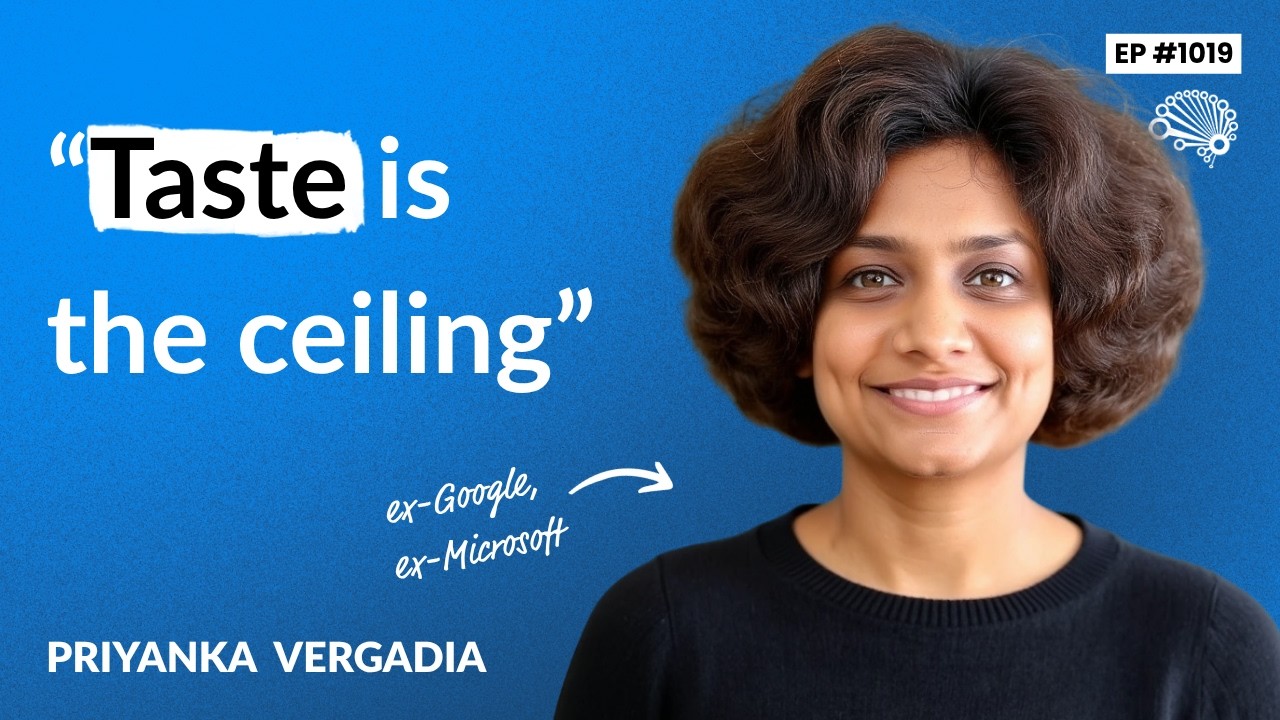
Priyanka Vergadia, known as The Cloud Girl, highlights a critical issue in AI adoption: despite widespread purchase of AI tools, most companies are not seeing a return on investment. She proposes a budget split that allocates a significantly larger portion, specifically seven dollars, to employee training for every dollar spent on the tools themselves. This approach stems from her extensive experience turning complex cloud and AI concepts into accessible content and her work driving enterprise adoption of tools like GitHub Copilot.
The Evolution of Technical Skills: AI Raises the Floor, Taste Becomes the Ceiling
Vergadia argues that AI has “raised the technical floor,” meaning that many basic technical tasks, such as coding, can now be augmented or performed by AI. This shift, however, has made “taste” the new ceiling for what distinguishes high-value professionals. She defines taste as an abstract quality derived from having played with tools extensively, possessing a unique perspective, and drawing from lived experiences. In interviews, she now prioritizes a candidate’s ability to think, their distinct ideas, and their unique style over mere tool proficiency. She emphasizes that AI models, being trained on average internet data, often produce “at best average” output, making human creativity and unique perspectives indispensable.
She addresses the concept of “AI slop,” where AI-generated content lacks depth or originality. To combat this, she advocates for transparency in AI usage and injecting personal credibility, personality, and lived experiences into the content. For example, her own GenAI-powered sketches are fine-tuned with her unique hand-drawn style and guided by her personal storytelling framework, ensuring the output reflects her distinctive “taste” and expertise, rather than generic AI output.
Structuring Claude Skills for Optimal Output
To maximize the utility of AI tools like Claude and avoid generic “slop,” Vergadia details a methodical approach to building “skills”:
- Define the Task: Clearly articulate the overall task to be accomplished.
- Break into Explicit Subtasks: Deconstruct the main task into smaller, manageable steps, mimicking how a human would approach it.
- Example (Blog Writing Skill):
- Step 1: Research: Use a highly specific prompt to ensure high-quality research from credible sources (e.g., “only high-quality content written by researchers and scientific research from schools and universities…”).
- Step 2: Synthesize (Human-in-the-Loop): Incorporate a human review step. Claude sends the research, allowing for human assessment and instruction before proceeding.
- Step 3: Outline: Generate an initial outline, rather than directly writing the full blog.
- Step 4: Analogies & Storytelling: Integrate personal analogies and storytelling elements based on lived experiences.
- Step 5: Formatting & Examples: Specify desired structure (e.g., “three developer-focused images,” “one practical example from my experiences,” for which Claude can prompt for input).
- Example (Blog Writing Skill):
- Use Detailed Prompts: For each subtask, craft precise prompts that guide the AI’s behavior and desired output.
This structured approach ensures a more personalized and higher-quality outcome, typically achieving an 80% complete draft ready for final human editing, thus leveraging AI’s efficiency without sacrificing uniqueness.
The 10-20-70 Framework for AI Budgets
Vergadia introduces her 10-20-70 framework, a strategic allocation of AI budgets designed to foster genuine adoption and ROI:
- 10% on Tools: The actual purchase and licensing of AI software.
- 20% on Execution: The implementation and integration of these tools into existing workflows.
- 70% on Education and Skilling/Upskilling: The most crucial, yet often overlooked, component involving comprehensive employee training.
She explains that AI adoption follows a “J-curve,” requiring a sustained, long-term investment. Simply providing tools or generic training leads to “token maxing”—employees using AI for trivial tasks, resulting in high costs and no tangible returns. Effective skilling involves showing employees how to use AI tools effectively for real use cases within their specific jobs, rather than just generic instruction. This necessitates building internal communities where colleagues can share experiences and best practices. While this 70% investment can be costly and challenging for CFOs to accept due to its long-term nature (6-8 months for productivity gains to become apparent), Vergadia argues it is the only way to build effective AI habits and achieve company-wide efficiency through the evolution from better prompts to full agents across business units. She likens this to the long-term community building inherent in Developer Relations, where benefits materialize over years, not quarters.
Priyanka’s Entrepreneurial Journey and Future Outlook
Priyanka recently transitioned from her senior roles at Google (Head of North America Developer Relations) and Microsoft (Senior Director of AI Transformation for GitHub Copilot) to focus full-time on her own firm, The Cloud Girl. This move is driven by her dual passion for learning and teaching, which she now applies to product storytelling for startups and enterprises, and career storytelling for individuals. She believes that in the current rapidly evolving AI landscape, where products and resumes can sound increasingly similar, effective storytelling is paramount for differentiation.
Breaking news, she is currently working on her next book: a “tech storytelling” guide aimed at bridging the gap in product and career narratives within the technology sector.
Her guidance for individuals and organizations preparing for the future revolves around identifying and leveraging one’s Unique Selling Proposition (USP). For individuals, this means undertaking a “weekend exercise” to answer deep, personal questions about their purpose and impact, moving beyond mere skills to articulate why someone would hire them. For businesses, it involves understanding the core problem their product solves, beyond just features, to differentiate themselves in a crowded market.