Ai strategy

The Reason Your Claude Output Still Looks Like Slop (with Priyanka Vergadia)

The Reason Your Claude Output Still Looks Like Slop (with Priyanka Vergadia)

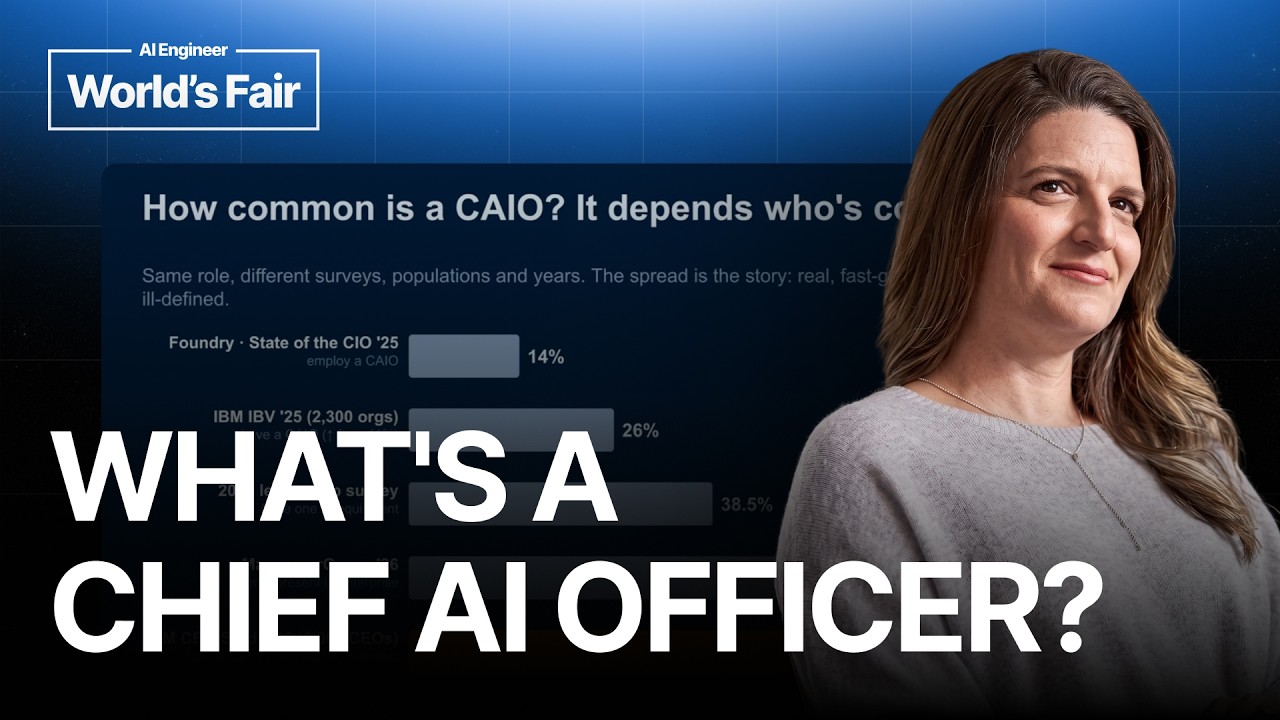
Priyanka Vergadia, The Cloud Girl, discusses why most companies see no ROI from AI tools, proposing a 7:1 budget split for training over tools. She explains how AI has made "taste" the new ceiling, detailing how to build effective Claude skills by breaking tasks into explicit subtasks with human-in-the-loop oversight. She introduces her 10-20-70 framework for AI budgets, emphasizing the long-term investment needed for employee skilling and community building. Priyanka also shares her transition to full-time entrepreneurship, focusing on product and career storytelling, and reveals her upcoming book on tech storytelling.

How Harvey Built a Research Lab on a Budget | Gabe Pereyra

How Harvey Built a Research Lab on a Budget | Gabe Pereyra

Gabe Pereyra of Harvey details a playbook for application companies to compete with frontier AI labs by leveraging the ecosystem. Key strategies include building specialized benchmarks like Legal Agent Bench, using domain experts for synthetic data generation to overcome sensitive client data issues, partnering with multiple 'neo labs' for post-training, and developing robust model serving and evaluation infrastructure. He emphasizes open-sourcing data for validation and the 'Moneyball' philosophy for success, addressing challenges like talent acquisition and long-context management in the Q&A.

How Companies Are Building Their Own Intelligence | Sonya Huang, Sequoia Capital

How Companies Are Building Their Own Intelligence | Sonya Huang, Sequoia Capital

Sonya Huang of Sequoia Capital discusses the strategic imperative for companies to embrace "sovereign AI" by owning their AI models and weights. She identifies cost, speed, performance, and controlling destiny as the four driving forces behind this shift. Huang argues that the competitive landscape is moving towards owning the intelligence layer, positioning application companies as the new innovation labs. She provides a practical, opinionated framework covering strategy (what to own vs. rent), team building, ensuring external legibility of research, and a technical roadmap for implementation, emphasizing how open-weight models now enable frontier-level performance through ownership and customization.

Kavak's Playbook for Rebuilding a Company Around AI

Kavak's Playbook for Rebuilding a Company Around AI

Alejandro Maza Ayala, Chief Product & AI Officer at Kavak, details how the used-car marketplace transformed into an AI-native company. He explains the 'agent-per-customer' architecture, where individual agents handle 96% of customer interactions and 95% of transactions, outperforming human teams in sales (2.1x better conversion) and even acting as an 'AI CEO' that boosted profits by 50% in an experimental city. The discussion covers the need to redesign company structures, the importance of robust evaluations, and how a 'Jedi Academy' trains all employees, from executives to mechanics, to build and collaborate with AI agents. Ayala argues for 'creative destruction,' suggesting that true AI leverage comes from rebuilding organizations from the ground up, rather than incremental adoption, presenting a massive opportunity for new founders.

Decagon’s Playbook for Building Enterprise AI Applications

Decagon’s Playbook for Building Enterprise AI Applications

Jesse Zhang and Ashwin Sreenivas, co-founders of Decagon, discuss their company's transition to open-source models for enterprise AI, emphasizing how fine-tuned small models outperform frontier models on specific tasks. They delve into the role of application-layer companies in an AI-first world, their product-driven 'glass box' approach for enterprises, and the transformative power of their 'Duet Autopilot' agent, which builds other AI agents. The conversation also covers AI's impact on jobs, highlighting the Jevons Paradox in customer support.

Notion's Token Town — Sarah Sachs, Notion

Notion's Token Town — Sarah Sachs, Notion

Sarah Sachs, Head of AI Engineering at Notion, discusses the economic traps of AI model contracts and advocates for a "win on product" strategy. She details how Notion maintains optionality and leverage by treating suppliers as competitors, implementing a model-agnostic "AI Switzerland" approach with an auto model, leveraging open-weight models, and prioritizing data flywheels and orchestration over token economics to build sustainable AI products.