AI agent adoption: From scientists to CFOs
This episode explores the transformative impact of AI through three key discussions: a homeowner using ChatGPT to sell his house, a study on AI adoption in scientific research, and Adobe's CFO building an internal AI lab. The experts deliberate on AI's role in democratizing expertise, the future of professional roles, the challenges and biases in measuring AI's scientific impact, and the critical factors for successful enterprise AI adoption, including process and cultural shifts, and identifying the hottest areas for implementation.
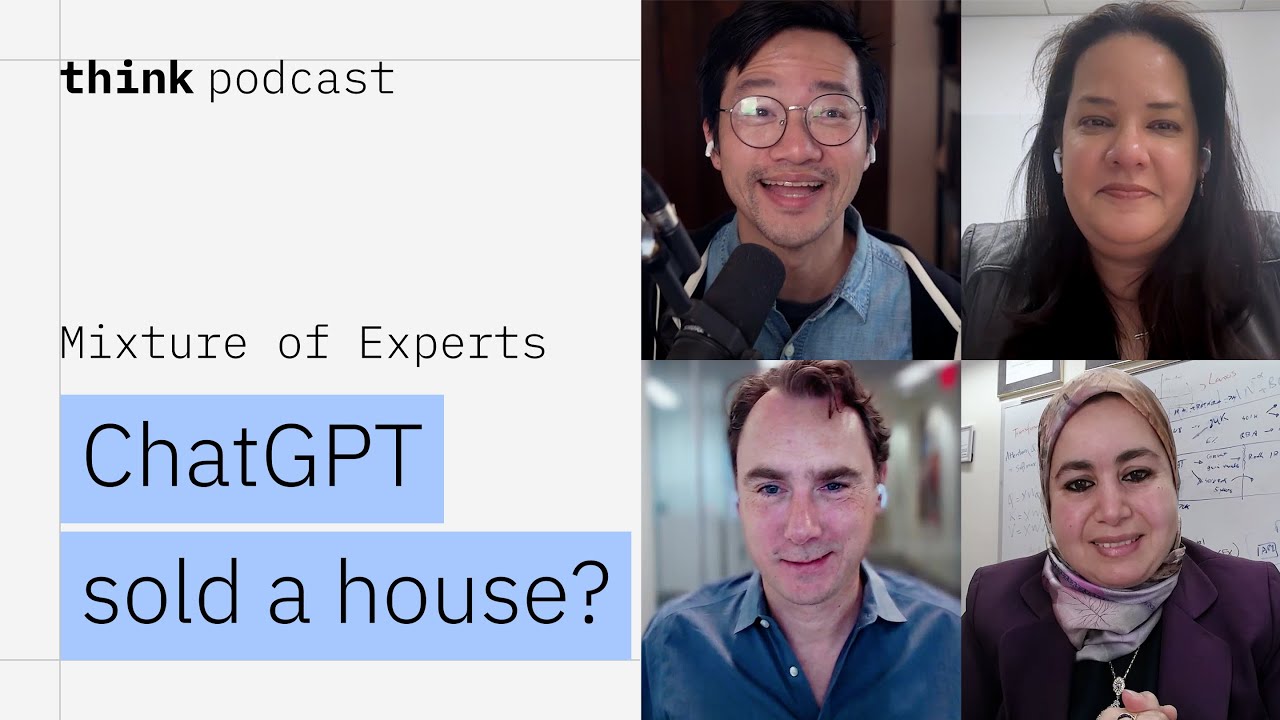
This 100th episode of Mixture of Experts reflects on the rapid evolution of AI, from GPT-2 to current advanced models, by examining three key discussions on its impact across society, scientific research, and enterprise.
AI and the Democratization of Expertise: The ChatGPT Home Sale
The episode opens with a compelling anecdote: a homeowner successfully used ChatGPT to sell his house for $100,000 over realtor estimates. This immediately sparked a discussion on AI’s role in democratizing expertise and lowering skill barriers. The panelists emphasized that this isn’t just about real estate, but about how AI is becoming “essential in almost everything that we do,” enabling individuals without specialized knowledge to achieve expert-level outcomes by reducing workflow barriers. Ritika Gunnar notes that those who work with AI will “see those gains and those right kind of outcomes.”
Kaoutar El Maghraoui highlighted that current LLMs act as a “distilled representation of that collective expertise,” capable of simulating top-tier expert actions when prompted correctly. This leads to a “compression of expertise,” changing who has access to specialized knowledge. A crucial question raised is whether widespread AI adoption will lead to market homogenization, where everyone following AI advice results in a “new middle” with higher overall quality, but potentially less diversity.
The debate then shifted to the future of professional roles, specifically lawyers. While the homeowner used ChatGPT for much of the process, a human lawyer was still consulted for contract review. Volkmar Uhlig argued that for AI to deliver full economic gains, it needs to close the loop 100%, suggesting lawyers, too, might eventually be replaced. However, Gunnar countered, proposing that AI would differentiate lawyers, making those who leverage AI far more efficient. The “bar for those lawyers is now a lot higher,” as AI automates tasks like search and document review, but human judgment, strategy, ambiguous interpretation, and client trust remain irreplaceable. The panelists agreed that entry-level tasks will change, but the need for entry-level workers to become future experts persists.
A final point concerned data. Gunnar posited that while LLMs excel with public data, an organization’s or individual’s private data becomes the true source of differentiating value and, essentially, “the application.” Furthermore, the panel stressed that foundational skills are shifting; coding, once considered the “fourth ‘R’,” is now often handled by GenAI tools. The new essential skill is “understanding how to work with GenAI tools” and driving value from them, making AI literacy crucial for future workforces.
AI in Scientific Research: Claude Code Adoption Study
The second segment analyzed a Substack article by Charles Yang, which estimated that only 2.1% of scientists with linked GitHub profiles use Claude Code. The study, which used ORCID profiles and GitHub data, suggested a bell-curve adoption pattern, with more established and younger academics using AI agents.
The panelists were skeptical of the study’s methodology. Uhlig found the 2.1% adoption rate surprisingly low, expecting 30-40% given the “10 to 100x productivity gain” AI offers. He questioned the potential for bias in focusing solely on GitHub users and whether this reflected true innovation or merely repetition in science. El Maghraoui pointed out a fundamental mismatch: while AI can write code that runs, scientific rigor demands understanding why it works, reproducibility, and verifiability—qualities often lacking in probabilistic, non-deterministic AI systems. She stressed the need for AI systems to become more “deterministic, calibrated, [and] traceable” for broader scientific adoption.
Gunnar highlighted the “lumpy effect” AI might have on scientific progress due to varying data readiness across fields. Many researchers use proprietary, field-specific datasets and tools (MATLAB, SPSS, Excel), which are not typically found in GitHub repositories. The study’s narrow focus on GitHub-linked ORCID profiles for “computationally active researchers” excluded a vast segment of the scientific community (e.g., wet lab scientists, clinicians, social scientists), underscoring a significant “measurement bias.” This segment concluded that a “shadow AI economy” likely exists within scientific research, underrepresented by such studies.
Enterprise AI Adoption: Adobe’s CFO and the AI Lab
The final discussion centered on Adobe CFO Dan Durn’s initiative to transform his finance team into an internal “AI lab.” His team uses autonomous agents for forecasting, contract analysis, and inbox management, achieving significant time savings with “boring use cases” that are high-impact and low-risk.
This raised the question of AI ownership within companies: centralized IT/AI departments versus distributed adoption. Gunnar, citing an IBM study, noted that successful AI projects require a three-pronged approach: technology, process change (top-down vision combined with bottom-up experimentation), and, most critically, cultural transformation. She observed that projects taking years now take weeks, necessitating resource reallocation and upskilling for finance experts to work with AI tools.
El Maghraoui envisioned an “inevitable shift to distributed AI,” where an AI platform team centralizes infrastructure, models, and guardrails, while “every team will become an AI team,” embedding AI into sales, HR, legal, and other functions. Uhlig emphasized that mundane, high-volume tasks with structured data and clear safeguards (like PDF extraction in finance) are ideal starting points for AI adoption. These “low-hanging fruits of very high impact” build confidence and free up resources for more advanced applications.
The panelists identified three hottest areas for enterprise AI adoption:
- Software Development Lifecycle (SDLC): Automating not just coding but the entire development process.
- Back-Office Tasks: Areas like finance, supply chain, marketing, and HR, where high access to enterprise data allows for automation and orchestration to drive efficiencies and new ways of working.
- Customer Care: Enhancing support, client knowledge, and targeted product offerings, marking a significant transformation in client interactions.
Looking ahead, Gunnar suggested that jobs requiring high emotional intelligence (EQ) or physical labor would be the hardest to replace by AI. However, El Maghraoui countered that the emergence of “physical AI and humanoid robots” suggests even physical labor might eventually be disrupted, marking the next frontier after agentic AI. The overall consensus is that while certain human elements remain critical, every profession will be transformed, requiring an “AI-first organization” mindset.