Workflow automation

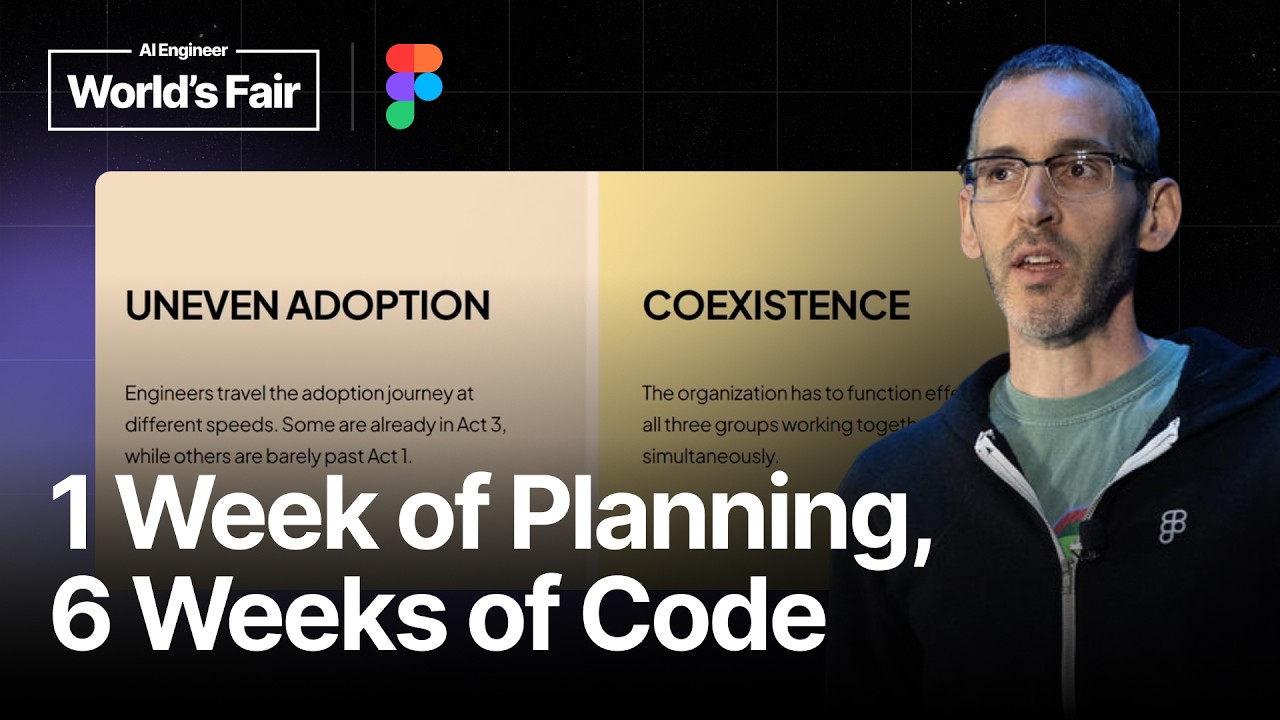
How to Get Your Org to Adopt Coding Agents (Without Shipping Garbage) — Eyal Blum, Figma

How to Get Your Org to Adopt Coding Agents (Without Shipping Garbage) — Eyal Blum, Figma

Figma's internal AI agent adoption journey faces challenges like reduced developer agency, skepticism from senior engineers, and communication inefficiency. Solutions include investing in verification, using a testing pyramid for agent review, prioritizing detailed planning over prompting, engaging skeptics to build AI safety roadmaps, and implementing attention-aware communication by clearly marking AI-generated content.

AI Evals for Cross-Functional Teams — Nachiket Paranjape & Swaroop Chitlur Haridas, DoorDash

AI Evals for Cross-Functional Teams — Nachiket Paranjape & Swaroop Chitlur Haridas, DoorDash

DoorDash's GenAI platform team transformed evaluation from an engineering-centric task into a cross-functional workflow. By adopting an API-first strategy, they empowered non-engineers like Strategy & Operations to "vibe code" their own annotation UIs using coding agents and self-serve calibrate LLM judge prompts. This approach dramatically reduced annotation costs, accelerated iteration, and fostered broader organizational ownership of AI quality.

AI in GTM at Notion — Flora Liu

AI in GTM at Notion — Flora Liu

Flora Liu from Notion's GTM engineering team discusses transforming a fragmented Go-to-Market system into a unified, agent-driven platform. She details how Notion tackles challenges like dispersed customer data and unstructured insights by building a four-layered architecture (Know, Decide, Act, Learn) where humans and AI agents operate on the same substrate, leveraging Snowflake, DynamoDB, and Notion itself to create durable, self-improving workflows and boost sales and marketing effectiveness.

CAN CHINA BEAT WAYMO?

CAN CHINA BEAT WAYMO?

This episode discusses three critical topics in AI: the true nature of recent AI agent "breakouts," arguing they highlight governance and security flaws rather than model danger; the role of AGI narratives in fueling the current AI investment bubble and questioning its sustainability; and China's aggressive strategy in the global robotaxi market, potentially outpacing Western counterparts like Waymo.

AI tools for Forward Deployed Engineering — Vasuman Moza, Varick Agents

AI tools for Forward Deployed Engineering — Vasuman Moza, Varick Agents

Varick Agents tackles the enterprise AI adoption challenge by deploying Forward Deployed Engineers (FDEs) who map, re-engineer, and automate complex workflows directly on top of existing systems, avoiding costly migrations. The company develops specialized internal AI tooling, including 'Engagement' and 'Workflow' agents, and employs custom model training with RL environments to overcome frontier model limitations in context extraction and clarity, enabling department-wide AI transformation.

How Forward Deployed Engineering is done at Ramp — Leo Mehr

How Forward Deployed Engineering is done at Ramp — Leo Mehr

Leo Mehr, Director of Engineering at Ramp, outlines two critical principles for Forward Deployed Engineering (FDE): "Always Be Scoping" to ensure the delivery of the right product by deeply understanding customer needs and context, and "Scale with Tokens" by strategically integrating AI agents into FDE workflows. He highlights Ramp's success in automating request intake and spec generation using AI, emphasizing the need for both human judgment and AI-driven efficiency to thrive in the future.