How to Get Your Org to Adopt Coding Agents (Without Shipping Garbage) — Eyal Blum, Figma
Figma's internal AI agent adoption journey faces challenges like reduced developer agency, skepticism from senior engineers, and communication inefficiency. Solutions include investing in verification, using a testing pyramid for agent review, prioritizing detailed planning over prompting, engaging skeptics to build AI safety roadmaps, and implementing attention-aware communication by clearly marking AI-generated content.
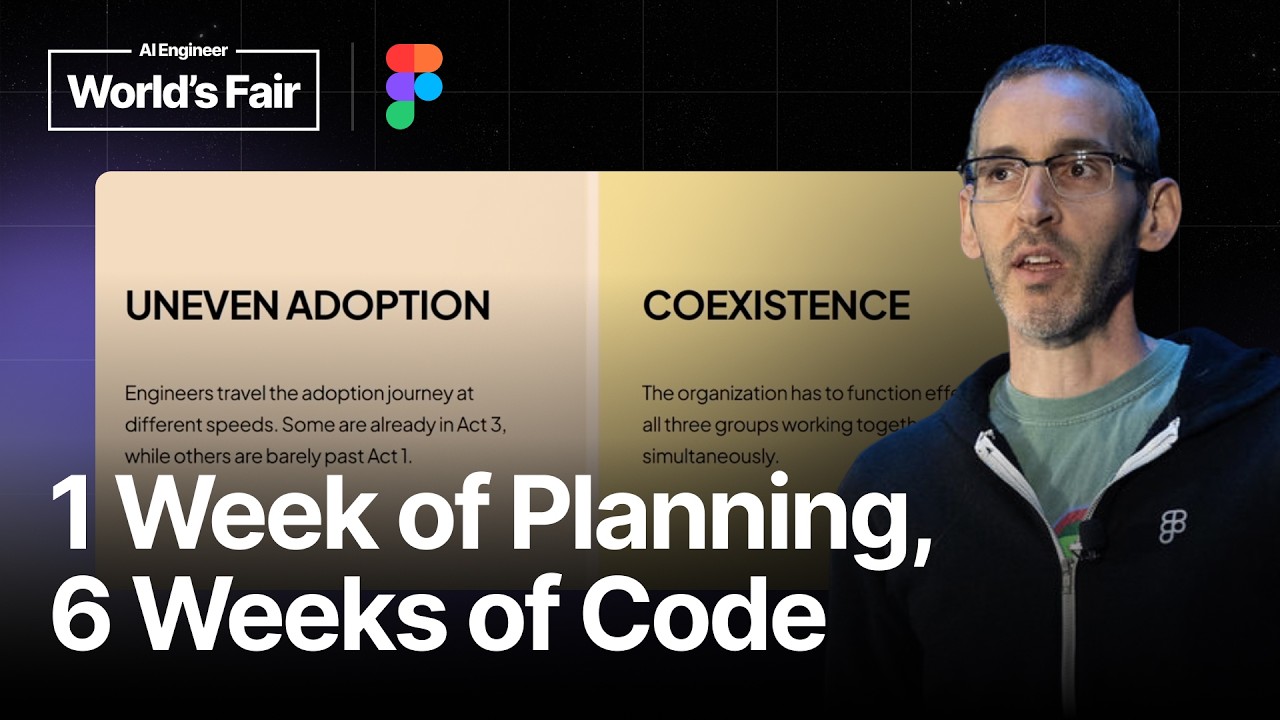
Eyal Blum from Figma details the company’s internal adoption of AI agents, describing a “three-act process” for AI integration: initial success, followed by failures and eroded trust, culminating in building real skill with guardrails and proper context. Figma has observed “uneven adoption” across teams, alongside significant friction points that demand strategic solutions.## Key Friction PointsThe integration of AI agents has introduced several challenges within Figma’s engineering organization:1. Reduced Developer Agency: Many engineers, who once found satisfaction in coding, now feel their craft is diminishing. They find themselves in a “prompt cycle,” waiting for AI output, which leads to burnout and decreased job satisfaction.2. Skepticism from Senior Engineers: The most experienced engineers, those who possess crucial institutional knowledge and hold the codebase together with “mental duct tape,” are often the slowest to adopt. They anticipate and identify potential failure modes first, becoming bottlenecks due to the burden of preempting AI-driven issues. Their initial resistance is seen as a direct indicator of where validation is missing.3. Inefficient Communication: The proliferation of AI-generated content has led to design documents, Slack messages, and emails becoming “three or four times as long” without proportional increases in meaningful content. This dilutes important information and makes it difficult to discern high-quality insights.## Strategies for Successful AI Agent AdoptionFigma has developed and implemented several strategies to address these challenges and foster effective AI integration:### 1. Invest in Verification and Deterministic FlowsThe highest value investment is in verification. By “left-shifting” tasks from human effort to agent verification, such as leveraging tools like Playwright for code exploration, significant productivity gains are achieved. When an agent discovers a useful pattern or solution, it should be codified into a deterministic flow. This approach saves compute tokens and time, reserving large language models (LLMs) for complex reasoning rather than repeatable, known tasks.Employing a Test-Driven Development (TDD) style for agents is also highly beneficial. By tasking agents to write code that passes pre-defined tests, the output quality is significantly higher compared to agents writing code first and then attempting to fit tests to it.### 2. Implement a Testing Pyramid for Agent ReviewBlum advocates for a testing pyramid model for reviewing agent output, akin to traditional software testing: * Base (Deterministic Analysis): Maximize coverage here. This includes automated linting, compiler checks, and unit tests. Agents can effectively review outputs against easily encoded architectural standards and coding conventions. * Top (Human Review): Human involvement should be reserved for high-level judgment tasks, such as assessing overall functionality and confirming whether “this is the right thing to build.” This ensures human attention is focused on areas where it provides the most value.### 3. Prioritize Planning Over PromptingTo restore developer agency and enhance AI output, Figma champions planning over direct prompting. Engineers are encouraged to dedicate substantial time (e.g., “a week” for comprehensive planning, including peer reviews) to meticulously define the problem, make design decisions, and iterate on a detailed plan. Only after this rigorous planning phase is the plan handed to an agent for implementation (which might occur “overnight”). This process reintroduces “the joy of building back into the process.“A “good plan” for agents is characterized by: * A clear “why” statement at the beginning to prevent “agent drift.” * Decomposition into small, independently verifiable parts. A heuristic for sizing is that each part should correspond to a PR that can be reviewed in a single sitting. * Inclusion of validation gates or exception criteria for each phase, making the plan resilient to unforeseen issues and preventing cascading errors.### 4. Engage Skeptics as Roadmap ContributorsInstead of convincing skeptical engineers, Blum suggests leveraging their insights. Their critiques of AI agents are not merely complaints but “basically the roadmap of how to improve your agent” and expose where “validation is lacking.” By involving these skeptics in defining the roadmap for making AI safe and reliable within the codebase, they become active participants and allies. They are more likely to adopt AI tools once they witness the improvements directly addressing their concerns and making their own work easier.### 5. Adopt Attention-Aware CommunicationRecognizing that “human attention is a scarce resource,” Figma emphasizes attention-aware communication. It is crucial to clearly mark what content was generated by AI versus what was written by a human. This practice helps recipients gauge how much time to allocate for reading and anticipate potential “slop” in AI-generated sections.A prime example is the convention for Pull Request (PR) descriptions: they now start with “a line a human actually typed” outlining the core change, followed by the AI-generated description. This cultural shift arose from an incident where an unmarked AI analysis was perceived as “sloppy” by a senior engineer, highlighting the importance of transparency and managing expectations.Simple, everyday integrations, such as tagging an agent in Slack for a quick task, also help normalize AI usage by meeting users “where they’re at” and reducing friction.## The Ongoing JourneyFigma’s journey with AI adoption is continuous, marked by constant experimentation and learning. Blum asserts that this transformation—encompassing both cultural and technological shifts—represents the “biggest change by orders of magnitude” he has observed in 15 years in the tech industry, underscoring the collaborative and evolving nature of this endeavor.