Making Codebases Agent Ready – Eno Reyes, Factory AI
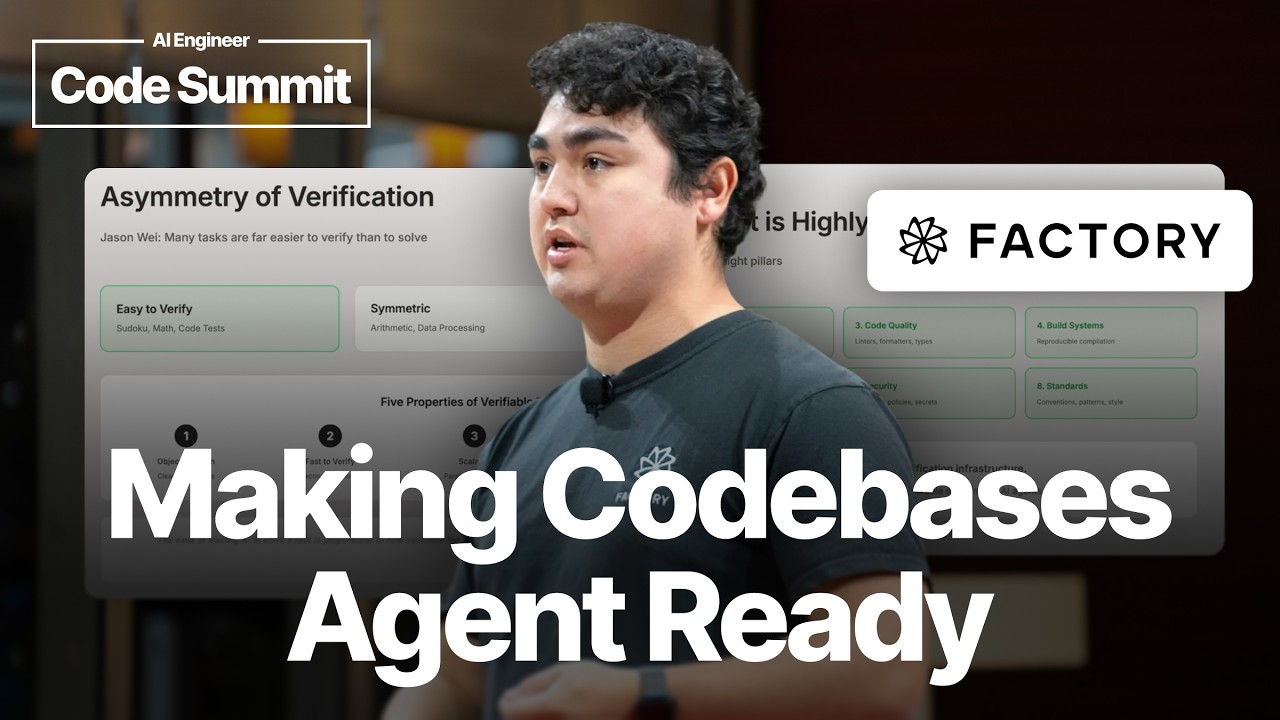
The effectiveness of AI coding agents is not limited by model quality, but by "Agent Readiness"—the state of your development environment. This talk explains why agents fail on codebases with flaky tests, low validation, and tribal knowledge. It introduces a framework for improving your environment's readiness through rigorous verification, automated validation, and a shift to specification-driven development, arguing this is the key to unlocking 5-7x productivity gains and enabling true software engineering autonomy.
The Bottleneck for AI Agents is the Environment, Not the Model
The primary obstacle to successfully deploying AI agents in software engineering is not the capability of the AI models themselves, but the “Agent Readiness” of the development environment. While agents perform well in controlled demos, they often fail in production due to environmental factors like missing variables, flaky builds, undocumented dependencies, and implicit “tribal knowledge.” The key to unlocking agent productivity lies in making the development environment more explicit, predictable, and verifiable.
From Specification to Verification
Inspired by Andrej Karpathy’s concept of Software 2.0, the talk highlights a paradigm shift from automation via specification (telling a system exactly how to do something) to automation via verification (telling a system what a successful outcome looks like and letting it search for a solution). Software development is an ideal domain for this approach because it is highly verifiable through existing mechanisms:
- Testing: Unit tests, end-to-end tests, and QA tests provide a clear pass/fail signal.
- Linting & Formatting: Automated tools enforce code style and quality standards.
- Documentation: Formal specifications like OpenAPI specs can validate API implementations.
However, most organizations have validation systems that are “good enough” for humans, who can manually test and work around inconsistencies. AI agents cannot. They require rigorous, automated validation to function reliably. A 50% test coverage or a build that flakes every third run is a critical blocker for an agent.
The New Development Loop and the Evolving Engineer
With robust verification in place, the development process shifts to a new loop: Specify -> Generate -> Verify -> Iterate. In this model, the developer’s role evolves from a direct code author to a curator of the development “garden.”
Engineers become responsible for:
- Setting Constraints: Defining the rules and validation criteria for the codebase.
- Building Automations: Creating increasingly “opinionated” linters and tests that enforce the standards of a senior engineer.
- Curating the Environment: Ensuring the entire development lifecycle is predictable and automated.
One opinionated engineer can now scale their expertise across the entire organization by embedding their standards into these automated validation systems.
The “Agent Readiness” Flywheel
The relationship between agents and their environment creates a powerful feedback loop. A better, more verifiable environment enables agents to perform more effectively. More effective agents free up developer time, which can then be reinvested into making the environment even better. This virtuous cycle is the key to unlocking massive productivity gains and is referred to as the “new DevX loop.”
Achieving Full Autonomy
The ultimate vision of a fully autonomous workflow—where a bug ticket is automatically picked up, coded, tested, approved, and deployed in hours—is not a fantasy. The speaker argues it is technically feasible today. The limiter is not the AI’s capability but the organization’s validation infrastructure.
Investing in “Agent Readiness” is not about incremental improvements (1.5x-2x). It’s about achieving exponential gains (5x, 6x, 7x) in engineering velocity. Organizations that invest now in creating highly verifiable, agent-ready environments will significantly outcompete those who wait for the models to magically solve the problem.