962: Wharton Prof Ethan Mollick on Why Your AI Strategy Is Already Obsolete
Ethan Mollick, author of "Co-Intelligence", discusses the necessity for US firms to reignite their experimental approach to management to successfully adopt AI. He introduces his "Leadership, Lab, and Crowd" framework for fostering internal innovation and cautions against over-reliance on external consultants and opaque vendor solutions, urging companies to empower their "secret cyborgs" to drive productivity.
The nature of human-AI collaboration is evolving beyond simple interactive partnerships. Initially, working with AI required constant guidance—a mode of “co-intelligence” that remains valuable. However, the landscape now includes more sophisticated modes of interaction:
- Interactive Co-intelligence: The classic back-and-forth conversation with a chatbot.
- Delegation: Assigning a specific task to an AI, using human expertise to define the task and evaluate the outcome, and intervening or taking over if the results are unsatisfactory.
- Autonomy: Allowing AI to handle certain tasks completely on its own.
Professionals will increasingly need to choose the appropriate mode for a given task, including opting to work alone when necessary.
The Enterprise Failure to Experiment
A significant portion of the competitive advantage of American firms in the 20th century—estimated at 20-40%—stemmed from a willingness to experiment with and innovate in management techniques. Today, that experimental spirit has waned. Many companies now default to hiring external consultants or trusting SaaS vendors to dictate their operational strategies. This reluctance to innovate internally is a major impediment to effective AI adoption.
This leads to common, yet suboptimal, patterns in enterprise AI implementation. A frequent first step is building a “talk to our documents” chatbot using Retrieval-Augmented Generation (RAG). While the concept of RAG is sound, a custom-built, mediocre RAG solution that was expensive a year ago is now easily outperformed by off-the-shelf frontier models. The key isn’t that RAG or consultants are inherently bad, but that relying on them exclusively, without ambitious internal experimentation, is a flawed strategy.
A Framework for AI Adoption: Leadership, Lab, and Crowd
To successfully integrate AI, organizations should adopt a three-pronged approach:
- Leadership: The C-suite must establish a clear vision for AI’s role in the company. Their primary responsibility is to create incentives that encourage employees to use AI and share their findings. Without the right incentives, productivity gains will remain hidden.
- Crowd: This represents all employees within the organization. By providing broad access to advanced AI tools, companies empower individuals to discover novel use cases within their own areas of expertise. It is far more efficient for an employee to identify a high-impact application for their own workflow than for an external consultant to find it for them.
- Lab: The lab is a central, interdisciplinary group—not just an extension of IT—that acts on the discoveries made by the crowd. It should be populated by the top few percent of employees who demonstrate a natural aptitude for AI. The lab’s functions are to:
- Rapidly test, refine, and scale promising ideas and prompts from the crowd.
- Benchmark different models and solutions (buy vs. build vs. rent).
- Decide whether to develop advanced products internally or procure them from vendors.
Navigating the “Buy vs. Build vs. Rent” Decision
When considering external AI solutions, transparency is paramount. Most vendors do not build their own foundation models; they use another company’s API (e.g., Gemini) and add a layer of prompting. Organizations must demand to know:
- Which underlying models are being used?
- What prompts are being run?
If your secret sauce is we are using a prompt and we are using you know Gemini that is not secret sauce like if that’s your competitive advantage you are in big trouble.
Without this transparency, companies are vulnerable to vendors using outdated models or manipulative prompts that make results seem better than they are.
The “Secret Cyborgs” and Hidden Productivity
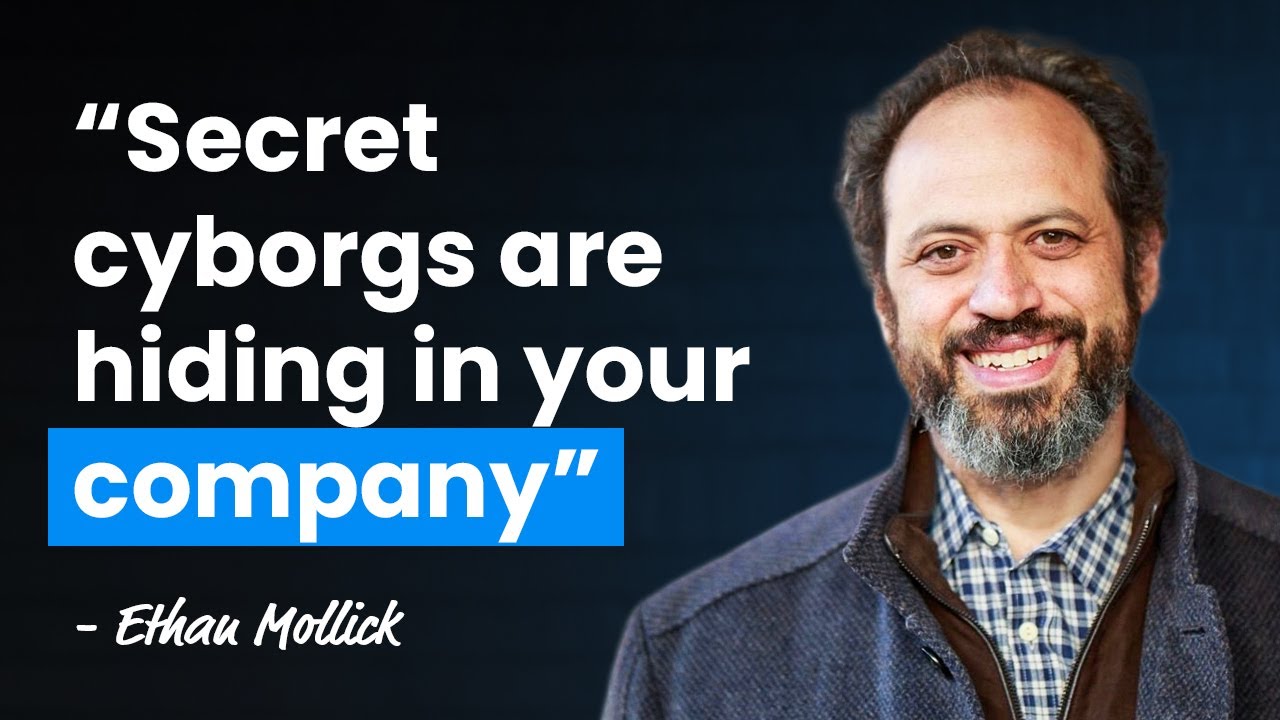
There is a growing cohort of employees—“secret cyborgs”—who are using AI to achieve massive productivity gains, saving anywhere from 20% to 70% of their time on tasks while maintaining or improving quality. Recent data suggests over 50% of American workers use AI, reporting a 3x performance improvement on about one-fifth of the tasks where they apply it.
However, these gains are often hidden for two main reasons:
- Misaligned Incentives: Employees fear that revealing their efficiency will lead to layoffs for themselves or their colleagues, or that they will simply be given more work without additional compensation.
- Process Mismatch: Existing corporate processes, like Agile sprints, are not designed for a world where a task can be completed almost instantly. What is the purpose of a daily stand-up if a developer finishes their weekly coding tasks on Monday morning?
To unlock this hidden potential, leadership must create incentives for these “secret cyborgs” to come forward. The “Lab” then provides a formal destination for their discoveries, allowing their innovative prompts and workflows to be refined and distributed throughout the organization.
Preparing for the Future
The best way to prepare for the inevitable advancement of AI capabilities is through direct, consistent use.
Use frontier models, figure out what they do… You can bet pretty reasonably that they will get better and cheaper.
Instead of just following the news, professionals should actively use the most advanced models available for real work. By approaching the tools with a mindset of making them work, rather than skepticism, one learns the “shape of the frontier” and will be naturally prepared as it expands.