AI Consulting in Practice – NLW, Super ai
The host of the AI Daily Brief, NLW, shares initial findings from a self-reported study of over 2,500 AI use cases across enterprises. The analysis moves beyond the 'AI bubble' narrative to uncover where organizations are genuinely finding value, detailing ROI distribution by company size, role, and use case, and highlighting the surprising impact of agents and risk reduction applications.
The State of Enterprise AI Adoption
Despite narratives of an “AI bubble,” enterprise adoption of AI is growing significantly. A major inflection point this year has been in coding and software engineering, where adoption has seen a huge uptick. This trend extends beyond engineering teams, as other parts of the organization are now exploring how to communicate with and build things with code.
A key theme for 2024 was the anticipated rise of AI agents within the enterprise. While a mass automation shift didn’t materialize across all functions, the adoption of agents has been surprisingly rapid.
- A KPMG quarterly pulse survey of companies with over $1 billion in revenue shows a jump in full production agent deployment from 11% in Q1 to 42% in Q3.
- This rapid progression from pilot to production has shifted the focus towards the human side of agent interaction, including upskilling, enablement, and creating “sandboxes” for experimentation.
However, challenges remain. A recent McKinsey study found that most enterprises are still in the early stages:
- Only 7% of organizations consider themselves fully at scale with AI.
- 62% are still in the pilot or experimentation phase.
- Interestingly, larger organizations are often ahead of smaller, more nimble companies in scaling their AI efforts.
A clear bifurcation is emerging between “leaders” and “laggards.” Leaders are distinguished by a more comprehensive and systematic approach—they pursue multiple initiatives simultaneously and think beyond simple productivity gains towards revenue growth and creating entirely new capabilities.
Investment and ROI Expectations
AI spending is set to increase dramatically. The average expected spend over the next 12 months for large organizations has risen to $130 million, according to KPMG. Furthermore, over 90% of organizations surveyed by Deloitte intend to increase their AI spend.
This increased investment is coupled with accelerated expectations for returns.
A KPMG CEO survey reveals a massive shift: last year, 63% of CEOs expected AI ROI in 3-5 years. This year, 67% expect it in 1-3 years, with 19% anticipating returns in just 6-12 months.
The primary challenge is that measuring this ROI is difficult. 78% of leaders report that traditional impact metrics are falling short for AI technologies. This gap in understanding prompted the creation of a new, self-reported study to gather more direct information on AI’s impact.
Findings from a Real-World ROI Study
To get a ground-level view, a study was launched to collect self-reported ROI data from an audience of AI professionals. The initial analysis covers ~2,500 use cases from over 1,000 organizations, categorized by impact types like time savings, increased output, quality improvement, new capabilities, and risk reduction.
High-Level Observations
- ROI is Real: 44.3% of respondents report “modest” ROI, and another 37.6% report “high” ROI (significant or transformational). Only 5% see a negative ROI so far.
- Sky-High Optimism: 67% expect high growth in ROI over the next year. Even among teams currently experiencing negative ROI, 53% predict high growth.
- Time Savings is the Gateway: “Time savings” is the most common starting point, accounting for 35% of all use cases. The sweet spot is saving 5-10 hours per week, which translates to winning back 7-10 workweeks per year—a powerful proposition for any enterprise.
Deeper Insights
The data reveals fascinating patterns when segmented:
-
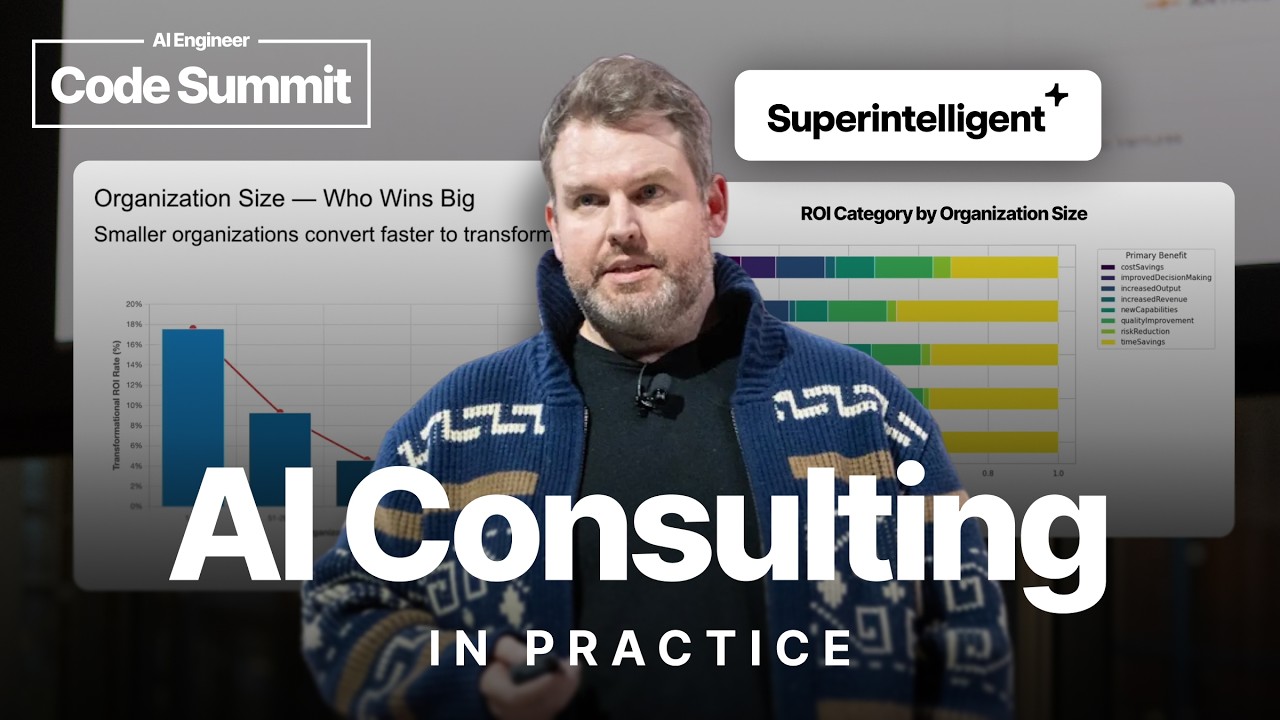
By Organization Size:
- Mid-sized companies (200-1,000 employees) focus heavily on “increasing output.”
- The smallest companies (1-50 employees) report a higher concentration of “transformational” benefits, suggesting agility can lead to early, high-impact wins.
-
By Role:
- C-suite executives are less focused on simple time savings and more on strategic goals like increased output and developing new capabilities.
- Consequently, leaders report more transformational outcomes, with 17% of their submitted use cases already having transformational ROI.
-
By Use Case:
- Risk Reduction as a Dark Horse: While only 3.4% of use cases listed risk reduction as their primary benefit, these cases are by far the most impactful. A full 25% of them delivered “transformational” ROI. This aligns with anecdotal evidence from compliance and back-office functions where AI can manage sheer volume and complexity.
- Coding & Software: As expected, use cases related to software development show higher-than-average ROI.
-
By Industry: Use cases in Healthcare and Manufacturing demonstrated meaningfully higher impact on average compared to the overall dataset.
The Power of Automation and a Systematic Approach
The study provides two clear indicators of success:
- Advanced Use Cases: Use cases that explicitly mention “automation” or “agents” wildly outperform others in self-reported ROI. This points towards the next frontier of value creation beyond simple productivity hacks.
- Systematic Strategy: There is a direct correlation between the number of use cases an organization submitted and their average reported ROI. This strongly suggests that organizations moving beyond isolated experiments to a comprehensive, cross-organizational AI strategy are reaping greater rewards.
The findings underscore a move away from generic conversations about AI’s potential towards data-driven experiments to uncover where the impact truly lies.