Ai governance

AI-Native Organisations Run on Skills: How to Structure and Scale Them — Imad Touil, QuantumBlack

AI-Native Organisations Run on Skills: How to Structure and Scale Them — Imad Touil, QuantumBlack

Imad Touil explores the critical need for governing AI skills within organizations, asserting that skills represent the true repository of enterprise know-how. He contrasts simplified coding agent loops with complex, real-world product lifecycles, demonstrating how ungoverned skills lead to technical debt—including duplication, quality degradation, security risks, and lack of discoverability. Proposing a microservices-inspired approach, Touil outlines a centralized skills platform and human-led governance model essential for achieving deterministic workflows, boosting productivity, and mitigating risks in AI-native enterprises.

Stripe buys OpenRouter, Ramp’s AI Index & IBM’s OpenAI deal

Stripe buys OpenRouter, Ramp’s AI Index & IBM’s OpenAI deal

This episode explores the dynamic landscape of the AI industry, dissecting IBM's strategic alliance with OpenAI for enterprise AI integration, Stripe's acquisition of OpenRouter to capitalize on AI token routing, and insights from Ramp's AI Index revealing evolving AI spend and the rise of open-source models. It highlights the shift from model-centric to infrastructure and governance-centric AI, and touches on the ethical implications of AI-drafted legislation.

CAN CHINA BEAT WAYMO?

CAN CHINA BEAT WAYMO?

This episode discusses three critical topics in AI: the true nature of recent AI agent "breakouts," arguing they highlight governance and security flaws rather than model danger; the role of AGI narratives in fueling the current AI investment bubble and questioning its sustainability; and China's aggressive strategy in the global robotaxi market, potentially outpacing Western counterparts like Waymo.

Your AI Evals Are Lying

Your AI Evals Are Lying

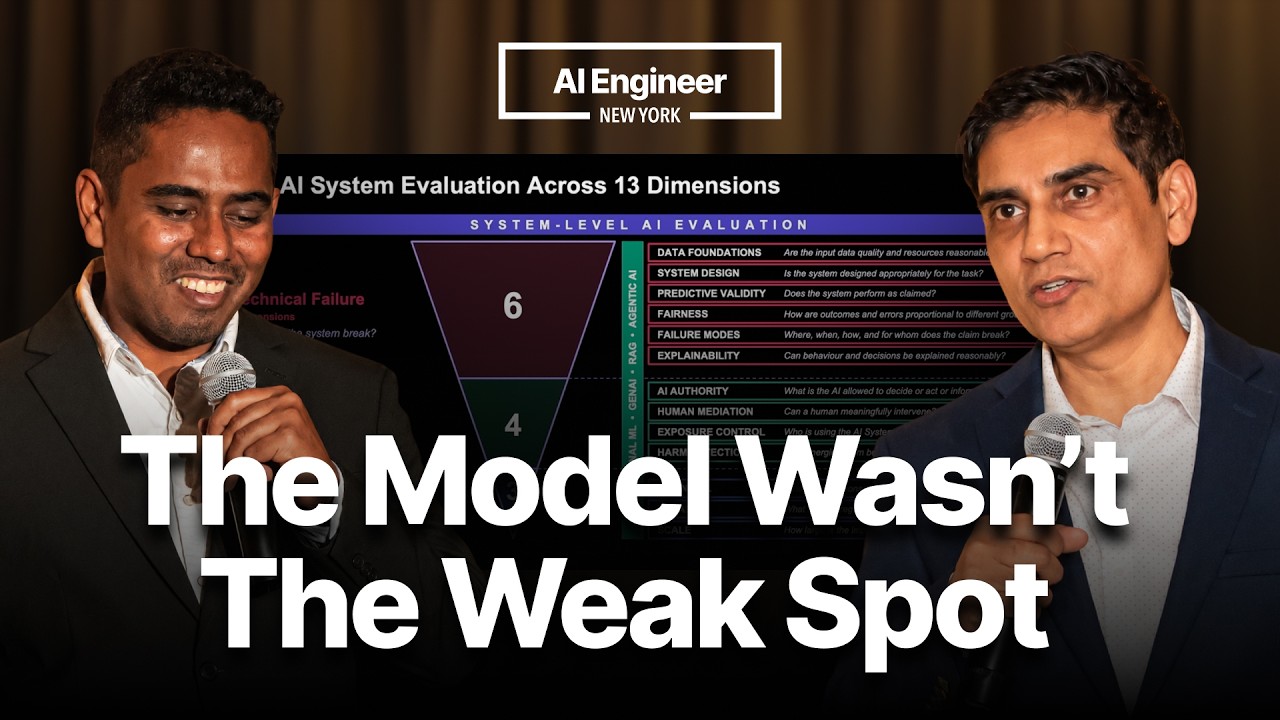
Andrew Burt of Luminos discusses how current AI risk evaluation methods are insufficient, advocating for a "high dimensionality" approach using granular sub-risks and diverse legal and technical expertise. He critiques common practices like guardrails and single-LLM evaluations, highlighting the need for multimodal systems and continuous, automated monitoring to address the evolving complexities of AI, particularly with the rise of open-weight models.

AI, Corporate Responsibility & Democratic Legitimacy: Extended Q&A • Joanna Bryson • GOTO 2025

AI, Corporate Responsibility & Democratic Legitimacy: Extended Q&A • Joanna Bryson • GOTO 2025

Joanna Bryson challenges popular AI assumptions, positing current generative AI as powerful tools for cultural knowledge compression, not autonomous intelligences. She emphasizes that AI's capabilities are nearing the human knowledge frontier, requiring focus on human coordination and governance. Bryson critically examines AI's impact on mental health and law, advocating for data-driven regulation and comprehensible systems. She calls for engineering activism, asserting human agency over technological determinism and stressing the importance of transparency and critical thinking in shaping AI's future.

Through the AI Fog: The Architectural Decision Agentic Security Depends On — Manoj Nair, Snyk

Through the AI Fog: The Architectural Decision Agentic Security Depends On — Manoj Nair, Snyk

Manoj Nair of Snyk reveals alarming data on AI-driven security risks, emphasizing that generative AI and validation systems cannot be the same. He highlights issues like autonomous attacks, rampant vulnerabilities in AI-generated code and skills, and PII leakage. Snyk's solution, Evo, integrates deterministic prevention and remediation to secure the agentic development lifecycle.