This CPO regrets that product management exists | Tom Verrilli (CPO of Whatnot)
Tom Verrilli, CPO at Whatnot, discusses his controversial stance that "we regret product management exists," advocating for a leaner, more hands-on PM approach. He delves into how Whatnot structures its product team, its rigorous hiring process focused on deep systems thinking and IC work, and the transformative impact of AI on product and data science functions. Verrilli also shares mental models for balancing strategy and iteration, navigating the CPO-founder relationship, and key lessons from his time at Twitter, emphasizing the importance of core PM skills in an AI-driven world.
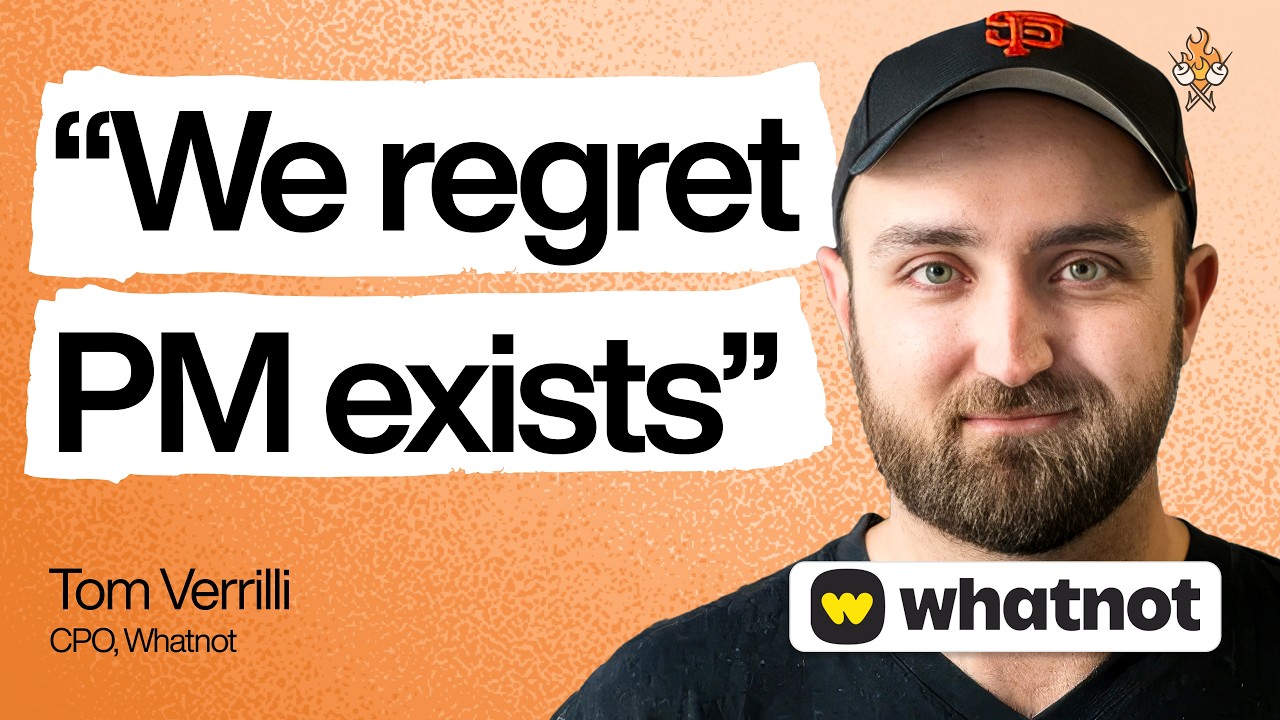
Tom Verrilli, CPO at Whatnot, challenges traditional product management, advocating for a leaner, more hands-on approach, especially with the advent of AI. He articulates the premise “we regret that product management exists,” not to dismiss PMs, but to emphasize that their presence shouldn’t be assumed everywhere. Historically, engineering and design directly built products, and the specialist PM role emerged with scaling tech companies, often leading to an “HR ratio” where PMs were hired proportionally to engineers, potentially infantilizing other functions.
The “Whatnot Way” of Product Management
Whatnot’s PM organization is characterized by a small team (around 20 PMs for a high-volume marketplace) focused on specific problems rather than permanent team assignments. PMs are reassigned regularly based on 6-month planning cycles, aligning them with critical company objectives. This fluid structure encourages PMs to gain diverse experience and “muscle reps” across different problem spaces.
When hiring, Verrilli prioritizes candidates demonstrating deep systems thinking—the ability to grasp both macro strategic implications and micro-execution details. What’s “trending down” in hiring are PMs who focus heavily on “driving alignment and stakeholder management,” as this often indicates a specialization in politics rather than technical or customer understanding. Whatnot famously hired only one PM out of 31,832 applicants in two years, underscoring their stringent criteria for deeply analytical and hands-on builders.
The Shift to Senior IC Work
Verrilli champions a model where senior product leaders, including himself, remain deeply involved in individual contributor (IC) work. He critiques the traditional promotion path where successful PMs become managers, removing them from hands-on work. This shift allows experienced leaders to leverage their honed judgment for faster, more efficient decision-making, handling the workload of multiple junior PMs. By having a single senior PM accountable for multiple interconnected areas (e.g., discovery and ads), they naturally align conflicting priorities, cutting down on