What Tesla and SpaceX Teach Founders About Building Hardware | a16z
Ex-Tesla and SpaceX engineers Chandler Luzsicza and Turner Caldwell share the practical lessons they learned about building complex hardware and how they apply them at their own startups. They cover core principles like decision velocity, strategic vertical integration, managing the critical path without creating new bottlenecks, and using aggressive milestones as a forcing function to reveal true priorities. The discussion also delves into the value of a 'factory mindset,' the importance of a rigorous hiring process, and advice for young engineers.
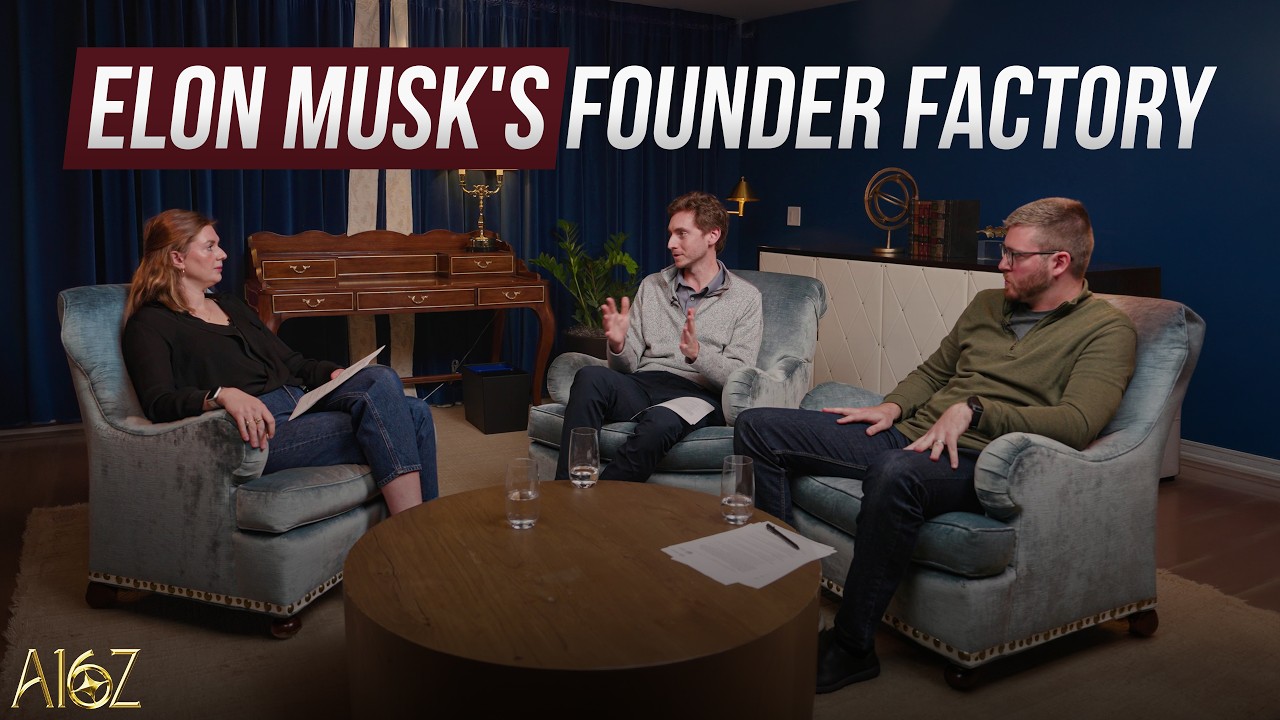
Erin Price-Wright from a16z speaks with Chandler Luzsicza (CEO, Galadyne; ex-SpaceX) and Turner Caldwell (CEO, Mariana Minerals; ex-Tesla) about translating the operational principles from their former employers into their own hardware startups.
Core Principles: Decision Velocity & Flat Organizations
- Flat Organizations for Information Flow: The primary purpose of a flat organization is to accelerate the flow of information and enable collaboration. Any junior engineer should feel empowered to speak directly with senior leadership to remove communication bottlenecks that arise from funneling information through managers.
- Decision Velocity: Leadership must demonstrate high conviction and make decisions quickly, even with incomplete information. This absolves junior engineers of the paralysis that comes with high-stakes decisions, allowing them to execute faster. The goal isn’t to always be right, but to iterate quickly and learn from every decision.
Execution and Project Management
- Focus on the Critical Path: Chandler emphasizes the importance of relentlessly pursuing the “critical path”—the single task or procurement activity driving the overall project schedule. This involves a constant game of “whack-a-mole” to unblock the next phase.
- Avoid “Second-Grade Soccer”: Turner adds a crucial nuance: while focusing on the critical path, you must avoid having the entire team swarm the problem (like second graders chasing a soccer ball). This can cause the next task to fall behind and become the new critical path. The solution is to deploy small, independent “SWAT teams” to attack problems in parallel, maintaining momentum across the board.
- Democratize Information: To combat the natural formation of data silos as a company grows, Turner’s company builds around a central, integrated data framework. Information is not siloed in emails or local hard drives; it’s on a web app with open access. This provides context for every decision, allowing team members to make globally optimal choices. LLMs can be used to query this data repository, making information even more accessible.
- Setting Aggressive Milestones: Setting extremely aggressive goals (e.g., a 6-month timeline for a 36-month project) is a forcing function. Its purpose is to make the team deliberately identify the handful of tasks that are truly impossible on that timeline. This immediately reveals the highest-priority items that must be attacked or engineered around from day one.
The Factory Mindset
- Question Every Requirement: Drawing from his experience on Starship, Chandler explains that simplifying design for manufacturing begins with aggressively questioning and eliminating requirements. He provides an example where instead of designing a bespoke part for the ship, his team validated that they could reuse an existing part from the booster. This saved an entire design cycle and aligned production across both vehicle systems.
- Everything is a Manufacturing Problem: Turner discusses applying manufacturing principles like takt time analysis to non-traditional areas like R&D labs, mining, and refinery construction. By breaking down complex processes into discrete, measurable steps, you can optimize them. The goal is to implement short-interval control, similar to a factory floor, where teams have quantified daily goals and dashboards to track progress, a practice largely missing in large-scale construction.
Strategic Vertical Integration
Vertical integration should not be an ideological goal but a strategic tool. The speakers advise against integrating for the sake of it.
- For an early-stage startup, the question should be: “Does the company exist if we don’t vertically integrate this?” Integration is justified if a critical component or technology doesn’t exist, is prohibitively expensive, or is an existential bottleneck.
- It’s a mistake to view it purely as a cost-saving measure in the early days. When you vertically integrate, you aren’t eliminating a supply chain risk; you are absorbing your supplier’s supply chain and all its associated complexities and risks.
Building High-Talent-Density Teams
- Rigorous Hiring: Both Tesla and SpaceX employ a deep, technically rigorous hiring process involving 6-10 conversations and a technical test. This process is a feature, not a bug. It positively filters for highly motivated, capable engineers who want to work with other top talent, ensuring a high baseline of technical autonomy and accountability.
- The Internship Funnel: The internship program is a crucial talent pipeline. It acts as a 3-month, high-stakes trial period. Many of the most critical roles are filled by intern conversions who have already proven their ability to execute within the company’s demanding culture.
Advice for Aspiring Founders
- Become a Sponge, Get Your Reps In: Before starting a company, surround yourself with the best people and see multiple projects through from start to finish. This builds an invaluable, intuitive understanding of “what good looks like” and provides the credibility needed to attract talent.
- Build Your Technical Foundation First: You’ll never be fully trained to be a founder. However, you should over-index on building a deep technical basis before you have to learn the entirely separate skill sets of fundraising, company building, and management. Don’t try to learn how to build rockets on the job as a founder.