The most successful AI company you’ve never heard of | Qasar Younis
Qasar Younis, CEO of Applied Intuition, discusses the future of AI, arguing its most significant near-term impact will be in physical industries like farming, mining, and construction. He shares his philosophy on building a company quietly, the importance of early traction, and the core values that drive Applied Intuition, while also offering a nuanced perspective on China's AI capabilities and how to develop leadership taste.
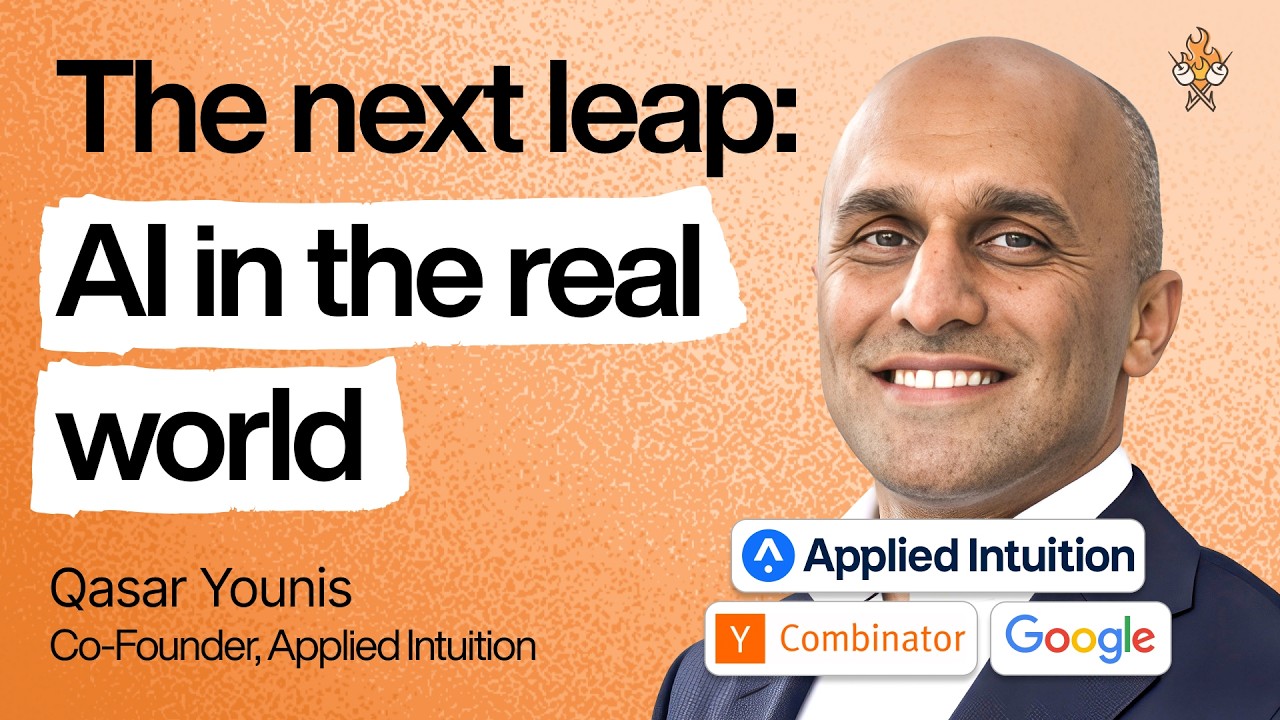
Qasar Younis, co-founder and CEO of Applied Intuition, presents a vision of the future where the most profound impact of AI in the next 5 to 10 years will be in the physical world—industries like farming, mining, construction, and logistics—rather than solely in software.
The Optimistic Vision for AI
Drawing parallels to the Industrial Revolution, Younis is a “fundamental optimist” about AI’s potential to reduce net human suffering. He believes that just as industrialization brought widespread access to healthcare, heating, and material goods, AI will bring a new level of abundance.
- Solving “Impossible” Problems: AI will be instrumental in tackling challenges like curing cancer.
- Democratizing Access: Technologies like autonomous vehicles will provide nearly free mobility, which is life-changing for the disabled or those in remote regions without access to transportation. For instance, a self-driving car could be the difference between life and death for someone in rural Rwanda who is hours from the nearest hospital.
- Combating Fear with Understanding: Younis argues that anxiety about AI stems from a fundamental misunderstanding of its current capabilities. He encourages people to learn about the technology to see its limitations.
“The core root of fear is misunderstanding. If you at home are very anxious about AI, the best thing that you can do is spend time to understand and you will quickly see the limitations.”
He distinguishes between societal anxiety and market sell-offs, explaining that public market reactions are often driven by high-level pattern matching by investors, not a deep, nuanced understanding of how AI will replace established companies.
The Real Revolution: Physical AI
The most significant AI advancements will not be limited to software. The real-world impact will come from integrating intelligence into existing physical machinery.
- A Spectrum of Autonomy: We already live with robots, from Roombas to coffee machines. The next step is adding more sophisticated intelligence to large, existing platforms like cars, trucks, and mining equipment.
- Coming “Just in Time”: Rather than taking jobs, AI and autonomy are arriving just in time to solve critical labor shortages in essential industries.
- The average age of a farmer in the U.S. is in the late 50s, creating an impending retirement crisis.
- There is a persistent shortage of long-haul truck drivers.
- Safety and Productivity: Autonomous systems are “supremely more safe” than human operators. In the U.S. alone, over 30,000 people die in traffic accidents annually. AI-driven vehicles can drastically reduce this number. This same principle applies to dangerous jobs in mining and construction.
A Contrarian Take on China’s AI
Younis cautions against direct, one-to-one comparisons between American and Chinese tech companies, calling it a “category error.”
- State-Driven vs. Market-Driven: Companies like Huawei are extensions of the Chinese state, with goals tied to national ambition (“Huawei” translates to “China’s ambition”), not shareholder profit. A significant portion of their employees are members of the Communist Party.
- Unsustainable Models: Chinese EV companies are often lauded, but they operate without the market pressure to be profitable. A U.S. equivalent like Rivian, despite making excellent products, is heavily scrutinized by investors for its losses. If U.S. companies could operate without regard for profit, they would also produce “wow products.”
“Instead of thinking OpenAI is competing against DeepSeek, you say OpenAI is competing against the Chinese government.”
Building Applied Intuition: A Philosophy of Quiet Execution
Younis built his $15 billion company by intentionally staying out of the spotlight, a counter-narrative to the “build in public” mantra.
- Focus on Craft: “Our best work is done alone and quietly.” Every moment spent on public relations is a moment not spent on customers and product. He advises, however, that this strategy may not work for unknown first-time founders who need to build a network.
- The Importance of Early Traction: Successful companies tend to show positive signs early. For founders who are struggling for years, he suggests a “hard reset” to re-evaluate the core foundation—the co-founding team, the market, or their own commitment.
- Core Values: The company’s culture is built on a set of pragmatic operating principles:
- Radical Pragmatism: The meta-value that guides all decisions.
- Speed Above Everything: With a focus on decisiveness.
- Never Disappoint the Customer.
- Laugh a Lot: Humor provides perspective and a way to deliver subtle feedback.
- Half the Work Is Follow-Up: Emphasizing operational diligence.
- Operational Excellence: The company has never spent any of its raised capital, operating as a functioning business from its revenue. This ethos extends to the culture, where employees participate in a weekly “cleaning zen” to maintain their own workspace, fostering a sense of craft and ownership.
Leadership, Decision-Making, and Taste
Younis shares his philosophy on leadership and personal development.
- Listen to Naysayers: A culture that encourages debate and allows the best ideas to win is crucial. Leaders must be humble enough to listen to dissenting opinions and adjust course. This prevents the “wall of sound” momentum that can lead successful companies astray, as seen with Google’s failure to compete with Facebook in social media.
- Remove Emotion from Decisions: Decisions should be rational and consistent. The ideal is a system where multiple people, faced with the same information, would arrive at the same conclusion.
- Building Taste Through Reading: The best way to develop good judgment is to read old books, as time has filtered out the noise. Younis advocates for reading broadly on topics one knows nothing about. He believes many Silicon Valley CEOs lack “taste” because their life experiences are too narrow, and this broader perspective, gained from history, art, and diverse life experiences, is what makes a founder truly effective.