Mental models for building products people love ft. Stewart Butterfield
Stewart Butterfield, co-founder of Slack and Flickr, shares the product frameworks and leadership principles that guided his success. He delves into concepts like "utility curves" for feature investment, the "owner's delusion" in product design, and why focusing on "comprehension" is often more important than reducing friction. He also introduces powerful mental models for organizational effectiveness, such as combating "hyper-realistic work-like activities" and applying Parkinson's Law to team growth.
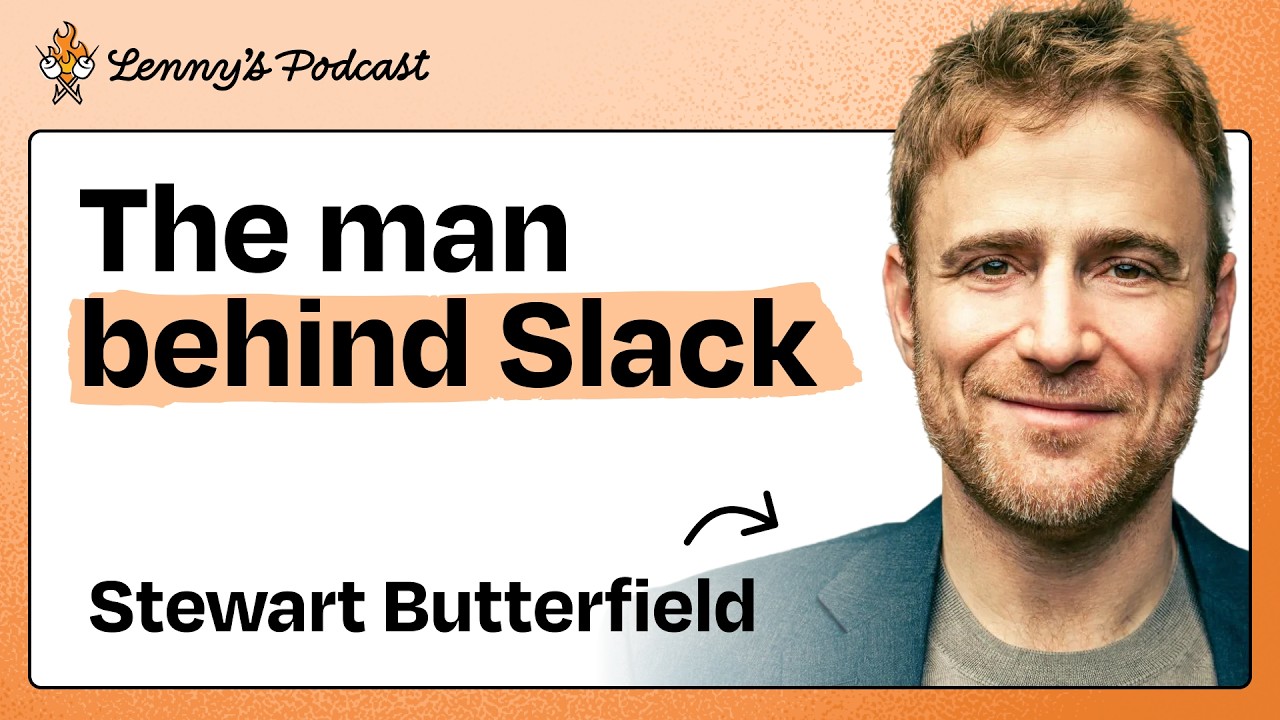
Stewart Butterfield, a key figure in modern product development, believes that the foundation of a successful product lies in a relentless, almost embarrassing, dissatisfaction with its current state. In 2014, the year Slack launched, he described the product as a “giant piece of [__]” that the team should be “humiliated” to offer. This mindset isn’t about negativity, but about recognizing the “almost limitless opportunities to improve.” If you can’t see those opportunities, you shouldn’t be designing the product. This philosophy of continuous improvement is the thread connecting his various frameworks on product, strategy, and leadership.
On Product Craft and User Experience
Utility Curves and Divine Discontent
A core framework for evaluating feature investment is the “utility curve,” a classic S-curve plotting effort/cost against value/convenience.
- The Flat Start: The initial effort yields little value. For example, creating a
userstable in a database adds zero value to the end-user initially. - The Steep Climb: After a threshold, small investments produce an enormous amount of value. This is the sweet spot.
- The Plateau: Continued investment yields diminishing returns.
This model helps teams decide whether a feature is underfunded and stuck on the first part of the curve, or if it has already delivered most of its potential value. Often, teams abandon a feature because it’s not good enough, adding complexity without hitting the steep part of the curve.
This curve isn’t static. It’s influenced by what Jeff Bezos called “divine discontent”—as user standards rise across the industry, the baseline for “good” moves up. This requires constant reinvestment in core features like login, password reset, and onboarding, which are often implemented once and then neglected.
Friction vs. Comprehension: “Don’t Make Me Think”
A common mantra in product design is to “reduce friction.” Butterfield argues this is often misguided. The real challenge is comprehension.
- High Intent vs. Low Intent: A user buying Taylor Swift tickets on Ticketmaster has maximum intent and comprehension. Friction is an annoyance, but they will persist. A user visiting Slack’s website for the first time after hearing about it from a friend has minimal intent and low comprehension.
- The Cost of Thinking: For these low-intent users, the goal isn’t to reduce clicks but to “not make them think.” Forcing a user to make a decision they don’t understand has two costs:
- Cognitive Cost: It literally burns glucose. People have finite decision-making energy.
- Emotional Cost: It makes the user feel stupid, creating a negative association with the product.
Instead of optimizing for fewer clicks, optimize for trivially easy, comprehensible steps. A process with eight obvious, thoughtless clicks is superior to one with two fraught, confusing clicks.
Tilting Your Umbrella: Empathy in Design
Craftsmanship stems from a deep empathy for the user’s experience. This is encapsulated in the metaphor of “tilting your umbrella.” When walking on a crowded sidewalk in the rain, most people don’t tilt their umbrella to make space for others, either from malice, obliviousness, or helplessness.
“Your failure to really be considerate and exercise this courtesy and really be empathic about other people’s experience is an advantage… Tilting your umbrella is our opportunity.”
This principle manifested in Slack through many small, delightful details:
- Magic Links: Instead of forcing users to type complex passwords on mobile, Slack emailed a one-click login link, one of the first major products to scale this pattern.
- The “Shouty Rooster”: To prevent the abuse of
@everyone, which notified hundreds of people, Slack introduced a confirmation step. A pop-up of a rooster would say, “This is going to cause a notification for 147 people in eight different time zones. Are you sure?” This taught users the impact of their actions and shaped considerate communication norms.
On Strategy and Leadership
“We Don’t Sell Saddles Here”
In a now-famous internal memo, Butterfield articulated that a company’s job isn’t just to build a product but also to create the market for it. The focus shouldn’t be on the features of the tool (the saddle), but on the outcome and experience it enables (the joy of horseback riding).
You are not just responsible for creating the product, but also for creating the market. This involves positioning your product by connecting existing ideas in a user’s mind (“It’s Uber for pets”) rather than trying to create a net-new category from scratch.
The Owner’s Delusion
Product builders often suffer from the “owner’s delusion.” They are so immersed in their own creation that they forget what it’s like to be a first-time user with no context.
This is why old restaurant websites were so frustrating. The owner, proud of the ambiance, would create a slow-loading site with atmospheric music. Meanwhile, the user just wanted one of five things: address, phone number, hours, menu, or reservations. The owner, despite having been a user of other restaurant websites, forgets this reality when it comes to their own. The solution is to constantly force yourself to step back: “pretend that you’re an actual human being… and then look at this thing.”
When to Pivot
Having pivoted twice from failed games into massive successes (Flickr and Slack), Butterfield’s advice on pivoting is to be “coldly rational.” The decision should come when you have exhausted all non-ridiculous, long-shot ideas to make the current venture successful.
It’s a humiliating and painful process, as you’ve convinced investors, employees, and users to believe in a vision. The emotional weight makes it tempting to let the company die slowly rather than admitting it didn’t work. Creating intellectual distance is essential to make a rational decision based on expected value.
Generosity as a Core Principle
Generosity is a powerful, practical leadership strategy. It’s a way to signal cooperation in the “iterated prisoner’s dilemma” of business. By demonstrating you will cooperate, you build trust and encourage others to cooperate as well, leading to mutually beneficial outcomes. This attracts more ethical, high-quality employees and builds deep customer loyalty.
This principle was the driving force behind Slack’s fair billing policy, providing credits during outages, and creating an employee-friendly structure for its direct listing and acquisition. It’s all rooted in a core mantra that Butterfield had the entire company chant at all-hands meetings:
“In the long run, the measure of our success will be the amount of value that we create for customers.”
On Organizational Health
Parkinson’s Law and Hyper-Realistic Work-Like Activities
Butterfield is a firm believer in Parkinson’s Law: “work expands to fill the time available for its completion.” In organizations, this manifests as administrative functions growing disproportionately to output. The vast majority of people, driven by career incentives, want to hire direct reports.
This creates a dangerous dynamic. As a company grows, the supply of “known valuable work to do” diminishes. Early on, the tasks are obvious and high-value (open a bank account, build a login system). Later, the decisions are complex and ambiguous (should we pursue a FedRAMP certification?).
When the demand for work (driven by headcount) outstrips the supply of known valuable work, people invent “hyper-realistic work-like activities.”
“People are calling meetings with their colleagues to preview the deck that they’re going to show in the big meeting to get feedback… it is superficially identical to work… but this is actually a fake bit of work.”
This isn’t because employees are lazy or stupid; it’s a systemic failure. The leader’s primary responsibility is to ensure there is a sufficient supply of known valuable work and to create the clarity and alignment for people to focus on it.