The Prime Intellect Stack — Will Brown, Prime Intellect
Deep dive into Prime Intellect's open-source ecosystem for post-training LLMs, covering the modular Verifiers V1 environment design, the asynchronous and scalable Primer RL training framework, and the Lab platform for hosted training and fine-tuning. Learn about advanced reward systems, the interception server pattern, and tokenization control with the Renderers library, all designed to enable frontier agentic model development.
Prime Intellect is committed to democratizing large-scale open-source AI research, enabling companies to train, deploy, and iteratively improve their own frontier agentic models. Their vision, encapsulated as the “Open Superintelligence Stack,” provides an open toolkit for real-world training and extensive model customization. This presentation delves into Prime Intellect’s post-training ecosystem, focusing on the open-source Verifiers and Primer RL libraries, alongside their Lab platform.
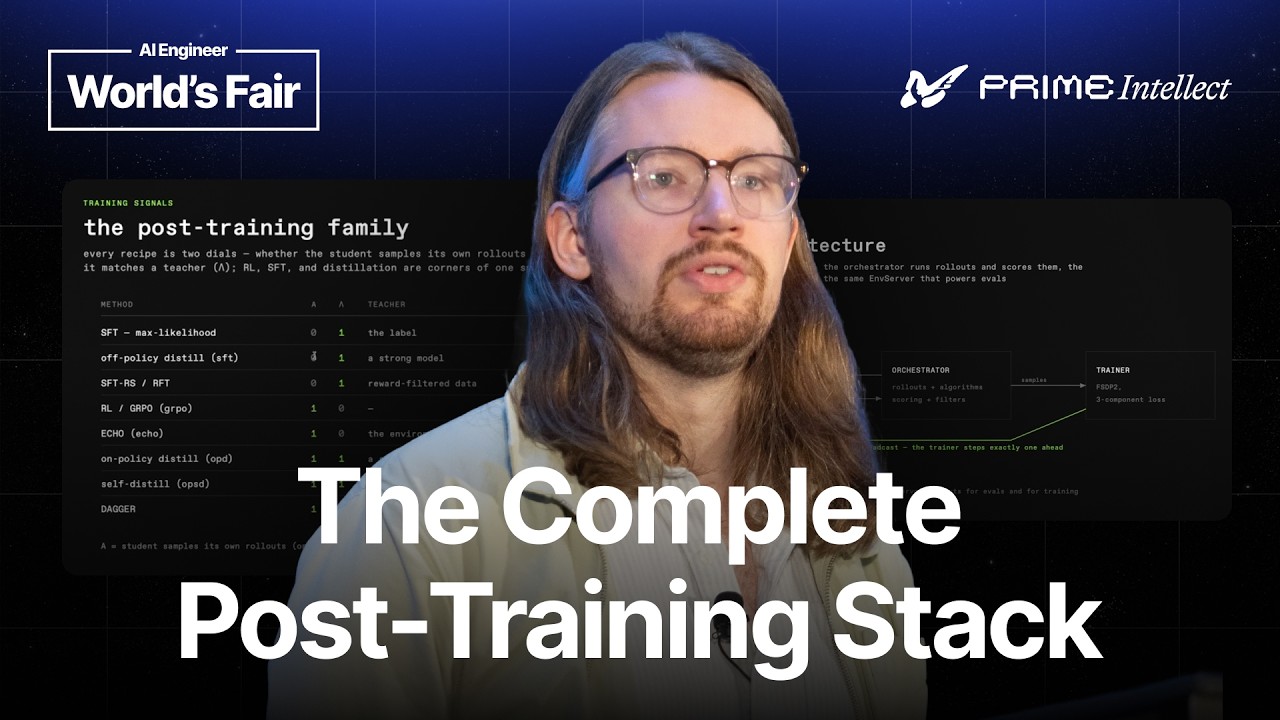
The Post-Training Paradigm: At the core of this ecosystem is the concept of “environments,” serving as a universal language to specify desired model behavior. Environments encapsulate data, scenarios for agent interaction, and mechanisms for scoring performance. While foundational for reinforcement learning, they are equally crucial for evaluation (evals), which serve as the initial gateway to post-training. The presentation highlights that modern post-training extends beyond the traditional SFT then RL sequence, incorporating advanced techniques like on-policy distillation and self-distillation, particularly beneficial for training expert models across diverse tasks. The ultimate goal is to establish iterative refinement flywheels, ensuring models continuously improve based on real-world feedback and amortizing training costs effectively.
Verifiers V1: A Modular Environment Framework: The Verifiers library has undergone a significant overhaul with its “V1” release, introducing a highly modular architecture. Environments are now decomposed into three composable components:
- Task Sets: Define the data and rules for an agent-agnostic task. They integrate seamlessly with existing data sources like Hugging Face datasets, Harbor, NeMo Gym, and Open Ended.
- Harnesses: Provide flexible execution logic for models, supporting complex patterns beyond simple loops. This includes recursive language models, CLI agents (e.g., Codex, Cloud Code), and integrations with arbitrary Python libraries like LangChain or DSPy. The default harness still accommodates traditional system prompt and tool-in-a-loop patterns.
- Runtimes: Specify the execution environment, supporting local runs, Docker containers, or Prime Intellect’s sandboxes. This modularity, enhanced by UV tooling for dependency management, allows for robust rollout execution, generating detailed “traces.” The framework emphasizes strong typing and configuration management using PyDantic, ensuring reliability and maintainability.
Advanced Reward and Metric Design: Verifiers V1 offers sophisticated mechanisms for defining rewards and metrics:
- Rewards are the primary drivers of RL progress.
- Metrics provide detailed logging for insights into model behavior (e.g., tool usage, error counts).
- Group-Level Rewards are a critical, often overlooked feature, enabling complex reward shaping. This includes pairwise judging, ranking, and bonuses for desirable properties like conciseness (e.g., penalizing overly long chains of thought from large language models). By leveraging multiple samples inherent in RL, the system can dynamically adjust rewards based on relative performance within a group, addressing challenges like unknown optimal answer lengths.
The Interception Server and Seamless Tooling: Prime Intellect introduces the Interception Server pattern to bridge the gap between model deployment and RL training. This server transparently intercepts requests from any standard harness (e.g., expecting an OpenAI or Anthropic API endpoint), allowing the harness to operate without modification. It handles back-end logistics, such as extracting log probabilities and setting temperatures, before routing requests to the RL trainer’s inference server. This design ensures harnesses remain generic code, facilitating seamless transitions between evaluation, training, and deployment. The framework also supports user simulators and MCP (Multi-agent Communication Protocol) integrations, allowing models to interact with simulated users or external tools within the environment, crucial for agentic product development.
Trace Graphs and Renderers for Tokenization Control: Underpinring the environment’s execution is the Trace Graph, a robust data structure designed to manage complex interactions, including sub-agents, parallel branching, and sequential dependencies. A key innovation is the Renderers library, a standalone, open-source tool addressing the intricacies of tokenization and chat templates. It aims to overcome limitations of traditional Jinja-based templates and the numerical instability caused by re-tokenization (due to the many-to-one mapping of tokens to text). Renderers provide a programmatic way to manage token-in/token-out concatenation, maintaining dual streams of logical text and tokens. This ensures accurate and consistent representation for both human understanding and the training/inference engines, preventing logical mismatches that can destabilize large-scale training.
Primer RL: Asynchronous and Scalable Training: Primer RL is Prime Intellect’s full-stack open-source training framework, built from the ground up for asynchronous reinforcement learning. This async-first approach is vital for agentic models, where rollout times can be highly variable and long. The Orchestrator manages the training run, decoupling inference and trainer processes, which can operate on separate hardware and scale independently. This allows rollouts to complete without blocking the training loop, optimizing GPU utilization by overlapping long-running tasks and tolerating slower components (e.g., sandbox boot-up, judge-based grading).
Prime Intellect has achieved impressive scaling results, demonstrating a GLM-5 step on 28 nodes in less than 5 minutes for long-horizon coding tasks with 131K context. This translates to a 1,000-step run in three days, costing approximately $50,000, making large-scale post-training economically viable for enterprises. The framework incorporates advanced optimizations like FP8 precision, wide expert YDP, disintegrated prefill, router re-place, and intelligent KV offloading, built on a highly hackable Torch Titan base for rapid research and iteration.
Algorithmic Flexibility and Customization: Primer RL provides a flexible architecture for researchers to experiment with diverse algorithms (e.g., on-policy distillation, self-distillation, Echo, Max RL). It decomposes algorithms into a Loss (for gradient computation) and an Algorithm (for data preparation). This separation allows researchers to mix and match components, enabling customization across two key dimensions:
- Rollout Source: Whether data originates from the current policy model (actor) or an external teacher (e.g., for SFT, context distillation).
- Advantage/Score: Generalizing the concept of advantage to encompass various scoring mechanisms, from simple cross-entropy (advantage 1) to log probabilities (for OPD) or reward-minus-baseline (for standard RL). This design allows for easy implementation of complex algorithms, such as combining cross-entropy on environment tokens with an RL objective on action tokens (as in the Echo paper), or dynamically selecting algorithms per environment.
The Lab Platform: Hosted Training Solutions: Prime Intellect’s Lab platform offers hosted Primer RL, abstracting away GPU management and operational complexities. Currently live is multi-tenant LoRA, a pattern enabling multiple users to train and serve LoRA adapters on a shared base model efficiently, ideal for token-based pricing and avoiding GPU reservations. Critically, full fine-tuning is coming soon, offering the ability to modify any aspect of Primer RL and perform full parameter training. This platform supports CPU-based environment development on local machines, with seamless deployment as environment packages to the cloud, providing auto-scaling, magic restarts, unified dashboards, and billing, empowering users to scale their post-training efforts from local prototyping to full-scale enterprise deployments.