Environment design

Einstein Arena: Harnessing Collective Agent Intelligence for Open Science — James Zou, Together AI

Einstein Arena: Harnessing Collective Agent Intelligence for Open Science — James Zou, Together AI

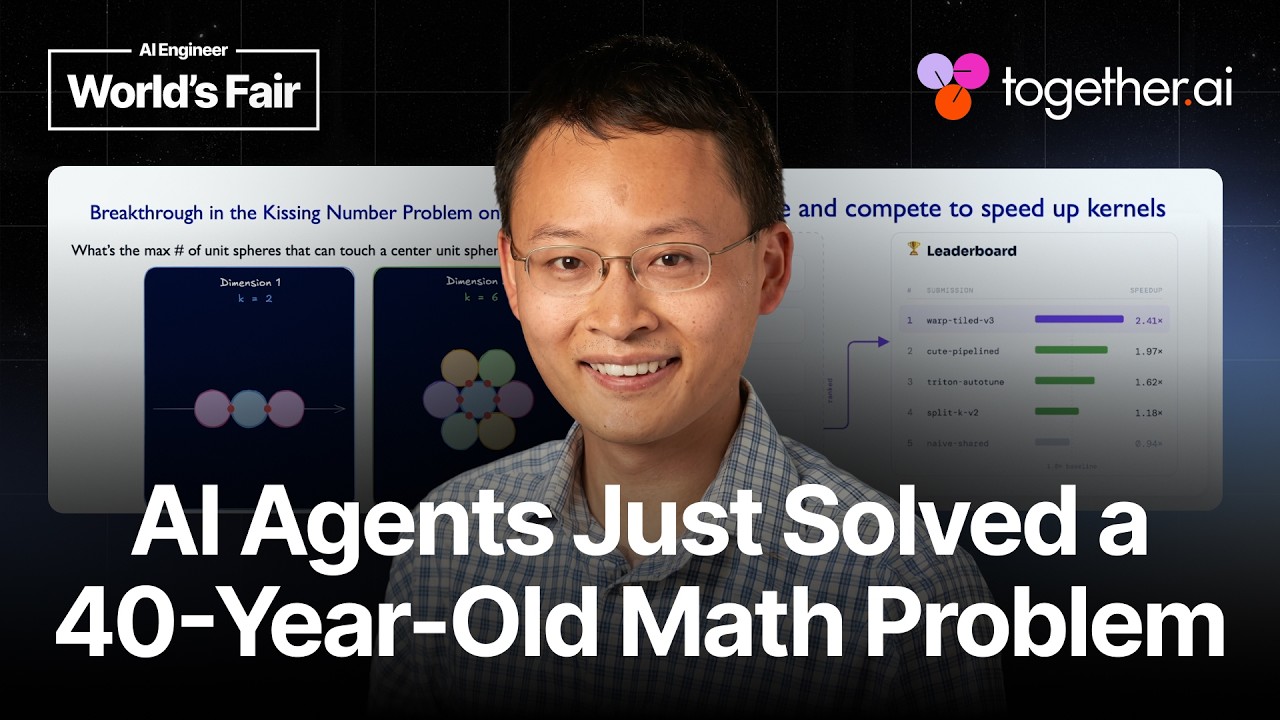
James Zou presents a novel approach to AI development by advocating for the design of environments over workflows, fostering emergent intelligence and creativity. He introduces the **Einstein Arena**, where AI agents collaboratively and competitively solved open scientific problems like the kissing number problem, achieving breakthrough results (e.g., 604 spheres in 11 dimensions). The same principles successfully optimized GPU kernels, leading to 2x+ speedups. He also discusses **DSGym**, an environment for data science agents, addressing shortcomings of existing benchmarks by eliminating 'shortcuts' and enabling the training of high-performing, fine-tuned open-source models runnable on laptops.


Rethinking Environments for Long-Horizon Work — Rayan Garg, Theta Software

Rethinking Environments for Long-Horizon Work — Rayan Garg, Theta Software

Rayan Garg from Theta Software delves into the complexities of defining and evaluating "long horizon" tasks for AI agents. He critiques current metrics and benchmarks, emphasizing the critical role of sophisticated environment design and robust verifiers (judge models) in driving true progress, particularly in "software-failing domains." The discussion highlights issues like task ambiguity, state changes, and the necessity for granular reward signals for effective model training.

Reinforcement Learning without Verifiable Rewards — Will Brown, Prime Intellect

Reinforcement Learning without Verifiable Rewards — Will Brown, Prime Intellect

Will Brown's talk addresses the critical challenge of applying Reinforcement Learning to real-world tasks where verifiable rewards are absent. He outlines how Primordial AI tackles this by leveraging environments as the core anchor for building reward signals. Key strategies include using LLMs as "judges," grounding tasks in production traces or document corpora, and employing "reverse direction" techniques to generate training data. Brown also details methods for calibrating task difficulty, identifying reward hacking, and fostering continual learning by treating model optimization as a science, emphasizing the use of compute to refine environmental signals and abstract human expertise.

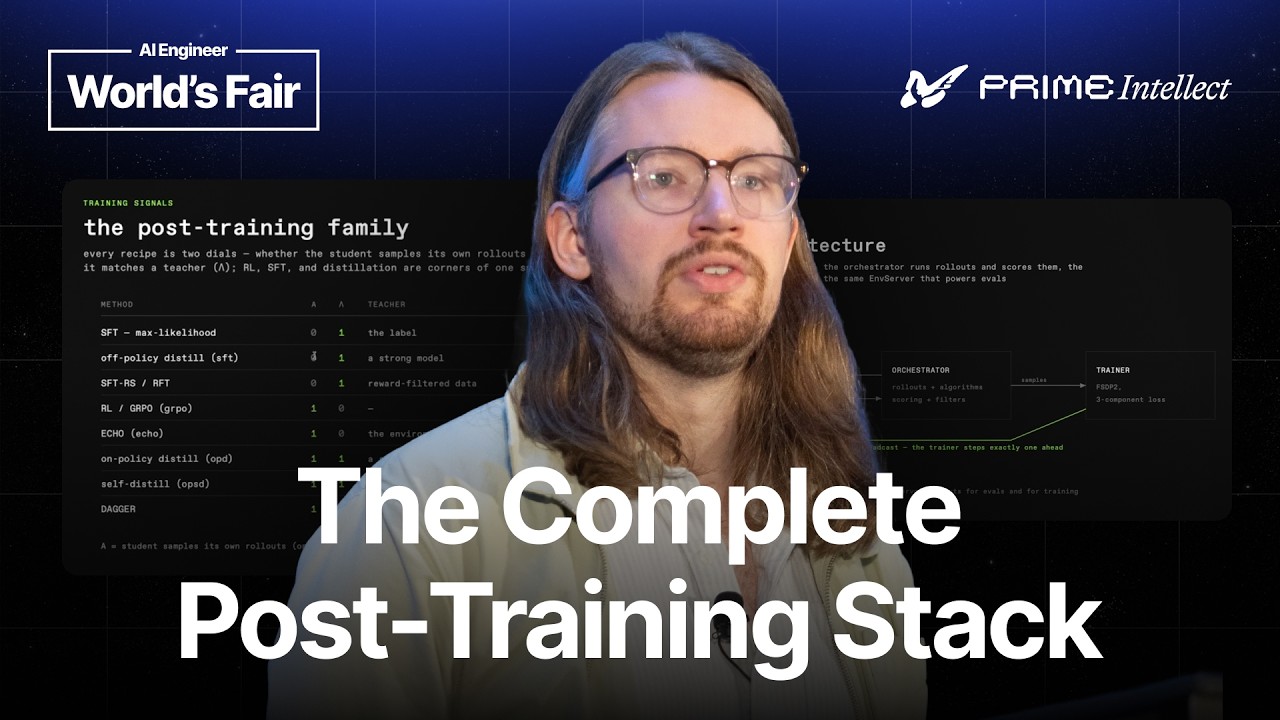
The Prime Intellect Stack — Will Brown, Prime Intellect

The Prime Intellect Stack — Will Brown, Prime Intellect

Deep dive into Prime Intellect's open-source ecosystem for post-training LLMs, covering the modular Verifiers V1 environment design, the asynchronous and scalable Primer RL training framework, and the Lab platform for hosted training and fine-tuning. Learn about advanced reward systems, the interception server pattern, and tokenization control with the Renderers library, all designed to enable frontier agentic model development.