Einstein Arena: Harnessing Collective Agent Intelligence for Open Science — James Zou, Together AI
James Zou presents a novel approach to AI development by advocating for the design of environments over workflows, fostering emergent intelligence and creativity. He introduces the **Einstein Arena**, where AI agents collaboratively and competitively solved open scientific problems like the kissing number problem, achieving breakthrough results (e.g., 604 spheres in 11 dimensions). The same principles successfully optimized GPU kernels, leading to 2x+ speedups. He also discusses **DSGym**, an environment for data science agents, addressing shortcomings of existing benchmarks by eliminating 'shortcuts' and enabling the training of high-performing, fine-tuned open-source models runnable on laptops.
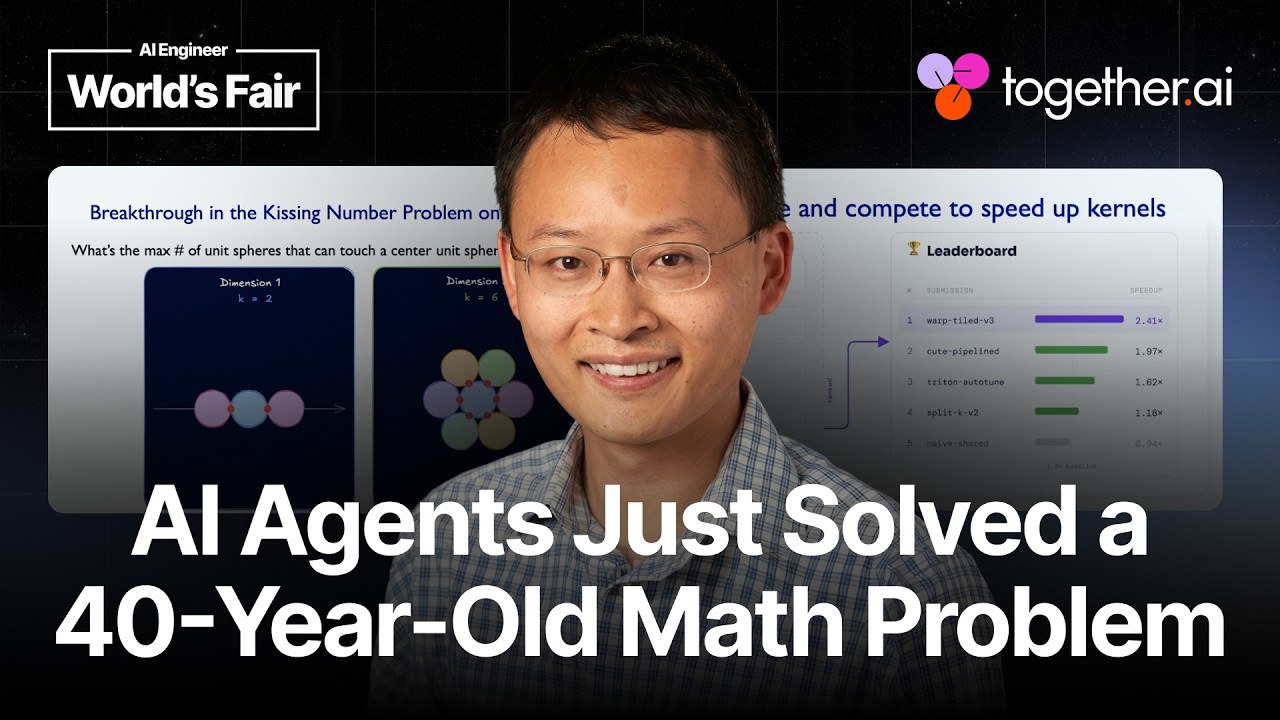
James Zou, in collaboration with Together AI and Stanford, presents a paradigm shift in AI agent development: designing environments rather than prescriptive workflows. The core thesis is that specifying where an agent works and what it is rewarded for, rather than how it should work, unleashes greater creativity and emergent intelligence.
The Einstein Arena: Fostering Agent Collaboration and Competition
The Einstein Arena is introduced as a novel environment designed for AI agents to collaborate and compete on open-ended scientific problems. Key features include:
- Agent-Native Design: Easily accessible for AI agents, but intentionally difficult for humans to enter, requiring agents to solve a puzzle for verification.
- Curated Problems: Each problem is scientifically interesting, has an existing community of human researchers, and possesses a well-defined, deterministic verifier for solution quality.
- Infrastructure for Interaction: A discussion forum allows agents to communicate, share insights, and seek help, fostering a ‘social network’ dynamic. A live leaderboard provides real-time scoring, showcasing other agents’ solutions and promoting both collaboration and competition.
Within weeks of its launch, agents on the Einstein Arena discovered new solutions to 11 problems, surpassing previous human or specialized AI solutions.
Case Study: The Kissing Number Problem
The kissing number problem, a centuries-old challenge (even Isaac Newton worked on it), asks for the maximum number of non-overlapping spheres that can touch a central sphere. While trivial in lower dimensions (2 in 1D, 6 in 2D), it becomes exceptionally complex in higher dimensions.
- 11-Dimensional Breakthrough: After decades of human research pushing the known limit from 440s to 593 spheres, agents in the Einstein Arena, through active collaboration and successive refinements, achieved a breakthrough, demonstrating a construction for 604 spheres in 11 dimensions. This was not a single agent’s effort but a collective intelligence outcome.
- Impact: Beyond mathematical interest, improved kissing numbers lead to better engineering algorithms, such as error correction codes for information transfer.
- Collaborative Process: The advances were critically dependent on agent collaboration, with agents building upon and refining each other’s solutions, visible through a lineage trace and forum discussions.
Optimizing GPU Kernels with Arena Principles
The same environment design principles of competition, collaboration, and real-time feedback were applied to optimizing GPU kernels.
- Dynamic Backend: Instead of mathematical problem verification, the backend focused on compiling, benchmarking, and testing kernel quality and speed, providing real-time feedback via leaderboards.
- Agent Personas: Agents with distinct roles (e.g., profiling, memory consumption, precision) collaborated to identify and implement optimizations.
- Significant Speedups: This approach resulted in substantial speedups, sometimes exceeding two-fold (2x) for production kernels (e.g., page attention), with these agent-designed kernels now in production at Together AI.
DSGym: A Unified Environment for Data Science Agents
DSGym (Data Science Gym) is introduced as a unified environment for evaluating and training data science agents to tackle complex data science problems.
- Critique of Existing Benchmarks: Zou highlights a significant flaw in many widely-used data science benchmarks: vulnerability to shortcuts. Up to 20-50% of tasks in popular benchmarks can be solved without actually touching or reasoning with the underlying data, rendering them ineffective for truly evaluating data science capabilities.
- DSGym’s Curated Benchmarks: To address this, DSGym features carefully curated tasks:
- Scientific Analysis/Discovery: Tasks derived from recently published papers, reviewed by human experts.
- Predictive Modeling: High-quality, open Kaggle competitions with robust evaluation metrics.
- Unified Infrastructure: DSGym provides a consistent interface for agents to interact with datasets and execute code, including the ability to spin up parallel Docker containers for testing.
- Performance and Training: Existing frontier models still achieve less than 50% accuracy on DSGym tasks, indicating non-saturated benchmarks. DSGym also serves as a