Gpu optimization

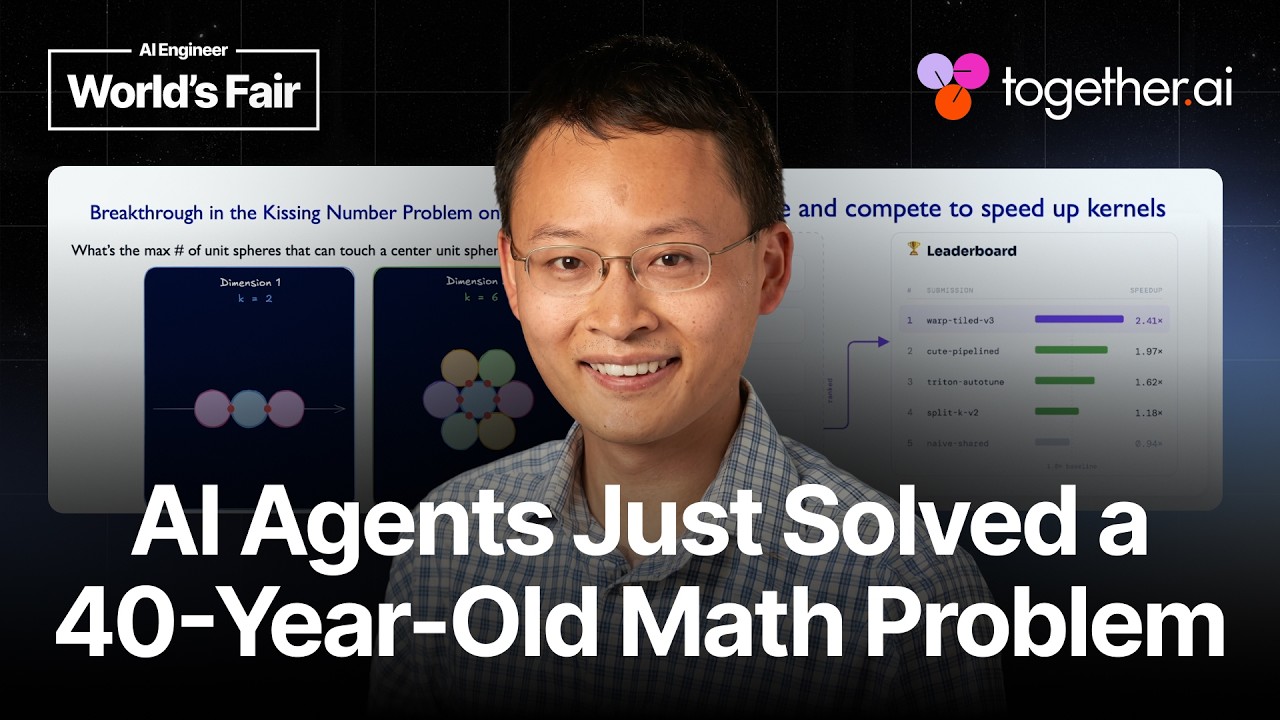
Einstein Arena: Harnessing Collective Agent Intelligence for Open Science — James Zou, Together AI

Einstein Arena: Harnessing Collective Agent Intelligence for Open Science — James Zou, Together AI

James Zou presents a novel approach to AI development by advocating for the design of environments over workflows, fostering emergent intelligence and creativity. He introduces the **Einstein Arena**, where AI agents collaboratively and competitively solved open scientific problems like the kissing number problem, achieving breakthrough results (e.g., 604 spheres in 11 dimensions). The same principles successfully optimized GPU kernels, leading to 2x+ speedups. He also discusses **DSGym**, an environment for data science agents, addressing shortcomings of existing benchmarks by eliminating 'shortcuts' and enabling the training of high-performing, fine-tuned open-source models runnable on laptops.

Agents at Scale: Inside MiniMax's Model and the Infrastructure Behind It — Olive Song

Agents at Scale: Inside MiniMax's Model and the Infrastructure Behind It — Olive Song

Olive Song, RL lead at MiniMax, details the engineering behind MiniMax's open-weight models, focusing on M3's multimodal and agentic capabilities, the necessity of day-zero inference stack readiness, and continuous GPU kernel optimization. She discusses multimodal training challenges, long-horizon task evaluation, and expresses optimism for open models rapidly closing the gap with frontier labs.

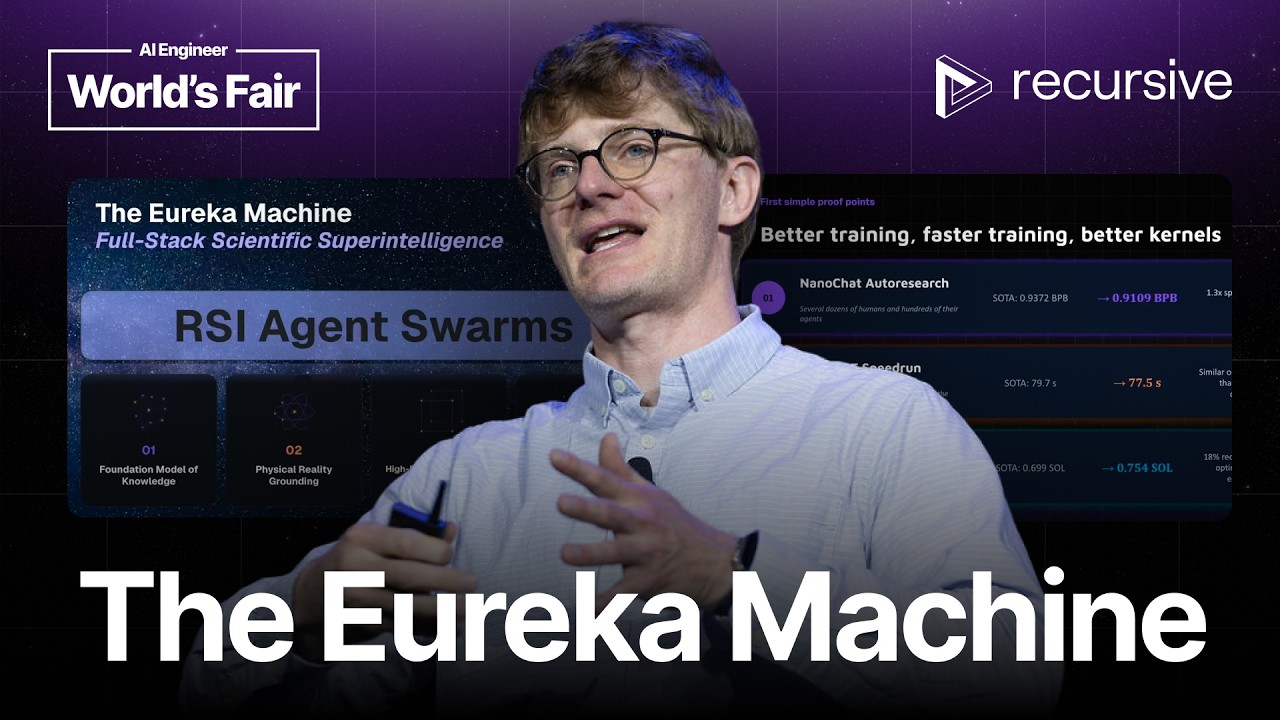
First Steps Toward Automated AI Research — Richard Socher, CEO Recursive AI

First Steps Toward Automated AI Research — Richard Socher, CEO Recursive AI

Richard Socher introduces the "Eureka machine," a concept for automating scientific research and invention through AI. Inspired by open-ended evolution and Karl Popper's philosophy of science, he argues that AI can compress the timeline of scientific discovery, overcoming human-centric bottlenecks. The machine relies on four pillars (knowledge, data, simulations, physical labs) orchestrated by an agent swarm, requiring a rethinking of existing infrastructure. Recursive Self-Improvement (RSI), where AI improves its own code and addresses its shortcomings, is presented as the path forward, with early proof points in model optimization, training speed, and GPU kernel efficiency.

Computer-Use 2.0: Agents Just Got Multi-Cursor — Francesco Bonacci, Cua

Computer-Use 2.0: Agents Just Got Multi-Cursor — Francesco Bonacci, Cua

This talk introduces cua driver, an open-source tool enabling AI agents to interact with computer GUIs in the background across macOS, Windows, and Linux by leveraging accessibility APIs. It details CUABench, a robust evaluation framework with over 130 verifiable tasks designed to benchmark and ensure the trustworthiness of computer-using agents, revealing current limitations in complex tasks like circuit design. Finally, it presents cua fleet, an infrastructure solution that optimizes GPU utilization and reduces costs for RL training of these agents by dynamically managing sandbox environments.

6 Things to Know about AIE World's Fair 2026

6 Things to Know about AIE World's Fair 2026

Discover the AI Engineering World's Fair 2026, the largest iteration yet, offering an unparalleled deep dive into AI engineering with expanded tracks on auto research, GPU specialization, and new verticals like finance and healthcare. Highlights include an innovative expo experience, exclusive leadership initiatives like the "Token Billionaires Program," and unique side events fostering community, including "Posters on AI" where attendees can defend their tweets. This event is designed to be a curated hub for practical, cutting-edge insights and networking in the AI/ML professional landscape.

How We Cut LLM Latency 70% With TensorRT in Production

How We Cut LLM Latency 70% With TensorRT in Production

An engineering leader details the journey of self-hosting LLMs at enterprise scale, covering how his team slashed latency by 70% with TensorRT-LLM, optimized GPU costs through counterintuitive scaling, and built a verticalized AI platform for HR tech. The summary explores practical solutions for cold starts, KV cache optimization, and managing the cultural adoption of AI coding agents in engineering teams.