First Steps Toward Automated AI Research — Richard Socher, CEO Recursive AI
Richard Socher introduces the "Eureka machine," a concept for automating scientific research and invention through AI. Inspired by open-ended evolution and Karl Popper's philosophy of science, he argues that AI can compress the timeline of scientific discovery, overcoming human-centric bottlenecks. The machine relies on four pillars (knowledge, data, simulations, physical labs) orchestrated by an agent swarm, requiring a rethinking of existing infrastructure. Recursive Self-Improvement (RSI), where AI improves its own code and addresses its shortcomings, is presented as the path forward, with early proof points in model optimization, training speed, and GPU kernel efficiency.
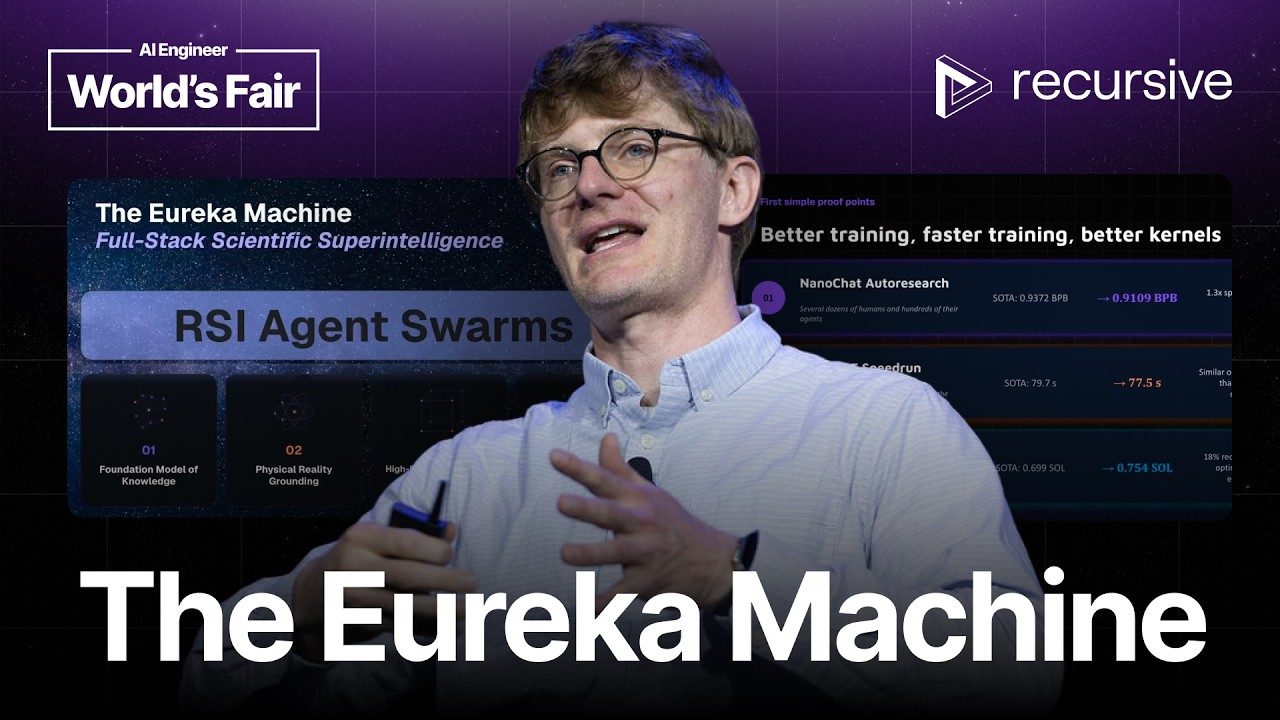
Richard Socher introduces the concept of the “Eureka machine,” an ambitious endeavor to automate scientific research and invention, ultimately accelerating human progress. Drawing inspiration from open-ended evolution, he posits that just as biological evolution led to complex life, and technological evolution spurred millennia of human advancement, AI can now compress the timeline for scientific discovery.
Socher emphasizes that humanity’s history demonstrates a remarkable ability to accelerate progress, citing the leap from the first sustained flight in 1903 to the moon landing in 1969 within a single lifetime. He suggests that AI can similarly compress the evolution of intelligence itself, transitioning from AI being inferior to humans in tasks to excelling in them within a few decades.
Philosophical Foundations
The talk connects this vision to Karl Popper’s philosophy of science, where scientific theories, like species in evolution, advance through rigorous testing and a “survival of the fittest.” However, Socher notes that the exponential growth of science is increasingly bottlenecked by the sheer specialization and limited number of human researchers in niche fields, making automation crucial.
The Eureka Machine: Architecture and Pillars
The proposed “Eureka machine” aims to automate scientific discovery across all domains, from physics and biology to medicine and economics. It relies on four core pillars:
- Knowledge Foundation: Understanding all existing human knowledge and inventions.
- Scientific Measurement Data: Ingesting and processing all scientific data.
- Simulations: Building models to verify and solve problems for phenomena that cannot yet be measured.
- Physical Labs: Conducting real-world experiments for final validation or when simulations are insufficient.
An “agent swarm” would orchestrate these pillars, managing knowledge, data, experimentation, and rewards.
Rethinking Infrastructure for Superintelligence
Socher argues that building a superintelligence requires rethinking every layer of existing technology infrastructure. For instance, traditional web search, designed for human consumption with “10 blue links,” is inadequate for AI agents that can process thousands of long snippets. He highlights You.com’s efforts in building web search specifically for LLMs and agents, and extends this need to browsers and GPUs, which must also be re-engineered as tools for AI.
Recursive Self-Improvement (RSI)
The most promising path to the Eureka machine is through Recursive Self-Improvement (RSI). Socher explains that AI has consistently shown greater progress when manual processes are replaced by learned systems (e.g., neural networks over rule-based linguistics). The recent ability of AI to write and improve its own code, developing a “sense of self-awareness of its own shortcomings,” makes true RSI feasible. This self-improving AI would autonomously refine its entire system, from pre-training to reinforcement learning, and apply this ideation-implementation-validation loop to scientific research.
Early Proof Points
Socher presents three early examples, which he clarifies are steps towards, rather than full manifestations of, RSI, but demonstrate the power of automated research:
- NanoChat Model Improvement: An automated system improved a small chat model’s bits-per-byte from 0.93 to 0.91 in 1-2 days, surpassing community efforts. Crucially, it discovered novel solutions like “hash bi-grams and tri-gram embeddings” and new mixing mechanisms, going beyond mere hyperparameter tuning.
- NanoGPT Speed Run: The system accelerated NanoGPT training by over 2 seconds (to 70 seconds), outperforming human-AI collaborations spanning over a year, by discovering innovative ideas.
- CUDA Kernels Optimization: To address the inefficiency of GPU utilization in large AI clusters, an automated system discovered better CUDA kernels than those listed on Nvidia’s benchmark leaderboards within days. This was achieved without specialized in-house CUDA kernel experts, validating the system’s ability to find optimal solutions across various kernel categories.
Future Outlook
Socher concludes that RSI represents the “next big S-curve” that will accelerate not just AI, but all of science and technology, leading to greater human flourishing. He stresses that despite rapid advancements, the field is still “astronomically far away” from reaching the upper bounds of intelligence across its many dimensions, inviting others to join in building this future.