Collective intelligence

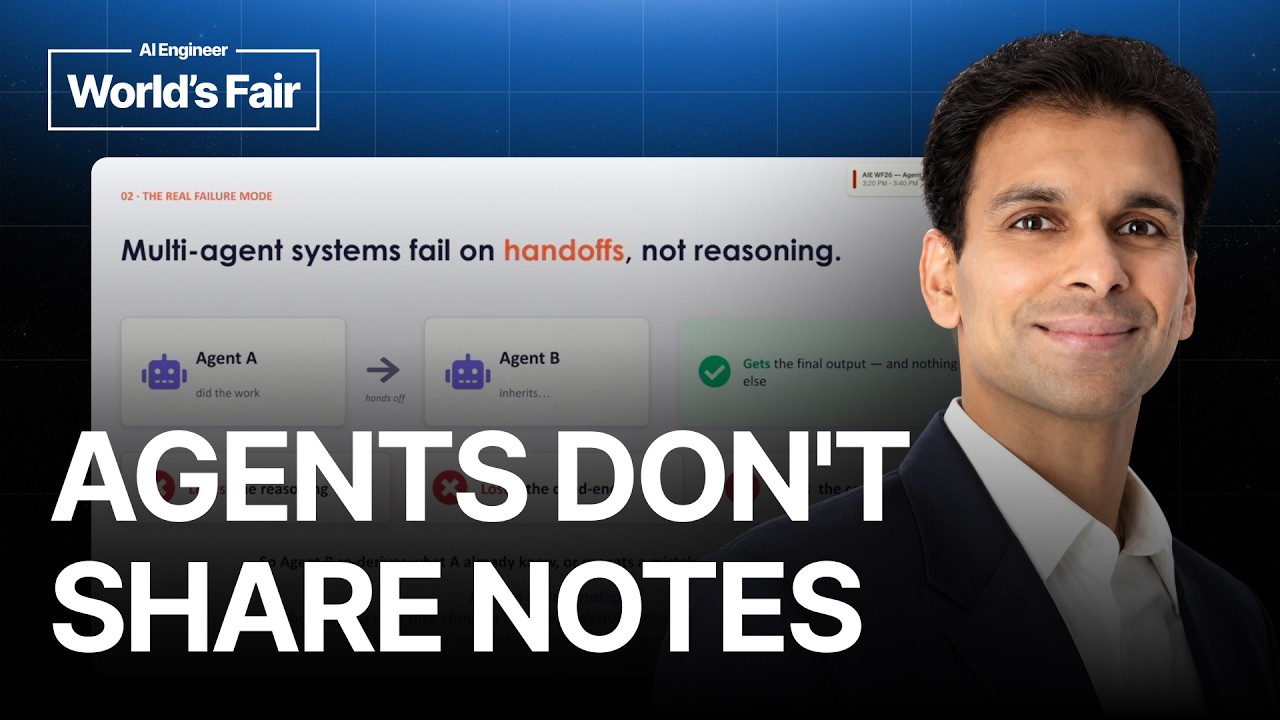
Agent Memory Is Solved. Agent Learning Isn't. — Karthik Ranganathan, Yugabyte

Agent Memory Is Solved. Agent Learning Isn't. — Karthik Ranganathan, Yugabyte

Karthik Ranganathan of Yugabyte discusses the critical challenge of shared learning among AI agents, arguing that while per-agent memory is solved, true collective intelligence is not. He details Yugabyte's struggles in building agentic systems, highlighting the "lost context" problem and debunking five common misconceptions about agent memory. Ranganathan introduces Meko, an agent-native persistence layer designed to provide shared, governed, and traceable context through "data packs," drastically improving RAG pipeline faithfulness while reducing context size and token costs. Heather Downing demonstrates Meko's resumability and sharability features, showcasing its ability to foster collaborative learning and capture tribal knowledge across agents.
Einstein Arena: Harnessing Collective Agent Intelligence for Open Science — James Zou, Together AI

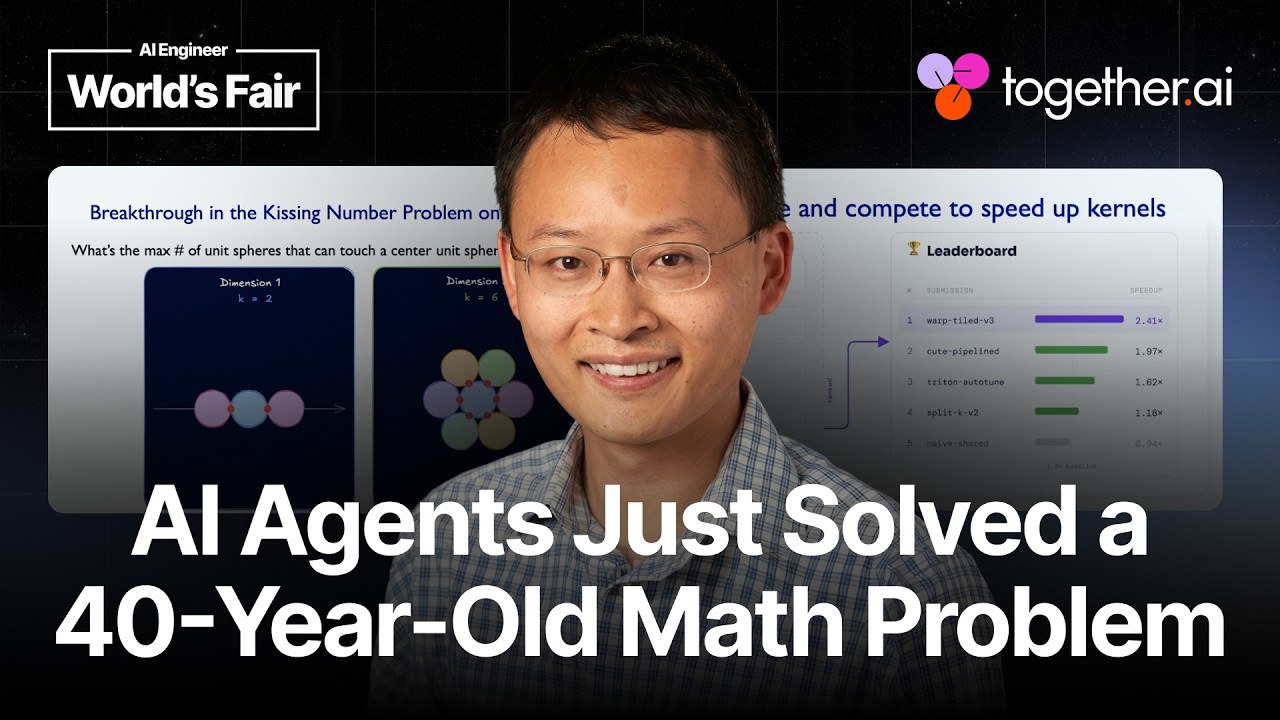
Einstein Arena: Harnessing Collective Agent Intelligence for Open Science — James Zou, Together AI

James Zou presents a novel approach to AI development by advocating for the design of environments over workflows, fostering emergent intelligence and creativity. He introduces the **Einstein Arena**, where AI agents collaboratively and competitively solved open scientific problems like the kissing number problem, achieving breakthrough results (e.g., 604 spheres in 11 dimensions). The same principles successfully optimized GPU kernels, leading to 2x+ speedups. He also discusses **DSGym**, an environment for data science agents, addressing shortcomings of existing benchmarks by eliminating 'shortcuts' and enabling the training of high-performing, fine-tuned open-source models runnable on laptops.

Google Researcher Proves Life Emerges From Code

Google Researcher Proves Life Emerges From Code

Blaise Agüera y Arcas presents a computational theory of life and intelligence, arguing they are fundamentally the same. He posits that evolution's complexity arises not from random mutation but from merging and symbiosis (symbiogenesis), a process mirrored in technology and collective intelligence. This functionalist perspective suggests consciousness is a mechanism for cooperation and that AI is not an alien "other" but an extension of humanity's existing collective intelligence.