Agent Memory Is Solved. Agent Learning Isn't. — Karthik Ranganathan, Yugabyte
Karthik Ranganathan of Yugabyte discusses the critical challenge of shared learning among AI agents, arguing that while per-agent memory is solved, true collective intelligence is not. He details Yugabyte's struggles in building agentic systems, highlighting the "lost context" problem and debunking five common misconceptions about agent memory. Ranganathan introduces Meko, an agent-native persistence layer designed to provide shared, governed, and traceable context through "data packs," drastically improving RAG pipeline faithfulness while reducing context size and token costs. Heather Downing demonstrates Meko's resumability and sharability features, showcasing its ability to foster collaborative learning and capture tribal knowledge across agents.
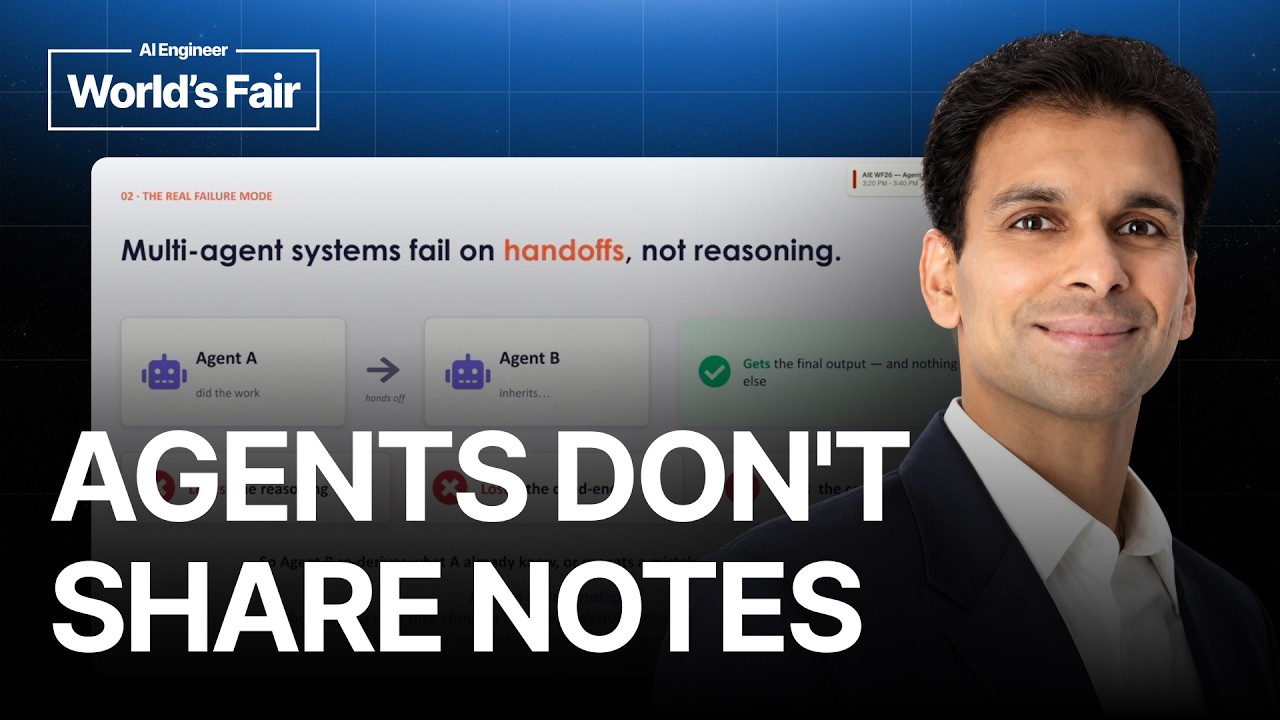
The speaker, Karthik Ranganathan of Yugabyte, highlights a crucial distinction in AI agent development: while per-agent memory is a solved problem, shared learning among agents is not. He emphasizes that learning, akin to human collaboration, “is never done in isolation” and necessitates groups of agents to “start learning and sharing.” Existing infrastructure, designed for single-agent memory, is ill-equipped for this collective intelligence.
Yugabyte’s venture into agentic data infrastructure stemmed from their own operational challenges. As a database company, they deployed four internal and external agents—Hagen (customer support), Growth Vector (go-to-market), Perf Advisor (database admin), and Voyager (database migration)—for nearly a year, yet “failed to ship anything and make it work at all.” This experience exposed a fundamental “data problem” within agentic systems.
The “Lost Context” Problem
The core issue identified was lost context. When an agent (Agent A) hands off work to another (Agent B), it only transmits the output (e.g., an MD file, PDF), but crucial information—the reasoning, the dead ends encountered, and the full context—is lost. This forces Agent B to “rederiving all of this stuff,” burning tokens and incurring unnecessary costs. Ranganathan draws an analogy to a new team member joining a human project without historical context, leading to redundant effort.
Five Misconceptions About Agent Memory and Learning
He debunks five common misconceptions:
- More memory is not learning: It’s merely increased storage, often at a higher cost.
- Shared state is not shared knowledge: Simply sharing a file doesn’t equate to shared understanding or knowledge.
- RAG transcripts are not quality learning: Indiscriminately “ragging everything” leads to “a whole bunch of garbage,” causing LLMs to “burn even more tokens to give you even worse results.”
- Fine-tuning is not scalable: It’s impractical to persist agent-derived lessons or build custom infrastructure through fine-tuning.
- Bigger context windows lead to failure: They are “the surest way to quickest failure in an expensive manner” due to context rot. These points underscore underlying “architecture gaps” in current approaches.
Meko’s Approach to Shared Context
To bridge these gaps, Yugabyte developed Meko, an approach centered on shared, governed, and traceable context:
- Shared: Allows agents to operate within a unified context, resolving the “lost context problem.”
- Governed/Promotable: Context must “degrade,” meaning direct, unfettered contributions are not permitted. A “supervised promotion” process, similar to code reviews, is essential for ensuring durable and high-quality knowledge.
- Traceable: The ability to “ask your the question, where the hell did this piece of information come from?” and trace it back to its original source (data, person, conversation) is vital for improving context quality.
RAG Pipeline Optimization Journey
Yugabyte’s initial attempts with a “distributed RAG pipeline” using “all the best components” yielded poor results: only 14% faithfulness on MD benchmarks, 20% on PDF, and 57% context precision. However, through rigorous “tuning and experimenting” with one variable at a time, they dramatically improved faithfulness to 82% and precision to 74%. Crucially, this improvement was achieved with a significant reduction in context size: from over 7,000 chunks to about 1,000 chunks—a seven-fold decrease, leading to higher precision and “a lot less money burned on tokens.”
Introducing Meko: The Agent-Native Persistence Layer
This experience culminated in the creation of Meko, an “agent-native persistence layer” that embodies these lessons. Meko exposes “data packs,” which are multi-modal databases (vector, graph, relational, NoSQL) designed to store diverse aspects of agent context: knowledge bases, memories, conversations, and observability data. Meko enables agents to push private context into their own space and then “promote that to a shared space.” Other agents or humans can then access this “promoted high-quality context,” facilitating efficient handoffs and collective learning.
Meko in Practice and Demo Highlights
Heather Downing, Developer Advocate at Yugabyte, demonstrated Meko’s capabilities. She illustrated how their presentation deck was collaboratively built using Meko: she created an outline in a Meko data pack, shared it with Karthik, who then used an agent to expand it and generate slides, all with minimal direct interaction, showcasing asynchronous, agent-driven collaboration through shared context.
The demo highlighted two key Meko features:
- Resumability: A user can start a conversation, save it to a data pack, terminate the session, and then resume it in a fresh chat window or across different agent interfaces (e.g., Claude, Codex), retrieving the full context without re-deriving it.
- Sharability: An agent can promote specific private memories (e.g., a “signup emails failed” incident) into a shared data pack. Another agent, even from a different IDE like Codex, can then access this promoted, fine-grained piece of knowledge. This enables controlled sharing and prevents redundant investigation.
A significant advantage is substantial token savings. By retrieving context directly from Meko rather than re-deriving it with LLMs, the “cost itself goes down tremendously.” Meko provides embedded language traces within data packs to verify these token savings.
Human Promotion as a Training Signal and Collective Knowledge
Ranganathan posits that human promotion acts as a “training signal” for future self-improving orchestration, essentially creating labeled examples of valuable knowledge. Meko also facilitates the capture of “tribal knowledge” within an organization, making it immediately accessible to new team members and agents, thereby speeding up onboarding and improving incident response by preventing multiple agents from redundantly diagnosing the same issue.